FAANG vs MANGO



Key takeaways:
- FAANG dominated US tech from 2013 to 2023 through platform dominance in social media, hardware, e-commerce, streaming, and search. MANGO represents the 2024 onwards shift toward AI infrastructure and models.
- The transition replaces Netflix and Amazon's platform focus with NVIDIA's compute layer and OpenAI's model leadership, while Google, Apple, and Meta remain common to both acronyms with evolved AI roles.
- MANGO rewards companies building infrastructure and intelligence layers beneath platforms, where compute, models, and inference pipelines are the new bottlenecks.
- For Indian investors tracking US markets, this shift reflects genuine value creation changes, not mere rebranding, requiring updated capital flow evaluation.
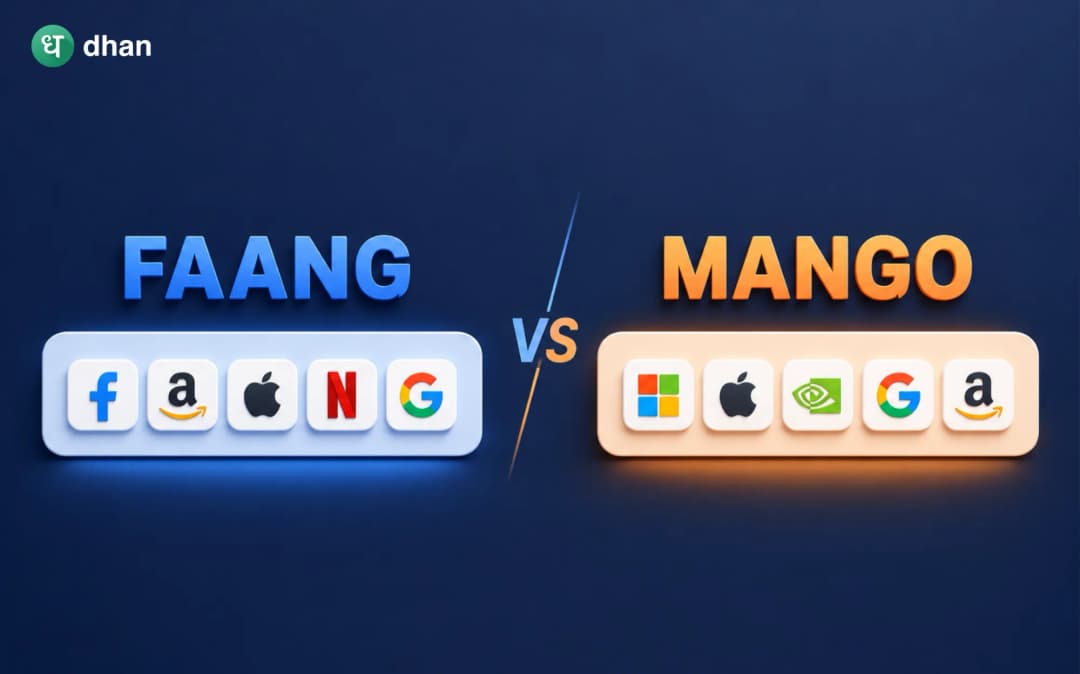
The short-form FAANG for the US tech giants was the rule for more than 10 years. The age of platforms, streaming, and e-commerce was set by Facebook, Apple, Amazon, Netflix, and Google. Amid a new world of similar terminology, one more acronym has entered the fray in 2025: MANGO.
The FAANG vs MANGO transition is important to all investors. Especially those who are watching where capital is going, which companies are compounding quickly, and what it means for the next stage of the US tech market.
So let's look at what happened and how it impacts the business.
What is FAANG, and why did it succeed?
FAANG was coined by CNBC's Jim Cramer in 2013, originally as FANG. Apple joined in 2017. The five companies, Facebook, Apple, Amazon, Netflix, and Google, each dominated a distinct consumer category.
Facebook (Meta)
Social media and digital advertising
Apple
Consumer hardware and the iOS ecosystem
Amazon
E-commerce and cloud infrastructure through AWS
Netflix
Subscription streaming and original content
Google (Alphabet)
Search, digital ads, and Android
They were growing due to their high level of user acquisition, platform lock-in, and recurrent revenues in amounts of gigantic proportions. The thesis was clear: control the platform, then control the monetisation atop it.
What MANGO means and who defines it now?
MANGO is not quite a fully-formed acronym. In 2025, the most popular definition is that of analyst Stirling Larkin, who calls MANGO "Meta, Apple, Nvidia, Google, and OpenAI". Outlets such as Axios use a different version that reads as: Microsoft, Anthropic, Nvidia, Google DeepMind, and OpenAI. They both coalesce to the same idea: AI is the new platform-less organiser.
The AI-native monetisation, model development, and AI infrastructure leaders bring the spotlight in 2026. The compute layer is provided by NVIDIA. With that, OpenAI and Anthropic control the most popular model layer.
Google and Meta are looking to monetise AI on scale in search and ads. In all the versions of MANGO, Apple is the outlier. It has been heavily criticised for its "incremental" advances to AI. That inclusion means it is a significant player in the brand weight and market cap. It does not mean it leads the way in AI.
The key differences between FAANG and MANGO
The backbone of Netflix's business model is its content and licensing. It does not have AI native, competitive moat. While AWS is still an incredibly valuable business, it's no longer seen as driving this cycle as NVIDIA or OpenAI is. The companies that pulled out are not in trouble. But they just don't have a moment anymore.
Why NVIDIA and OpenAI anchor MANGO
NVIDIA is the clearest expression of the AI infrastructure buildout. Alphabet, Microsoft, and other major hyperscalers are powering their AI-related efforts with NVIDIA's GPU architecture. Demand remains higher than supply, and there is no viable alternative available on a large scale.
OpenAI is not currently a public company. That's why it's been added to MANGO, as it is the most popular AI consumer product worldwide. ChatGPT is a benchmark that is now used to compare and measure all other AI companies. Anthropic is in a comparable place within the enterprise.
Both companies are players that are totally new to FAANG: no legacy platform to worry about protecting or cannibalising.
Compared to FAANG, what stays the same on MANGO?
There are three names that are shared between both lists: Google, Apple, and Meta, which is Facebook's new tag. Scale remains the same, but their functions have shifted as they continue to be involved.
Meta has taken a bold shift to AI-driven advertising and model development with open source LLaMA. Google is protecting its search monopoly as it grows its cloud offerings and DeepMind into a business. Both are earning revenue on AI faster than the market anticipated, as the mix of infrastructure spending stifles margins in the near-term.
Apple still exists, but its name is on the list of debate items for analysts. For all the other companies in MANGO, it's all about AI. Apple is there despite its AI progress.
What the shift from FAANG to MANGO tells investors
The FAANG era rewarded companies that built monopoly-like platforms over consumer behaviour. The MANGO era rewards companies building the infrastructure and intelligence layer beneath those platforms. Compute, models, and inference pipelines are the new bottlenecks, and investors are pricing whoever controls them at a premium.
Neither acronym is a buy list. Both are a lens for understanding which structural forces are repricing capital in US tech. For investors tracking the US market from India, the shift from FAANG to MANGO is not a rebranding exercise. It reflects a genuine change in where economic value in technology is being created.
Start tracking MANGO stocks before the market fully prices them in
The shift from FAANG to MANGO is not a semantic update. It marks a structural change in where technology value is being created. Platform dominance defined the last decade, but compute infrastructure, AI models, and inference pipelines are defining this one. For investors tracking the US market from India, this distinction carries real weight.
The companies anchoring MANGO are not just growing faster. They are building the layer that every other business will eventually depend on. Understanding the FAANG vs MANGO transition gives you a clearer lens for evaluating capital flows, sector rotation, and where long-term compounding is most likely to occur. Research thoroughly, track these businesses across quarters, and invest only after rigorous due diligence.