What is share pledging? Meaning, process, and risks explained




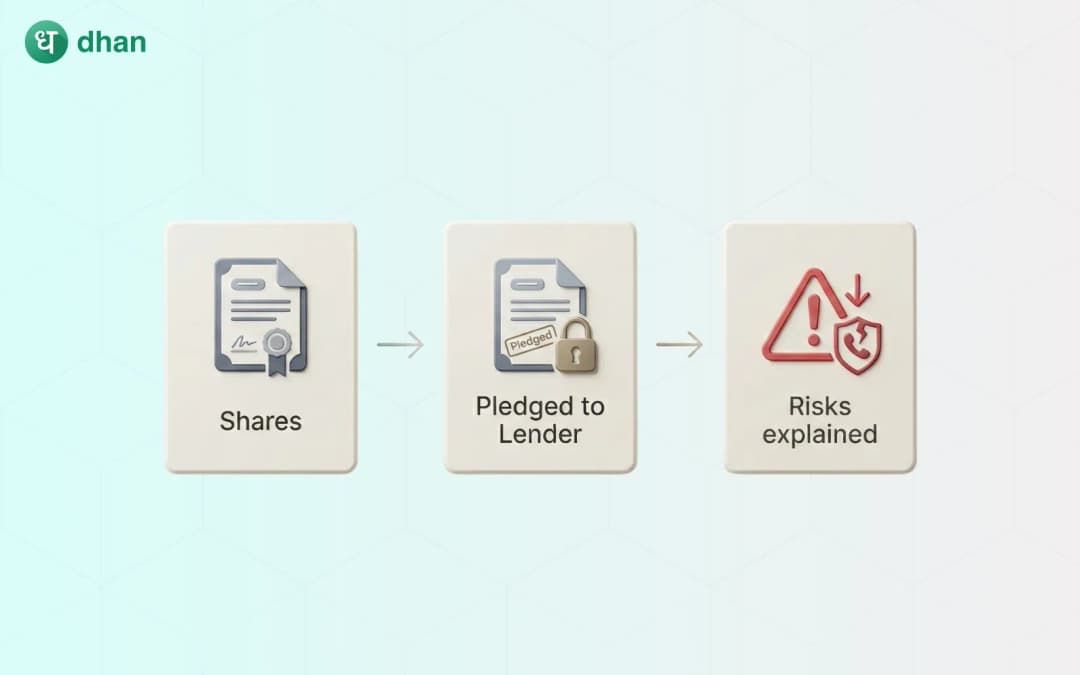


Share pledging has emerged as an important financial mechanism in India, not only among traders or long-term investors, but also among company promoters seeking to raise capital without selling a stake. Share pledging provides liquidity from existing shareholdings while allowing the owner to retain ownership.
Many investors pledge shares without having a clear understanding of when brokers can sell their pledged holdings, how margin shortfalls operate, or why share pledging by promoters often affects stock prices.
In this blog, we will explore what share pledging means, how the process works, the cost involved, and the risks associated with share pledging.
What is share pledging?
A share pledge is the process of using your shares as collateral to borrow money from a broker, bank, or NBFC. Instead of selling your shares, you temporarily "pledge" them, letting the lender have them as security until your loan is repaid.
For example, if you have a stockholding of Rs. 5 lakhs, then a lender may let you borrow 2.5-3.5 lakhs (depending on the loan-to-value rules). Once you repay, your shares are unpledged and restored.
Pledging does not transfer ownership. But you can't sell or transfer those shares until they're unpledged.
Promoters of listed companies often use the share pledging process to raise funds for business expansion or liquidity requirements. It is frequently used by retail investors to fund trading positions, short-term needs, or to avoid selling long-term holdings.
What is the share pledging process?
Dhan provides a digital-first pledging process for both margin trading and loans, making it easier and faster to access funds or trading power:
- Log in to Dhan: Log in to your account through the Dhan app or web platform.
- Select Shares: Choose eligible stocks or mutual funds from your holdings to pledge. Dhan covers more than 1450 stocks and multiple mutual funds for instant margin facilities.
- Initiate Pledge Request: Initiate margin pledge by submitting quantities and verifying details on the Dhan platform.
- Authorise via Depository: Complete transaction authorisation through CDSL or NSDL with OTP validation. Shares are then officially marked as ‘pledged’ in your account.
- Receive Margin or Loan: On successful pledge, Dhan credits instant margin for trading or disburses loans for eligible portfolios.
- Monitor & Maintain Margin: Regularly monitor the status of account margin. Failure to maintain required collateral may result in margin calls or auto-unpledging/sale.
- Unpledging: Easily accessible through the Dhan app/web, same charge per ISIN per request.
- Real-time Access: Margin benefits and pledged status update instantly after approval, so you can use funds instantly to trade or settle existing exposure.
Share pledging charges on Dhan
Understanding total cost is important for calculating actual gains and risks. Dhan's price structure is very competitive and transparent for pledge in share market:
- Pledging/Unpledging Charges: 15 Rs per ISIN Transaction + GST (Applicable for pledging, unpledging, as well as invocation requests for stocks and mutual funds).
- Brokerage on MTF trades: For margin trading, Dhan charges Rs 20 or 0.03% of the value of the transaction per executed order, whichever is lower.
- Delivery brokerage: Absolutely free (Rs. 0) for equity delivery/share transfer; intraday and F&O trading is (Rs. 20) per trade or 0.03% of trade value.
- Interest Charges (MTF): MTF interest charges begin at 12.49% p.a. Interest charges are calculated based on the funded amount daily until repayment and charged on a monthly basis.
Risks involved in share pledging
The pledging of shares provides quick access to funds or leverage, but places the market participant at several risks, which include:
Negative market perception
Excessive or frequent pledge in stock market by promoters is often viewed as a signal of financial distress or weak corporate governance and thereby triggers scepticism among analysts, investors, and ratings agencies. A perception, once formed, is difficult to shake off and may lead to long-term underperformance of the stock.
Margin call and forced liquidation risk
Sharp declines in the price of pledged shares can trigger additional funds demanded by lenders. If borrowers are unable to meet these demands, the lender may forcibly sell the pledged shares in the open market, often resulting in further price declines and undermining investor confidence.
Excessive leverage and financial stress
Excessive dependence on pledging for financing growth or liquidity management can result in over-leveraging. Since the underlying shares have been losing value, the stresses on borrowers increase as equity and credit risk rise. This would lead to a vicious cycle, especially if the promoter is not able to recover or refinance on time.
Interest burden and cost risks
The interest on pledged shares is usually high. If the pledged assets do not yield expected returns, the borrower may incur huge losses after factoring in interest payments.
Regulatory and disclosure risk
Complete disclosure of pledged shares is required under SEBI and stock exchanges. Non-reporting and non-compliance with reporting attract penalties and destroy investor trust, adding to other risks.
Loss of ownership and control
One important risk for the promoters is the loss of strategic control in case they default on their loan and the lender sells off substantial portions of pledged shares. This can dilute voting rights and alter the ability of the promoter to control company decisions, sometimes even allowing hostile takeovers or a change of management.
Increased volatility
Companies with high levels of pledged shares often experience more price volatility and are susceptible to price crashes in times when there is a market correction or liquidity crisis. A sudden surge in the selling of pledged shares can trigger instability in both the company's stock and the markets.
Final thoughts
Share pledging offers instant access to liquidity or margin for market participants at an economical cost but requires discipline and risk management. They are attractive because of their flat and transparent fees, real-time pledge operations; however, investors have to keep a close watch on market fluctuations, maintain sufficient collateral, and manage advance future interest outflows.
For investors who pledged shares, this strategy works best when used judiciously and with a clear risk-management mindset.
FAQs on Share Pledging
1. How much does Dhan charge for pledging and unpledging of shares?
Dhan charges Rs. 15 per ISIN per request, irrespective of the nature of the pledging/unpledging/invocation, and GST on every transaction is levied. This covers both shares and mutual funds.
2. How quickly is margin available after pledging shares?
Once the pledge authorisation is completed via the depository, CDSL/NSDL, Dhan instantly credits margin benefits and updates your account in real-time for use across various market segments.
3. Is share pledging the same as selling shares?
No. In pledging, investors only offer their shares as collateral while ownership still remains with them. However, they cannot sell those shares until the loan is repaid and the shares are unpledged.
4. Can I pledge any stock or mutual fund in my portfolio?
An investor can only pledge those stocks and funds that feature on the approved list shared by Dhan. These eligibility lists change based on market and regulatory limits and are updated regularly on the Dhan platform.
5. What if the stock value declines and I am unable to maintain the required margin?
Dhan will issue a margin call if your pledged stock falls below the required margin cover. Liquidation/unpledging and forced sale of shares may happen in case of failure to respond to recover exposures.