What is Exit Load in mutual funds?




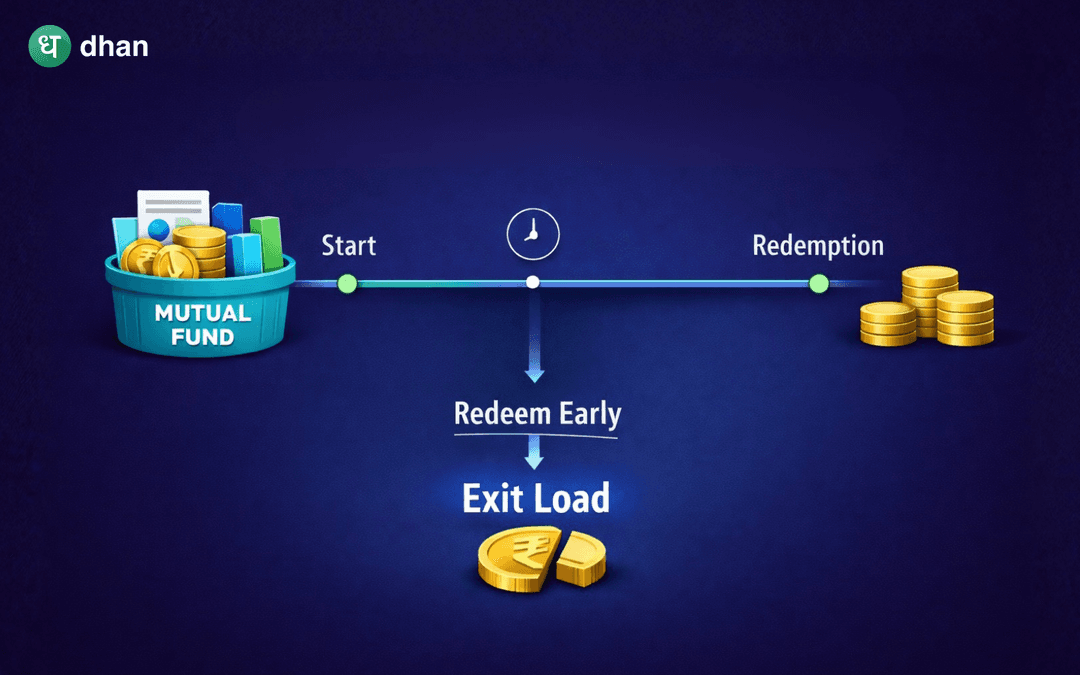




Mutual funds are a preferred investment option for building wealth due to diversification and professional management. However, some expenses affect investment returns, and one such cost is the exit load. The exit load is the fee charged by the fund houses when the investor sells the units before the specified period.
Exit loads prevent early withdrawal and help maintain stability in funds. The exit load may differ in computation and structure for different funds. Therefore, it is essential to know the impact of exit load on the returns of your investment. This blog will help you understand what exactly an exit load is, how it is calculated, and how it impacts your decisions while making investments in mutual funds.
Understanding Exit Load
Many new investors have a common query: what is exit load in mutual funds? and why is it levied? Simply put, an exit load is a charge levied by a mutual fund on its investors if units are redeemed or withdrawn by them before a certain time period.
The exit load is computed on a percentage of the redemption value, which is then reduced from the total amount received while withdrawing units. This means that the investor will receive a slightly lower amount than the total redemption value of the units.
Assume you have invested ₹10,000, which becomes ₹11,000 after one year. If you withdraw your units within one year, you would have to pay an exit load of 1%, which is ₹110. So, you would receive ₹10,890 instead of ₹11,000. This is how your returns can be reduced by the exit load if you withdraw your units early.
The structure of the exit load differs depending on the scheme, which is clearly mentioned in the Scheme Information Document (SID) provided by the fund house. Investors should refer to this document while investing.
Why mutual funds charge Exit Load
Now you know what is exit load in mutual funds, so let’s get in details. Mutual funds do not charge exit load to penalise investors; instead, it is a mechanism to ensure that the mutual fund scheme functions smoothly. There are various reasons why a mutual fund charges exit load:
1. Encouraging long-term investing
Typically, mutual funds are planned for medium- and long-term goals. Exit load encourages the investor not to withdraw their investments frequently. This allows them to reap the advantages of compounding as well as align their behaviour with their investment strategy.
2. Managing liquidity in the fund
A large and sudden redemption may also pose a liquidity concern for the mutual fund. To pay off the redemption, the mutual fund may be forced to sell assets at unfavourable prices, resulting in higher transaction costs. Exit load helps to moderate these redemption pressures, providing greater flexibility to the fund manager to manage the fund effectively.
3. Maintaining investment stability
Stable assets under management help fund managers in their long-term strategy without any frequent interruptions. The exit load acts as a deterrent for short-term trades and thus helps in the stability of the portfolio.
How Exit Load is calculated?
Exit load fee is normally calculated using the current value of the investment rather than the amount originally invested.
The basic formula is:
Exit Load = Exit Load Percentage × Redemption Value
Where:
- Redemption value = Number of units redeemed × Current Net Asset Value (NAV)
Example Calculation:
Suppose an investor invests ₹1,00,000 in a mutual fund, and the investment grows to ₹1,10,000.
Scenario 1: Redemption before exit-load period - If a mutual fund scheme has a 1% exit load for redemption within a period of one year:
- Exit load is 1% of ₹1,10,000 = ₹1,100
- Net amount received is ₹1,10,000 − ₹1,100 = ₹1,08,900
Scenario 2: Redemption after exit-load period - If the units are redeemed after the exit load period has ended, then no exit load will be applicable.
- Net amount received = ₹1,10,000 (full redemption value)
This clearly shows the impact of time factor in the amount obtained.
Exit Load across different mutual fund types
The exit load structure may vary depending on the type of mutual fund scheme. One should always refer to the scheme information before investing in the scheme.
Equity mutual funds
Equity mutual funds usually impose an exit load of around 1% for redemption of units within 12 months of investment. After the minimum period of holding the units is completed, the exit load is not imposed; hence, the entire amount invested in the mutual fund scheme is redeemed by the investor.
Debt mutual funds
The exit load rules for debt mutual funds are more diverse. For short-term or ultra-short-term debt funds, there is no exit load, but for accrual or credit-oriented debt funds, there is an exit load if redemption is done within a few months or a year.
Hybrid mutual funds
Hybrid funds, which have both equity and debt investments, may have similar rules for exit loads, though the structure may vary depending on the fund house.
Graded Exit Load Structure
Some plans have a graded structure, where the exit load reduces gradually with longer periods of investment. For instance:
- 2% if redeemed within the first year
- 1% if redeemed within the second year
- There is no exit load if redeemed after two years.
This structure is designed to encourage longer-term investments.
SEBI rules and regulations on Exit Load
In India, mutual funds are regulated under rules framed by the Securities Exchange Board of India (SEBI).
Mutual funds must disclose exit load in SID/KIM
SEBI regulations demand that the mutual funds disclose their entire structure of loads, including exit loads, in the offer document, such as the SID and KIM, for the knowledge of investors before investing. This is a transparency requirement for mutual funds.
SEBI abolished entry load in 2009
Entry loads on mutual funds have been officially banned by SEBI, which came into force from August 1, 2009. This means that an investor does not have to pay any fees while making an investment. This rule ensures that the entire amount is invested.
Maximum exit load limit set by SEBI
SEBI has put a limit on the maximum amount that mutual fund schemes may charge as exit load. Recent changes to regulations have reduced this cap from 5% to 3%, thus keeping exit loads reasonable.
Exit loads in SIPs, STPs, and SWPs
In SIPs, each instalment is treated as a separate purchase. The exit load clock starts running on each instalment. This means that the units purchased in January will complete their exit load period earlier than the units purchased in June, even if the units are in the same scheme. Most fund houses follow a first-in-first-out (FIFO) system while redeeming units. This means that the earliest units will be redeemed first. This helps the investor avoid the exit load in many cases.
For STPs, all movements from the source scheme are considered redemptions. If these movements take place before the end of the exit load period of the source fund, then the relevant exit charge is levied. It is essential to plan the transfer carefully in order to minimise costs.
SWPs involve periodic redemption of a mutual fund investment. Investing in a mutual fund and initiating an SWP immediately can lead to repeated deductions of an exit load on each redemption. Careful planning of an SWP can help minimise such charges incurred due to an exit load.
Scenarios where Exit Load does not apply
The exit load is applicable only for redemptions within a specific period, but there are certain circumstances under which the exit load is not applicable.
Holding beyond the exit‑load period
If you are holding your mutual fund units for a period beyond the minimum period for which the exit load is applicable (for example, one year for an equity scheme), then there is no exit load applicable, and you can get the full redemption proceeds.
Funds with zero exit load
There are certain schemes, for example, index funds, ETFs, overnight funds, and liquid funds, where there is no exit load applicable. This is scheme-dependent, so it is recommended to check the scheme.
Liquid and overnight funds (after minimum days)
Exit load is applicable in liquid funds only in case of withdrawal within a few days (usually within 7 days). After that period, the exit load is zero, and overnight funds have zero exit load due to their inherently short-term investment.
FIFO redemption in SIPs/STPs
Under SIP/STP, 'AMC redemption' is subject to the 'FIFO' method, i.e., older units are first redeemed. If these units have already completed their exit load period, then redemption is allowed without an exit load, even if other units are still pending.
SEBI‑Mandated switch/exit exemptions
Some recent regulations have permitted no exit load in changing from one scheme to another (e.g., from regular to direct plans within a scheme), as mandated by SEBI’s investor-friendly guidelines.
To conclude
Exit load is an important factor that the investor in a mutual fund scheme must know about. Exit load is a charge levied on the redemption of units of a mutual fund scheme before the completion of the specified holding period. Although the charge is minimal, it may impact the returns if the investment is redeemed prematurely. Understanding how an exit load works can help an investor avoid such deductions while managing their mutual funds effectively.
FAQs
1. Are the exit load charges applicable to all kinds of mutual funds?
Not really. The exit load period for equity funds, hybrid funds, and debt funds may vary. Liquid funds and overnight funds may not have any exit load, as these funds are used for short-term investments.
2. How can investors check the exit load of a mutual fund scheme?
The details of the exit load of the mutual fund scheme are mentioned in the Scheme Information Document and Key Information Memorandum provided on the mutual fund company’s website.
3. How does exit load impact returns during volatile markets?
In volatile markets, if an investor redeems their shares early, it may lead to a reduction in the NAV as well as the exit load, which may further reduce the amount invested. Being aware of exit loads helps investors from making any hasty decisions during market volatility.
4. Can exit load vary for different investment instalments in a SIP?
Yes. In an SIP, the purchase date and the period of holding are different for each instalment. The exit load is applicable only for the units that are redeemed before the exit load period ends.
5. Can I avoid exit load strategically?
Yes. You may avoid exit load by redeeming units after the exit load period, opt for no-load funds for your short-term needs, or plan a partial withdrawal from older units.