How to compare mutual funds?








Key takeaways
- The choice of a particular mutual fund depends on an individual investor's financial objectives.
- Sometimes, mutual funds with the highest returns or best ratings are not the right ones for an individual.
- To ensure that the comparison is accurate, investors should compare similar mutual funds, like large-cap funds against large-cap funds.
- Investors should consider the performance of mutual funds over different market cycles over a long time frame, not just one year's best performance.
One fund can show strong returns, another has a high rating. Again, a third fund is being recommended everywhere.
There’s no denying that most investors get confused while comparing mutual funds. In many cases, they assume that the fund with the highest return or the best rating would be the right choice. However, you need a much more stringent approach when it comes to comparing funds. Otherwise, it can lead to poor outcomes and disappointment in the long run.
In reality, there is no single mutual fund that can be the “best” for everyone. This choice depends on your goals, time horizon, and risk appetite. That’s why we have come up with a methodical process to compare mutual funds in this guide. Let’s break down this process step by step, so that you can adopt a clear procedure to evaluate mutual funds before investing.
Why does comparing mutual funds properly matter?
The biggest drawback of failing to compare mutual funds properly is the risk of making your decision based on incomplete information. For instance, if you choose a fund based only on its recent performance or popularity, it may work for a while. However, as soon as market conditions start changing, it can affect your returns.
As an investor, you must understand that each fund has a specific goal. Some of these are:
- Aggressive growth
- Generating regular income
- Stabilising your portfolio
- Helping you save taxes
So, if you pick a fund that doesn’t match your goal, even a good-performing fund may not deliver the desired outcome. That’s why it's important to know how to compare mutual funds based on your needs. Informed investors are less likely to make emotional decisions, which often happens to be one of the key mistakes.
A proper selection approach gives you a strategic process that complements your long-term financial goals.
Compare mutual funds: A step-by-step process
Investors can understand how to compare mutual funds through this step-by-step process.
Define your investment goal
In the first place, you must have a clear perspective on why you are investing. Decide what you are willing to achieve before choosing the fund. This might be:
- Build long-term wealth
- Generate regular income
- Save for a short-term goal
A different type of fund is needed for each of these objectives. Also, factor in your time horizon, which plays a significant role. While a long-term goal gives you the time to take more risks, short-term goals require stability.
Risk tolerance, which varies from one investor to another, is another key factor. Some investors are comfortable with fluctuating market conditions. Others are conservative with their approach and prefer steady returns.
Once you gain clarity on these aspects, you can proceed to the next steps.
Choose the right category
Now that you have a clear goal, you need to choose the appropriate category of mutual funds. Broadly, mutual funds are categorised into equity, debt, and hybrid funds. There are other classifications like large-cap, mid-cap, and small-cap funds within the equity segment.
When you learn how to compare mutual funds, it’s important to compare funds within the same category. For instance, there’s no point comparing a large-cap fund with a small-cap fund. The reason is that the risk profile of each category is different, and accordingly, their returns vary. With this step, you can significantly narrow down your options.
Shortlist 3 to 5 funds
By this stage, you’ll already have a category in mind. Now, you need to shortlist a few funds and compare them.
Many investors try to analyse too many funds at once. However, this approach often leads to confusion. Therefore, it’s logical to limit your selection to three to five funds. Shortlist these funds based on basic filters like:
- Category of the fund
- Historical performance
- Size of the fund
- Expense ratio
This way, you can keep your list focused, which makes it much more effective.
Compare key factors influencing performance
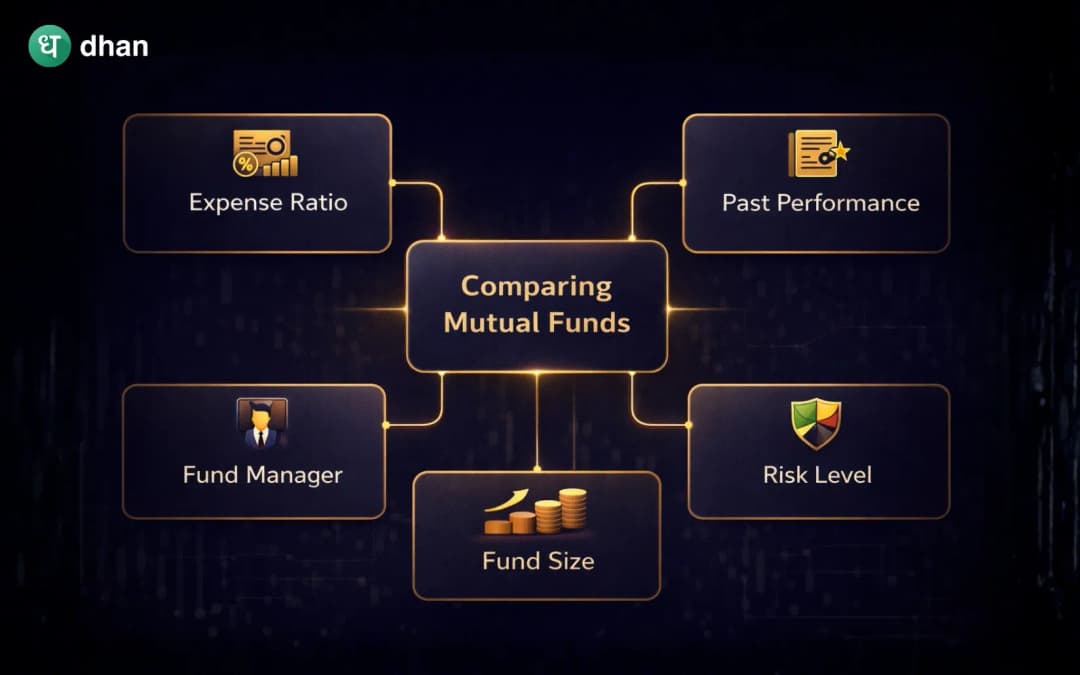
The real comparison begins once you have the list ready. Investors learning how to compare mutual funds often make a common mistake, as they decide only on the basis of past returns. However, you need to look at several other factors. These include:
- Consistency of returns
- Ability to preserve capital
- Associated costs
- Level of volatility and risk
- Quality of the portfolio
We have explained each of these factors in detail in the next section.
Key factors to consider when you compare mutual funds
Here’s how to compare mutual funds based on some of the crucial parameters that define your overall investment experience.
Consistency of returns
For investors, returns do matter. However, consistency cannot be overlooked, as that’s what defines your mental peace throughout your investment journey.
Investors shouldn’t choose the fund that delivered the highest return in a single year. Instead, examine how it performed over longer periods like three to five years. A fund that delivers consistent returns in different market cycles tends to be more reliable.
A stable performance in different market conditions shows that the fund can handle both rising and falling markets. It also points to a disciplined strategy of the fund manager.
Avoid funds that show extreme fluctuations in performance. Stability over time is a better indicator of long-term success.
Risk and volatility
A certain level of risk is associated with every mutual fund. Some funds show sharp volatility, while others tend to be more stable. As an investor, you must decide the extent of volatility you’re comfortable with before choosing a fund. Have a look at how the returns of the fund fluctuated over the months to get an idea of its risk level.
The goal is to match the risk profile of the fund with your comfort level. A fund that leads to mental stress during market downturns would probably not be the right choice for you.
Expense ratio
The expense ratio is the cost you pay for the management of the fund. It may seem small, but over long periods, it can significantly impact your returns. A higher expense ratio means a larger portion of your returns would be used to cover costs, thereby eroding your wealth.
However, this doesn’t necessarily mean investors should choose the fund with the lowest expense ratio. Make sure that the historical returns of the fund justify this cost.
Track record of the fund manager
Ultimately, it’s the expertise of the fund manager that determines how the fund performs. An experienced fund manager with a consistent track record is capable of handling changes in the market. Their approach to investment, stock selection, and risk management strategies has a direct impact on the outcome of the fund.
Also, find out how long the fund manager has been managing the fund. In case you notice frequent changes in management, it can lead to inconsistency.
Quality of portfolio and allocation
Investors exploring how to compare mutual funds must check out the quality of the portfolio and the underlying allocations. This often generates valuable insights that help you decide which fund to choose.
As an investor, you may consider funds with a well-diversified portfolio. It reduces risk as it spreads your investment across different companies and sectors. On the other hand, a concentrated portfolio may carry higher risk.
Also, analyse the quality of underlying assets. If you’re investing in equity funds, evaluate the performance of the companies included. For a debt fund, investors must look at the credit quality.
Ultimately, the goal is to make sure that the portfolio of the fund aligns with your expectations and risk tolerance.
Assets under management
Assets under management, or AUM, are the total value of the assets that the fund manages. If this size is too small, it may lead to instability and liquidity issues. On the other hand, an extremely large fund may find it challenging to maintain flexibility.
That’s why it’s wise to choose a fund with a balanced AUM size. It indicates that the fund managers would be able to manage your investments efficiently.
Conclusion
The choice of your mutual fund should be based on your goals, risk appetite, and investment horizon. When you know how to compare mutual funds, your financial planning becomes much simpler and practical. That’s what we have discussed in this guide, so that you aren’t distracted by short-term trends or hype.
There is no perfect fund that works for everyone. That’s why you need to personalise one based on your financial profile, analysing its underlying value and comparing its strengths. Stay consistent and avoid unnecessary changes over time. With a disciplined approach, the right fund can significantly help you create long-term wealth.
FAQs
How often should I compare mutual funds after investing?
You don’t have to compare funds too frequently. Review your portfolio once or twice a year. Consider the performance of the fund over the long term instead of short-term changes.
Is it okay to switch funds frequently?
It’s generally not advisable to switch funds frequently. It can disrupt your long-term strategy and invite additional costs. Only if you have a clear reason to change the fund, you may consider the same.
Do ratings matter while comparing mutual funds?
When you start evaluating a fund, ratings can be helpful. However, they should not be the only factor. Have a deeper look into the performance of the fund, the quality of its portfolio, and associated risks before you make a decision.
Should beginners use comparison tools or advisors?
Beginners may use comparison tools to simplify data analysis while choosing a fund. Advisors can also help, but it’s important to understand the basics yourself so that you can make informed decisions.
Can I compare mutual funds without technical knowledge?
Yes. Consider simple parameters like historical returns, consistency, risk, and cost, so that you can compare mutual funds even if you don’t have advanced technical knowledge.