Difference between SIP and RD




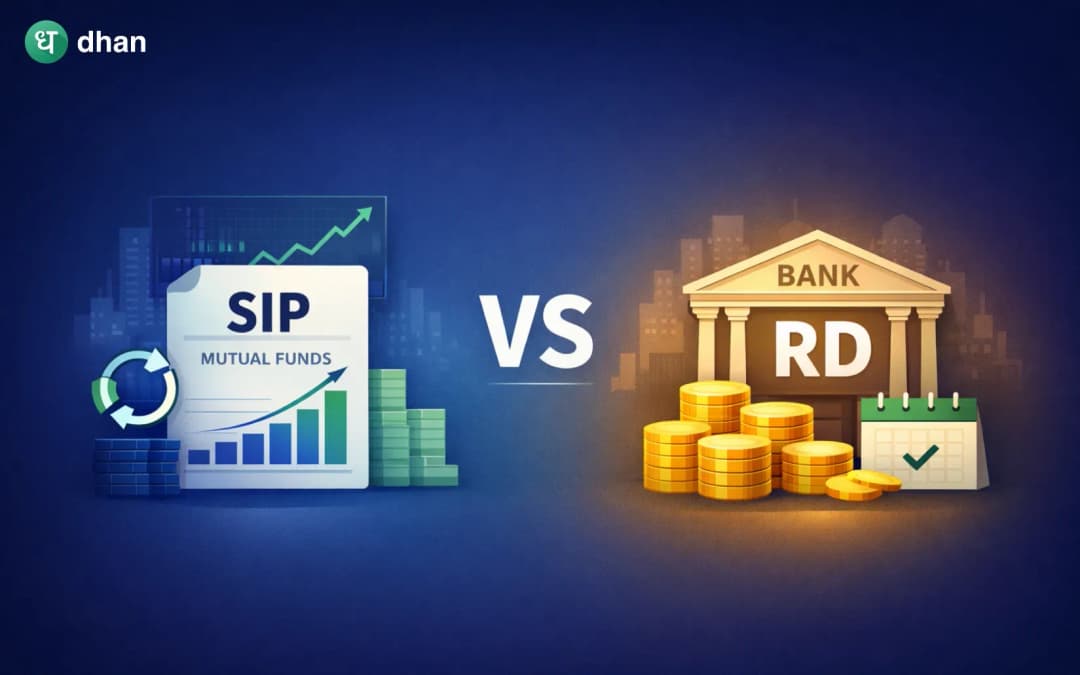




But both SIP and RD have very different processes, returns, and goals. People often tend to ask questions such as: Is it better to go for SIP than RD?, Is RD safer than SIP?, or where should new starters invest?
This article provides a clear and concise explanation of the difference between SIP vs RD. This further aims to assist you and educate you about both choices and help you pick a better option that could fulfil your financial objectives.
What Is SIP? (Systematic Investment Plan)
A Systematic Investment Plan, or SIP, is an instrument to invest in mutual funds. Instead of investing a lump sum, you invest a fixed amount of money periodically, usually monthly.
When you invest through SIP, your funds will be invested in mutual fund schemes. The mutual funds can be invested in equities (stocks), debt securities or a combination of both. Your investments are market-linked.
One great feature of SIP is that it encourages disciplined investing. You invest regularly, irrespective of market conditions. Over time, this helps in averaging out the cost of investment and allows your capital to grow through compounding, meaning earning returns on both your original investment and the returns already earned.
SIP is generally made for long-term goals, like retirement planning, children's education, or wealth creation over a period of time.
What Is RD? (Recurring Deposit)
A Recurring Deposit is an income-generating savings scheme provided by banks and post offices. In an RD, you pay a fixed sum every month, for example, for one year, two years, or five years.
The interest rate here remains fixed, and we also know the maturity value in advance. After the expiry of tenure, we get the total amount consisting of our deposit plus interest earned. You can simply calculate the returns from your recurring deposit using RD calculator.
RD is easy to understand, and it doesn't depend on market performance. Therefore, it is considered a safe choice for those who like stability in investments and are sure about what they will gain.
RDs are typically selected for a specific period of time for financial objectives such as a holiday trip, emergency purposes, or future expenditure.
Difference between SIP vs RD
Benefits of SIP
1. Long-term wealth creation through compounding - With SIP, your investment can grow on the principal as well as on the returns already earned on the investment. This helps in increasing the corpus in the future.
An online SIP calculator can be used to estimate the final returns on investment made in mutual funds using SIP, by entering the SIP amount, rate of return and time period.
2. Higher return potential - Since SIP invests in mutual funds, especially equity mutual funds, it has the potential of earning higher returns than fixed deposits and RDs in the long term.
3. Reduces market timing risk - Investing through SIP helps to distribute your investments at highs and lows of the market, thus reducing the risk of investing a lump sum amount at the wrong time.
4. Flexible investment options - You can invest small amounts, increase or decrease investment according to your financial condition, or pause SIPs.
Benefits of RD
1. Guaranteed returns RD - gives a constant rate of interest, so you know exactly how much interest you will receive at the end of the term.
2. Very low risk - Since the capital is deposited with banks or post offices, the risk involved is considerably less as compared to the market-linked options.
3. Simple and easy to manage - No complicated procedures or market monitoring involved-just deposit a fixed amount every month.
4. Ideal for risk-averse investors - For people seeking predictable returns and capital protection, RD is better than market-linked investments.
Conclusion
SIPs and RDS are both useful investment choices. But they have different applications. SIPs are for long-term objectives and are suited for people who are willing to take market risks. RDS are for short-term purposes and is suited for people who are looking for secure investments.
The most suitable one for you will depend on what you want to do with your finances, how quickly you want to reach your goals, and how comfortable you are with risk.
FAQs
Is SIP better than RD for long-term investment?
Yes, SIP is preferable when it comes to long-term investing because it provides greater growth opportunities with market-linked returns and compounding.
Is RD completely risk-free?
The risk associated with RD is very little, but it cannot guarantee that your investment will be protected from inflation.
Can I stop SIP vs RD before maturity?
SIP can be discontinued at any time without any charges. RD may have the feature of early withdrawal, but a penalty charge may apply.
Which option gives higher returns?
In SIP, the returns on investment are expected to be higher, and with RD, the returns on investment are fixed and predictable.
Can beginners choose SIP?
Yes, new investors can start with SIP, but for the long term, to build wealth and reduce market noise.