What are Value Funds?




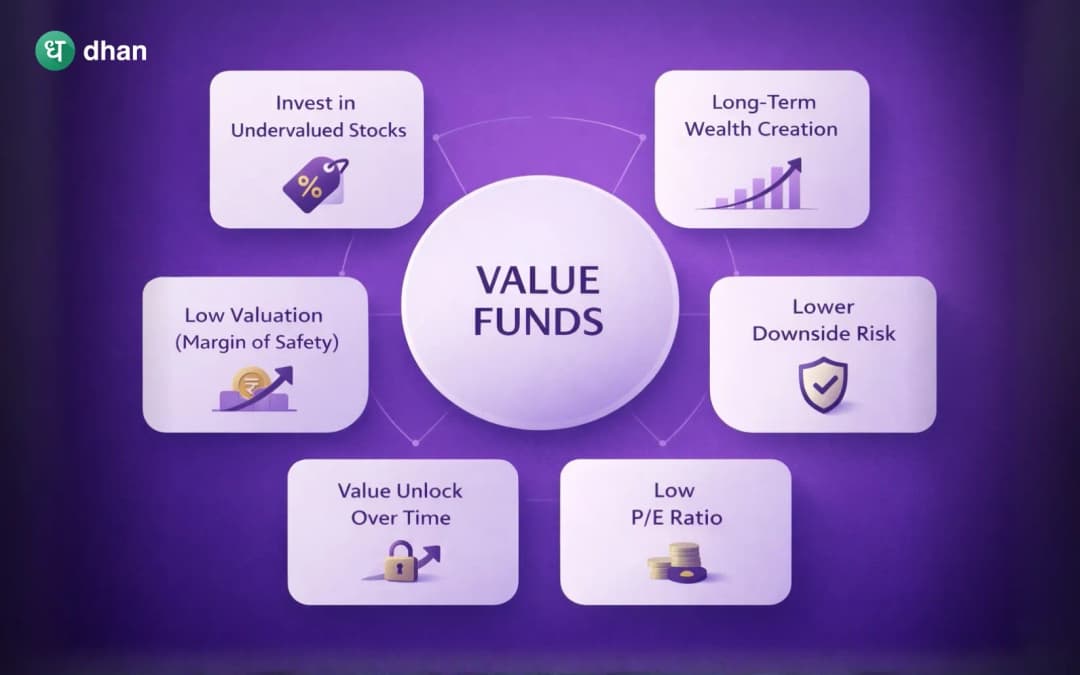




Investing in the equity market requires the correct philosophy. As an investor, you need to think about more than just choosing the right stocks. Talking about equity strategies, investors primarily select from two major styles - growth investing and value investing.
Growth investment is about choosing companies that are likely to expand rapidly. Value investing, however, follows a different approach. It involves identifying quality businesses that are currently undervalued in the market.
Long-term investors must understand value funds to build a resilient and balanced portfolio. In this blog, we have comprehensively discussed what are value funds and how they work. You will also come to know their characteristics, benefits, and risks.
Understanding the meaning of value funds
Value funds are equity mutual funds that invest in undervalued stocks to capitalise on their intrinsic worth over time. The approach works on a philosophy of buying strong companies at discounted or reasonable prices. Fund managers following this concept do not chase the momentum. Instead, they wait for the market price to fall, follow the fundamentals and remain disciplined.
Often, markets misprice stocks in the short term due to:
- Short-term concerns
- Negative sentiment
- Cyclical downturns
However, the prices tend to recover and align with the intrinsic value over time. So, if you are wondering what are value funds, they are actually equity funds that identify such opportunities.
Fund managers invest in value stocks that:
- Trade at lower valuations compared to its peers
- Faces temporary business or sector challenges
- Have strong fundamentals despite short-term price corrections
Fund managers perform detailed fundamental analysis. In the process, they determine whether or not the current market price of a stock reflects its actual long-term potential. If they find a gap between the price and the intrinsic value, the fund may invest in the company, expecting that the market will eventually correct the mispricing.
As investors may not enjoy immediate returns, they need patience and discipline. However, when the market recognises the true strength of these businesses, value funds can generate significant upside.
How do value funds work?
Investors must understand what are value funds and how they work. Here’s how fund managers capitalise on undervalued stocks to generate returns over time.
Identifying undervalued stocks
The first step involves screening companies that appear undervalued. Fund managers consider fundamental metrics like:
- P/E ratio
- P/B ratio
- Attractive dividend yield
- Discount compared to peers in the sector
However, it’s crucial to scrutinise aspects beyond low valuations. Fund managers can differentiate between a genuinely undervalued opportunity and a weak business.
Evaluating intrinsic value
Once potential stocks are shortlisted, fund managers perform detailed fundamental analysis. This includes:
- History of revenue and earnings growth
- Strength of the cash flow
- Debt levels
- Competitive advantage
- Management quality
The goal is to estimate the intrinsic value of the company. Its worth should be based on fundamentals, and not the current sentiment of the market.
Constructing the portfolio
Value funds usually diversify their portfolios across different sectors to reduce the risk of concentration. They may allocate to industries that are currently out of favour, but likely to recover over time.
This strategy often reflects a contrarian approach. When markets are overly optimistic about certain sectors, value funds may avoid them. On the contrary, when the sectors face temporary setbacks, value funds may selectively invest in them.
Return generation
When the market re-rates undervalued stocks, value funds start generating returns. With an improvement in the performance of these businesses, the market witnesses a shift in the sentiment of investors. Accordingly, the prices of stocks adjust upward toward the intrinsic value.
As the process takes time, value funds are mostly suitable for long-term investors.
Key characteristics of value funds
Investors can distinguish value funds from other equity strategies by observing their specific characteristics.
Long-term horizon
Returns from value funds often materialise over several years.
Margin of safety
Fund managers invest in undervalued stocks at a discounted price, which offers a downside cushion.
Contrarian nature
Value funds may invest in sectors that the market is currently ignoring.
Cyclical performance
Value funds show cyclical performance. They often perform better when the economy recovers.
Focus on fundamentals
A strong emphasis is laid on the financial health and sustainability of the underlying businesses.
Discipline in valuation
The principle of value investing avoids overpaying for growth even when the market sentiment looks strong.
When market environments are overvalued, these traits make value funds particularly relevant.
Benefits of investing in value funds
Investors can benefit in several ways from value funds.
- You can capitalise on the potential upside during market recovery. When undervalued sectors recover, they significantly benefit value funds.
- These funds come with a margin of safety. Your downside risk is reduced as you buy stocks at lower valuations.
- Investors have the opportunity to buy quality stocks at a discount. You gain exposure to fundamentally strong companies at attractive prices.
- If a portfolio is heavily tilted toward growth stocks, value funds can provide balance.
- As fund managers prioritise fundamentals, the risk of speculative exposure is reduced.
Value funds help long-term investors thrive through volatile cycles with their methodical approach.
Risks associated with value funds
Although value funds offer their advantages, they still carry risk for investors.
- Some stocks may become a value trap. They appear cheap because their fundamentals deteriorate permanently, and those businesses may not recover.
- Value stocks may underperform even in strong bull markets. When growth stocks dominate, value strategies may lag behind.
- Investors must remain patient and disciplined as value funds often take time to show their returns.
- Value stocks are often concentrated in cyclical sectors like banking, manufacturing, or energy.
Who should invest in value funds?
Value funds are most suitable for you in the following circumstances:
- You have a long-term investment horizon of over 5 years in mind
- Your risk appetite is moderate
- If you are comfortable with temporary underperformance
- You want to diversify from growth-oriented portfolios
Value funds may not suit investors looking for quick gains or strategies based on short-term timing in the market.
How to choose the right value fund
When it comes to choosing the right value fund, evaluate the following aspects:
- Check the expertise of the fund managers. They should have proven experience in managing value-oriented portfolios.
- Consider the valuation metrics and review the average P/E and P/B ratios of the portfolio relative to benchmarks.
- Scrutinise the sectoral allocation of the fund. The diversification must be adequate.
- The fund must show consistency across different cycles. Evaluate the performance of the fund both during bull and bear markets.
- Choose a value fund with a low expense ratio. This would help you retain most of your returns.
- Check the credibility of the fund house. They should have strong risk management and research capabilities in place.
Value funds vs growth funds
While discussing what are value funds, it’s essential to understand how they differ from growth funds.
Growth funds invest in companies that are expected to witness a rise in earnings at an above-average rate. Often, these companies trade at higher valuations as investors are willing to pay a premium for future growth potential.
On the contrary, value funds invest in companies that are currently undervalued. The near-term growth may appear moderate, but fund managers eye long-term returns.
The key differences between value funds and growth funds include:
Valuation
Growth funds invest in stocks with high growth and valuations. Value funds, on the other hand, invest in stocks with lower valuations.
Risk profile
Compared to value funds, growth funds may be more volatile if they fail to meet their earnings expectations. The results from value funds may be slower even during strong bull markets.
Market cycles
During expansionary phases, growth funds tend to outperform the market. Value funds, on the other hand, may outperform during market corrections or phases of economic recovery.
Both these strategies are effective. That’s why many investors combine these two strategies in diversified portfolios, thereby balancing risk and opportunities.
Wrapping up
Now that you have a detailed understanding on what are value funds, you may consider investing with this disciplined strategy. This approach to investment is relatively safer, as you need not chase the market momentum. Your patience and discipline pay off over the long term.
In booming markets, value funds may not always perform impressively. However, when markets correct or economic cycles turn, they deliver impressive returns.
If you’re eyeing long-term wealth creation, consider including value funds in your portfolio. These mutual funds give you a time-tested approach to investment when integrated thoughtfully into a diversified portfolio.
FAQs
Are value funds safer than growth funds?
Value funds are considered safer than growth funds since they carry a higher margin of safety due to their lower valuations.
Do value funds underperform in bull markets?
Yes, they can lag during strong rallies. However, value funds may also outperform during corrections or recoveries.
What is a value trap?
A value trap is a stock that appears undervalued but continues to decline as they have weak fundamentals.
Can value funds create long-term wealth?
Yes, investors can create long-term wealth through value funds, but the process requires patience and discipline.
Should I invest through SIP in value funds?
Yes. SIPs can help you manage volatility. You can build your exposure to value funds gradually over time.