XIRR vs CAGR: A complete comparison for investors


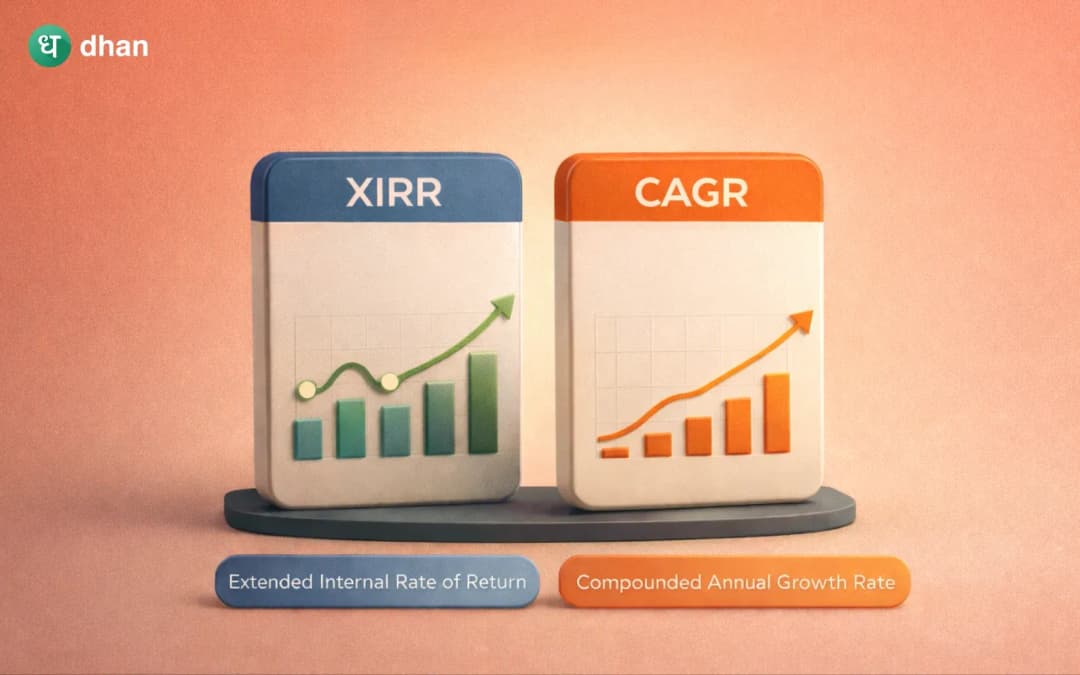




Investment is all about leveraging your money to work for you, but how can one assess whether the investments are performing as desired? Two key indicators, CAGR (Compound Annual Growth Rate) and XIRR (Extended Internal Rate of Return), can help investors monitor the performance of their investments effectively.
This blog will walk you through the differences in XIRR vs CAGR, calculations, pros and cons, and usage of these metrics for SIP returns and overall investment growth.
What is CAGR?
CAGR stands for Compound Annual Growth Rate. It is used to measure the average growth rate of an investment on an annual basis, assuming that the investments have been growing at a constant rate over the years.
For example, you invest ₹10,000, and after three years, the investment becomes ₹16,000. CAGR will give you the fixed rate at which the investment increases every year to take you from ₹10,000 to ₹16,000.
Formula:
CAGR= [(Ending Value/Beginning Value)^(1/Number of Years)] - 1
The CAGR is important as it offers a simplified view of the growth of an investment, making it easy to compare different funds or market indices. However, CAGR does not allow us to consider multiple investments as well as withdrawals, which is where the XIRR is important.
👉 Explore CAGR Calculator
What is XIRR?
XIRR, or Extended Internal Rate of Return, is used to determine the return on investments that are made at different times. XIRR considers the actual date and the actual investment amount. XIRR is useful in SIPs and other investments where funds are invested at different times.
For instance, if an investor has invested ₹5,000 in January, ₹10,000 in March, and ₹7,000 in September, XIRR helps find the returns on these investments, giving an idea of the actual growth of the money.
XIRR is especially beneficial for investors who have made multiple investments, redeemed their shares, or want to compare the actual performance of SIPs of different mutual funds.
👉 Explore XIRR Calculator
Key differences between CAGR and XIRR
Here’s a simple comparison of XIRR vs CAGR:
Pros and cons of CAGR vs XIRR
Here are the advantages and disadvantages of the two measures in more detail:
How to calculate CAGR and XIRR
Here is how you can calculate CAGR and XIRR.
Calculating CAGR
- Determine your initial investment (P) and final value (FV).
- Note the investment period (N) in years.
CAGR=(FV / P)^(1 / N) – 1
Example:
- Investment: ₹50,000
- Final Value: ₹75,000
- Period: 5 years
CAGR=(75,000/50,000)1/5−1=8.45%
CAGR assumes a single start investment and ignores additional contributions during the period.
Calculating XIRR
Suppose that on the first of January, 2025, you invested ₹1,00,000. In the middle of the year, i.e., on the first of July, 2025, you invested ₹50,000. On the last day of the year, i.e., on the 31st of December, 2025, your total return on investment from this project was ₹1,60,000.
We have the following cash flows to calculate XIRR:
- Cash flows: -1,00,000, -50,000, 1,60,000
- Dates: 01/01/2025, 01/07/2025, 31/12/2025
You may use the XIRR function in Microsoft Excel or Google Sheets as given below: XIRR (values, dates)
Outcome: 18.3%
The XIRR value of 18.3% is the actual return on investment, considering the actual dates when each investment was made as well as when each investment was paid out. XIRR is more realistic than CAGR, particularly when investing in projects with more than one cash flow.
When should you use CAGR?
The CAGR is best used when you want a quick summary of growth over time without taking into account irregular contributions. Use it when:
- Lump-sum investments: When all investments are made at the beginning of an investment period.
- Long-Term fund or index comparison: When comparing different funds or stocks over an extended period.
- Portfolio overview: When you need a quick snapshot of investment growth.
- Benchmarking performance: Check if the investment has met the expected growth over the long term.
When should you use XIRR?
CAGR can be employed when a brief summary of your growth is required without taking into consideration irregular contributions. CAGR can be employed in the following scenarios:
- SIP-Based investments: You are investing a certain amount every month or quarterly.
- Irregular contributions or Withdrawals: The investment or withdrawal takes place at different times.
- Actual performance comparison: Compare the performance of several mutual funds by considering the actual timing of investment.
- Project/portfolio analysis: Evaluate your actual return on investment by taking into account different cash flows.
Which is better for SIP investments?
In the case of SIPs (Systematic Investment Plans), XIRR is the way to go for correct analysis. Here’s why:
- Accurately measures the timing of investments: SIPs involve investing money at different points in time, which is accurately calculated by the XIRR.
- Shows the actual returns: It shows the actual returns on your SIP, not the ideal returns.
- Facilitates comparison: It helps in the comparison of two or more investment options, even if the SIPs started at different times.
- Manages partial withdrawal: XIRR takes care of any amount that may have been withdrawn before the SIP is over.
Limitations and assumptions of CAGR and XIRR
Though CAGR and XIRR are powerful tools, they also carry some assumptions and limitations that need to be understood by the investor to correctly understand the returns.
CAGR assumptions and limitations:
- It assumes steady growth, disregarding fluctuations, market volatilities, and even potential losses.
- It works on the principle of one lump sum investment and cannot deal with multiple cash flow situations.
- It does not take into account the timing of additional investments and withdrawals, as this may impact the actual investment returns.
- It shows the ideal rate that may not be possible in real situations where the contribution is variable.
XIRR assumptions and limitations:
- The assumption is that interim cash flows are reinvested at the same rate, but this is not always true in practical scenarios.
- The formula is sensitive to errors in dates or amounts, leading to computation errors.
- The calculation is more complex when done manually, but financial calculators or software are required to obtain accurate results.
- The metric is based on actual returns but cannot be used to forecast future market behaviour.
Conclusion
The difference between CAGR and XIRR is of utmost importance for any investor who wants to make the best of their money by making the right financial decisions. CAGR is an idealised growth, which is suitable for lump-sum investments, while XIRR is the actual growth, which is suitable for multiple investments, SIPs, and withdrawals.