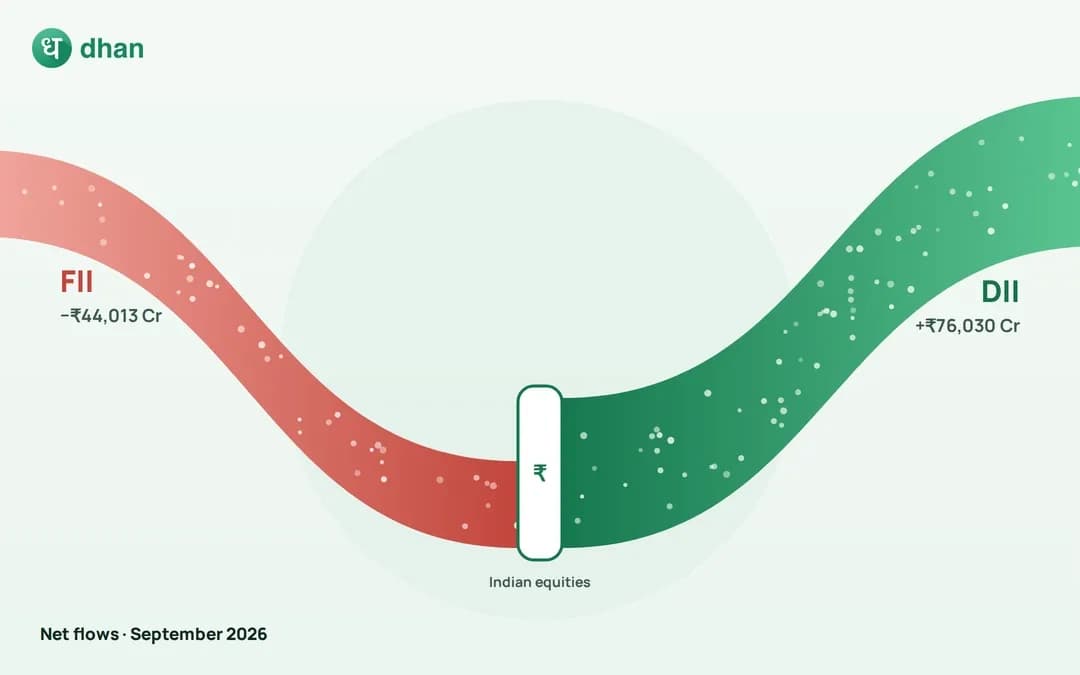
The month of April 2026 was another testing month for the Indian equity markets as the long-running tug-of-war between Foreign Institutional Investors (FIIs) and Domestic Institutional Investors (DIIs) intensified. As the selling streak of the FIIs continued, triggering massive capital outflows, DIIs came in to play the role of the primary shock absorbers. Here is a detailed outlook of the FII and DII data for April 2026 and the global and domestic factors that affect these important financial flows.FII & DII activity in April 2026In April 2026, the Foreign Portfolio Investors (FPIs/FIIs) were net buyers for the 10th month in a row. FPI gross purchase in the cash segment stood at Rs. 3,03,387.09 crores, while gross sales stood at Rs. 3,73,522.55 crores, which implies that FIIs were the net sellers from Indian equities, leading to a net outflow of Rs. 70,135.46 crores in April 2026. This massive outflow by FIIs in April brought the cumulative net FPI outflows for the first four months of 2026 to Rs. 1.92 lakh crores.On the other hand, Domestic Institutional Investors (DIIs) did their job of being counter-cyclical to FIIs outflows, where their gross purchase and sale stood at Rs. 3,77,771.28 crores and Rs. 3,26,707.41 crores respectively. This gave DIIs a net inflow of Rs. 51,063.87 crores during April 2026. This purchasing power by Indian domestic investors countered the selling power by foreigners and therefore, the benchmark Nifty index largely remained resilient, range-bound, and ended the month around 24,000 levels despite the FIIs' outflows from Indian equities.Why were FIIs selling in April 2026?The FII exodus in April was caused by a complex combination of macroeconomic headwinds and geopolitical uncertainties. The escalation in the US-Iran tensions was one of the key triggers of the FIIs outflows. The speculation of the potential blockade of Iranian ports threatened the important supply routes via the strategically crucial Strait of Hormuz. This drove crude oil prices above the $100 per barrel mark, reviving global inflation fears and causing a severe risk-off sentiment among foreign allocators.The weakening of the Indian Rupee, as it depreciated to ₹92 against the US dollar in April, had a significant effect on dollar-adjusted returns of foreign investors, which further accelerated their capital outflow from India.The US 10-year Treasury bond yields remained high because of the continuously high inflation data in the US. These dynamics made dollar-denominated, safe-haven assets much more attractive to global funds than emerging market equities such as India.Additionally, Indian equities were considered to be costly at a price-to-earnings (P/E) ratio of about 21x, relative to other emerging market counterparts. This caused foreign investors to pull out their investments from India to other cheaper alternatives. All these factors in combination led to FIIs' outflows in April 2026, but it was contained by the support of DII buying. Why were DIIs buying in April 2026?Although the foreign capital continued its outflows from Indian markets, domestic players offered a strong safety net to the Indian market, supported by the unwavering confidence of the retail investors in the growth potential of the Indian economy. The monthly SIP inflows continued to remain persistently above ₹25,000 crore. The persistent inflow of retail money allowed Indian mutual funds to deploy funds actively during market downturn periods, thereby cushioning the impact of the FIIs’ withdrawals.The domestic institutions continue to believe and focus on the long-term structural growth story of India, with a projected Nifty earnings compound annual growth rate (CAGR) of 16% between FY26 and FY28.In conjunction with this, DIIs were selectively buying fundamentally strong stocks in different sectors, taking advantage of the valuation corrections. Thus, DIIs provided a cushion against FII selling, limiting extreme volatility in indices like Nifty and Sensex. To summarizeApril 2026 FII and DII data underscored a profound structural transformation within the Indian stock market. Although foreign outflows of more than ₹70,000 crore were a severe test of broader market stability, the domestic institutional investors efficiently absorbed the macroeconomic shock. With steady retail SIPs acting as the backbone of domestic liquidity, the Indian financial ecosystem has continued to demonstrate its strength. In the near-term future, even though the short-term FII flows will still be determined by the global indicators, such as the crude oil prices and bond yields, the growing financial strength of DIIs is reducing the dependence of the Indian financial market on Foreign capital, which is transitioning India to be self-reliant.