Demat Account Charges and Fees







Today, for anyone wanting to enter the stock market, opening a Demat account is the first step towards possessing financial securities in a digital form. It functions similarly to having a bank account, but instead of keeping funds in it, a Demat account holds stocks, bonds, ETFs, and mutual funds in a digital form.
Among the various brokers and investing options available in India, Dhan has proven to be a reliable alternative for both traders and investor communities. Before starting the process of Demat account opening on any broking platform, it is necessary to understand one aspect, which is the Demat account charges.
These fees may appear to be insignificant, but they could accumulate if you trade actively or hold more than one investment. Understanding how fees are charged by brokers can help you plan your investment strategy better. Now, let’s discuss the charges in demat account and what a beginner should know before making a Demat account online.
What is a Demat Account and why does it matter?
A demat (Dematerialised) account is a digital account that holds all your investments in dematerialised form. It helps in faster transfer of funds as well as safe storage of holdings in dematerialised depositories such as CDSL (Central Depository Services Limited) or NSDL (National Securities Depository Limited).
Every investor who wants to hold listed securities like equities, ETFs, or bonds in electronic form needs a demat account. Without it, it is not possible to hold securities in digital form purchased on any stock exchange like the NSE and BSE.
Dhan partners with CDSL as its depository partner, ensuring safe, reliable, and transparent management of records.
Understanding Demat Account Charges
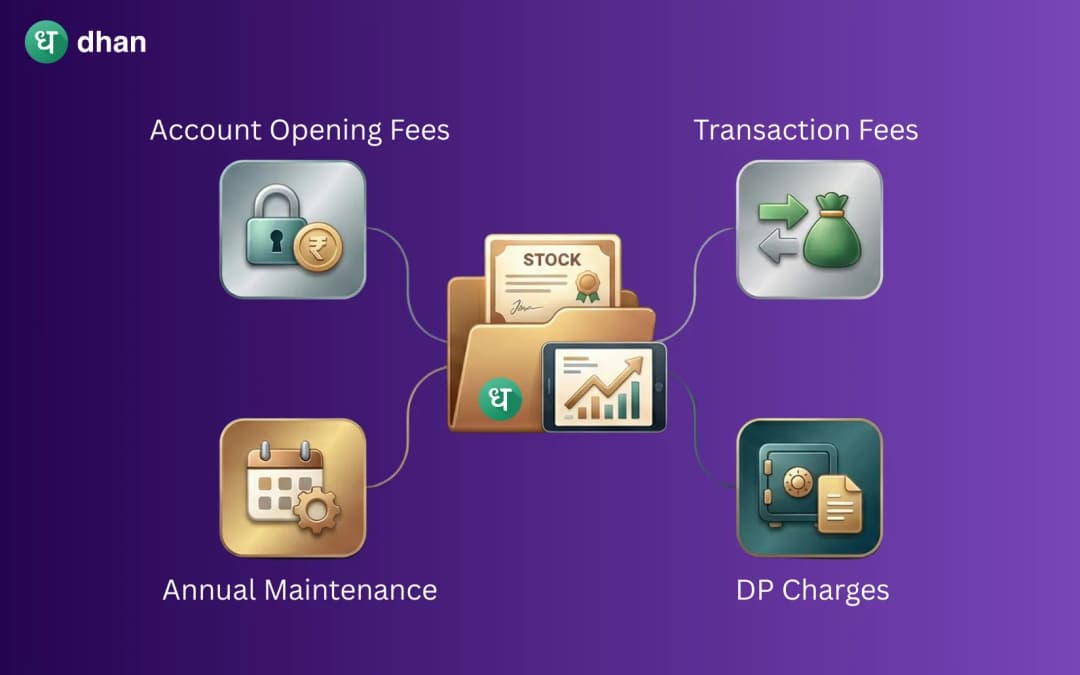
Charges in demat accounts are not arbitrary; they account for the operation and transfer costs incurred in holding and transferring securities. Charges associated with a Demat account are clearly disclosed to market participants to help them manage their portfolios at affordable costs with transparent pricing. The different charges associated with a demat account are:
Account opening fees
The good news is that opening a Demat account on most broking platforms is absolutely free for individuals & HUFs. Most brokers offer zero account opening fees for both trading and Demat accounts. The entire process of opening a demat account is online and only requires a few minutes of your time using your PAN, Aadhaar, and bank details.
This ease of accessibility makes Dhan an ideal platform for new investors to begin investing in stocks, ETFs, and mutual funds without any initial upfront costs.
Annual maintenance charges (AMC)
AMC is the annual maintenance charge, charged for maintaining the Demat account. Brokerage platforms charge this to cover the ongoing administrative costs, reducing long-term AMC costs, which can have a significant impact on your investment performance.
Brokers currently offer zero lifetime AMC for individual and HUF accounts, subject to applicable terms and conditions. AMC may apply to non-individual accounts such as NRIs, corporates, LLPs, partnership firms, and trusts, where AMC is ₹800 + GST.
DP (Depository Participant) charges
DP Charges are among the most essential yet misunderstood Demat fees. DP Charges stand for depository transaction charges that are charged every time you sell securities through your Demat account. According to the latest pricing, most brokers' DP charge is ₹15-20 per ISIN (only for sell transactions).
This means that if you sell shares of two or more companies' stocks in a single day, you will be charged ₹15-20 per ISIN.
Pledge and unpledge charges
Investors may pledge their holdings for collateral margin purposes for F&O or margin funding. Brokers offer this feature to their users and charge nominal fees as per the industry standard charges. To free their holdings from pledging, investors have to pay the due amount and unpledging charges.
According to the latest pricing structure, Dhan charges ₹ 15 / transaction / ISIN + GST for all requests, including pledge, unpledge, and invocation.
Additional other charges
Besides the above categories of charges, there are some other charges levied by the brokers, which are as follows:
- Platform Charges: ₹0
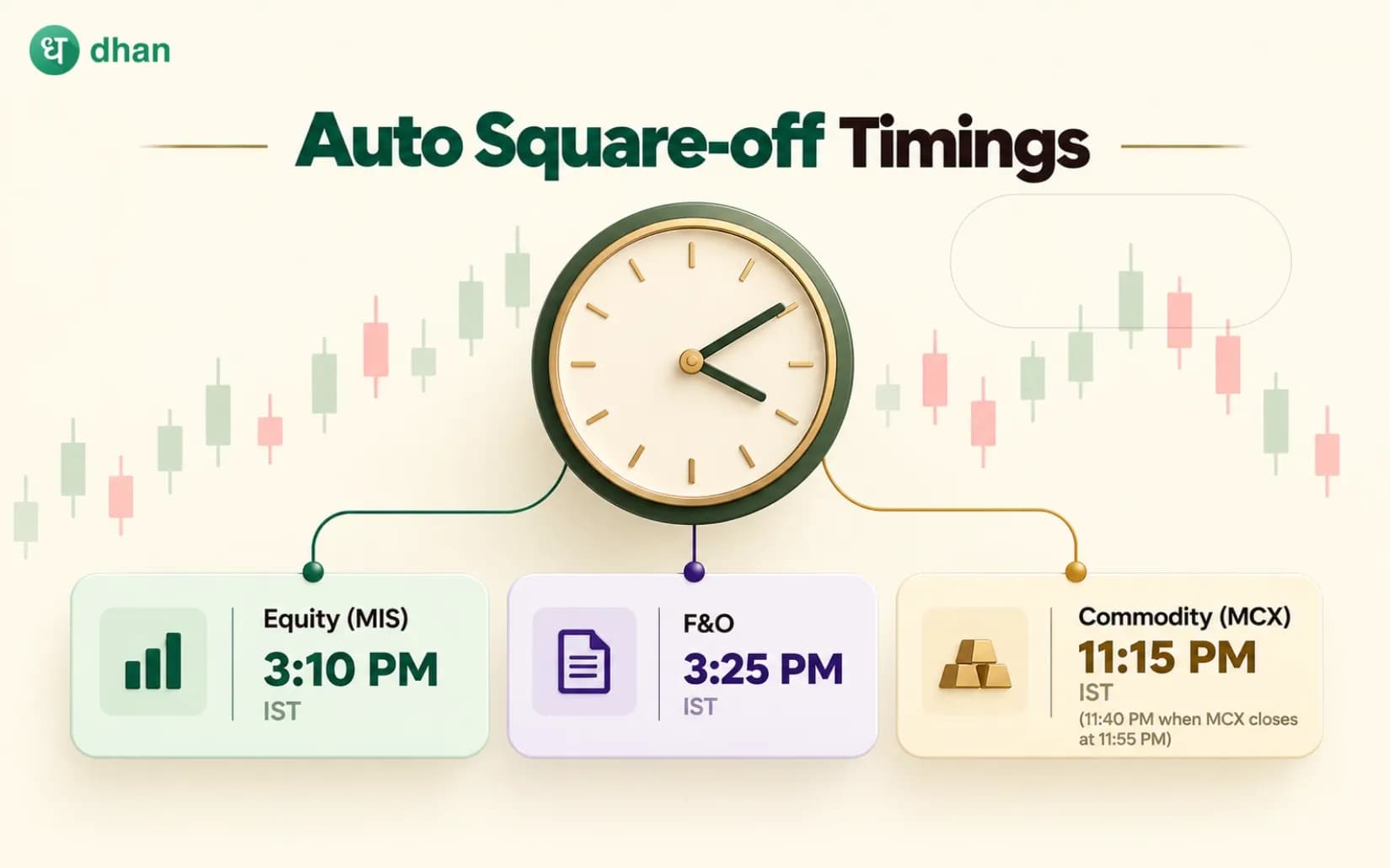
- Auto-Square Off Charges: If investors fail to maintain the required trading margin, Brokers may initiate an auto square-off and charge ₹30-40 per order + GST.
- Call & Trade: ₹ 50 / order + GST.
- Payment Gateway: It is free at ₹ 0 charges for transactions carried out via UPI payment or internet banking.
- Interest Charges: Dhan charges interest of 0.0438% per day on outstanding non-MTF debit and non-maintenance of a 50:50 margin, it varries from broker to broker.
- CUSPA Charges: ₹ 15 / instruction / ISIN + GST.
- Bounced Contract Note: ₹ 5 + GST per delivery for re-attempt via alternate digital channel. In case of failure, ₹ 100 + GST for physical delivery.
Government Taxes and Statutory Charges
Besides these specific charges, Brokers also levy some mandatory charges. These are:
- Securities Transaction Tax (STT): 0.1% on buy & sell.
- SEBI turnover charges: 0.0001% of the turnover.
- Stamp duty: 0.015% on turnover of buy orders
- GST: 18% on brokerage + transaction charges + SEBI Turnover + IPFT/Other Tax
- Transaction charges: For BSE transactions, it charges 0.00375%, and for NSE transactions, it charges 0.00297%.
- IPFT Contribution: 0.0001% of the turnover.
- Brokerage charge: ₹ 20 or 0.03% per executed order, whichever is lower.
These fees are not regulated by Brokers and are the same for all brokers registered with SEBI.
What beginners must check before opening a Demat Account?
Before opening a Demat account, the following factors must be thoroughly taken into account:
- Total cost of ownership: Compare the total cost of ownership. It is not only about the cost of one brokerage service. The total cost of ownership should be calculated in terms of AMC, DP charges, and transaction charges based on your trading pattern.
- Check for conditional waivers: There may be certain charges that would be waived if you meet a certain condition concerning trading volume/balance. Check that so you can benefit from it and minimise your charges.
- Understand the pricing structure: As an investor, zero AMC and low DP charges will be most important to you if you are a long-term investor. But as an active trader, brokerage on intraday and F&O will have more significance.
- Read the fine print: It is important to carefully read and go through the terms and conditions document of the brokerage service provided to avoid problems in the future.
- Verify platform features: Ensure the platform features, research tools, and customer support justify the charges you'll be paying.
- Consider scalability: When you have an expanding investment portfolio, it is essential that you consider whether or not your cost structure will continue to be optimal. This is because most brokers offer a pricing structure that becomes more economical with increased trade activity.
Final thoughts
Knowing the cost associated with a demat account is essential for making sound investment choices. While it is important to note that processing fees should not be the sole factor that determines your choice when considering the online investment platform to use, these costs will form a big part of what you ultimately get at the end. The fees associated with a demat account offered by Dhan have a transparent pricing structure and are competitive, which makes Dhan an attractive option for both beginners and experienced traders.
The key is to align the fee structure with your trading style and investment goals. Active traders will prefer a minimum brokerage charge and DP charge, but a minimum or free AMC will be more suitable for a long-term investor. After understanding these costs, one can plan their investment and make sure that there are no surprises in store with regard to investment returns.
FAQs
1. Do brokers really offer lifetime free AMC?
Yes, Brokers offers lifetime free AMC for most retail accounts. However, before investing, one needs to check if they are eligible for the same on their pricing page, as there may be some special cases in which Dhan charges ₹800 + GST, like for NRI, corporates, LLPs, partnership firms, and trusts demat accounts.
2. When are DP charges levied on Dhan?
DP Charges are levied only when you sell your holdings from your demat account. DP Charges are charged per ISIN per day, and these charges are mandatory, as per depository (CDSL) regulations. DP charges are not levied when you buy shares or when you trade intraday.
3. How can I check DP charges on Dhan?
There are various ways through which one can verify the DP charges levied on Dhan. One can visit the pricing page at Dhan's official website. Further, after a sell transaction has been carried out, one can evaluate DP charges levied through contract notes. Lastly, DP charges levied at Dhan can also be determined through an account statement, wherein DP charges debited from one's account have been shown.
4. Does Dhan charge any additional fees for demat accounts that are inactive?
No. There aren’t any additional charges for inactive demat accounts on Dhan. Even if the market participants aren’t actively involved in trading activities or remain inactive for a long time, there are no penalties or compulsory payment charges on their demat accounts on Dhan.
5. Are there any hidden charges in the Dhan Demat account?
No, Dhan follows a transparent pricing model, with all charges disclosed upfront on its pricing page, and they are also mentioned while executing trades in their trade contract and account statements. Dhan maintains honesty with users in terms of the fees it charges.