Dematerialisation of Shares




In Indian stock markets, physical share certificates were the traditional means of demonstrating ownership for decades. Yet, with the development of markets, inefficiencies and risks of the physical certificates could no longer be overlooked.
Today, stock markets in India completely operate in electronic form, and dematerialisation (demat) of stocks is not only advantageous but also required to support liquidity, trading, inheritance, and regulatory compliance. Investors who are holding old physical certificates or may have inherited them, the only way to modernise their shareholding is to shift to a demat account.
What is dematerialisation?
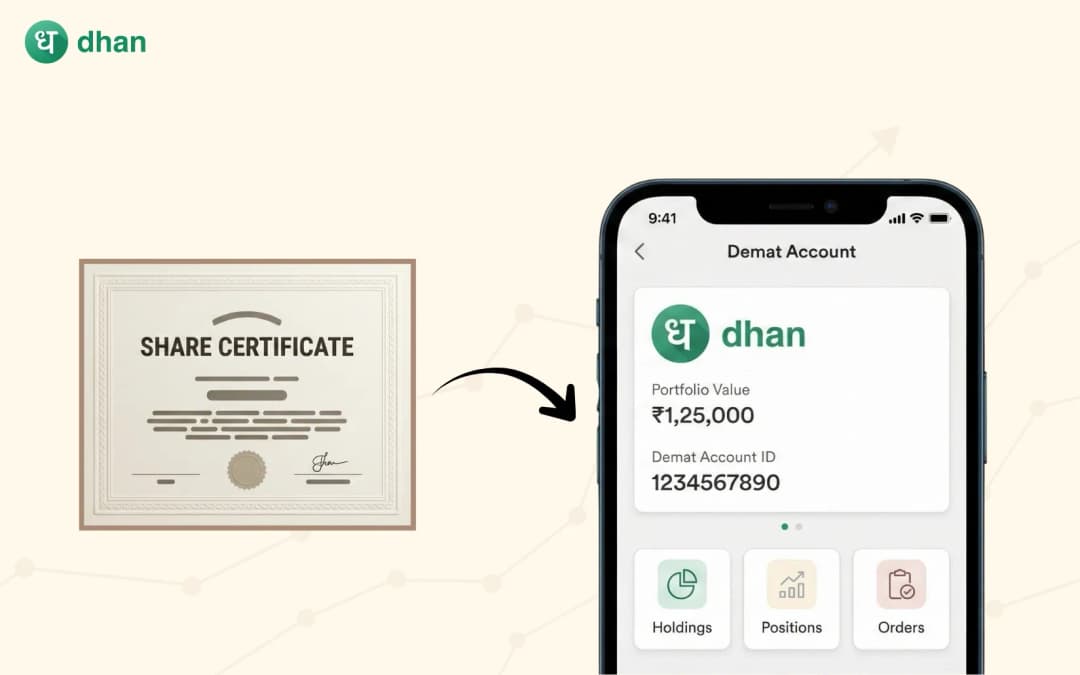
Demat account is the modern foundation of India’s equity market. Dematerialisation refers to the process of transforming the paper share certificates into electronic holdings within your demat account maintained by either NSDL or CDSL. Upon learning how to convert share certificate to demat and following the dematerialisation process, shares are:
- Easy to track
- Easy to sell
- Easy to transfer
- Impossible to lose or damage
- Automatic claim to digital dividends and corporate action.
Why shift from physical to demat?
The default or preferred form of securities holding in today’s digital era is no longer physical shares. The entire stock market operations have become digitalised after the Securities and Exchange Board of India (SEBI) mandated the use of demat accounts to trade, transfer, and hold shares.
Investors are now enjoying a myriad of advantages by knowing how to convert physical shares to demat shares, and this has reduced various concerns of investors, like:
- Fraud and theft elimination: With electronic holdings, there is no risk of counterfeit or stolen certificates.
- Safety: Demat accounts eliminate the risk of theft, destruction, and loss of share certificates.
- Transparency: The holdings can be seen online 24/7, including full transaction history and audit trails.
- Speed: Trades and transfers are finalised immediately, as opposed to weeks in paper dealings.
- Corporate actions: Automatic credit of dividends, bonuses, splits, or rights issues, which makes record-keeping easy.
- Liquidity: Demat shares are more liquid and can be sold, pledged, or transferred instantly, offering more flexibility to investors.
- Cost efficiency: With demat holdings, there is no requirement for stamp duty, postal expenses, and tedious forms with each transfer.
Transit to demat form digitises your investments, taking your shareholding into the new financial ecosystem like Dhan. It encourages a smoother and secure investing experience as it is integrated with online trading platforms, providing real-time access to your holdings and automation of corporate actions (bonus issues, dividends, splits).
The digital holdings minimise fraud and make it easier to exercise your rights as a shareholder. Dematerialisation is a future-proofing of personal finance and equity investment as SEBI continues to promote a paperless economy.
Documents required for converting physical shares to demat
During the process of how to dematerialising physical shares, a variety of documents are required. The required documents to convert physical shares into demat are.
- Use Existing Demat account or Open Demat account (mandatory)
- Original physical share certificates.
- Request Form (DRF) from your Depository Participant (DP)
- PAN card
- Aadhaar
- Address proof
- Your DP Client Master Report (CMR).
- Bank-issued signature validation (when signatures were altered)
- Transmission papers (in case of inheritance)
How to convert physical shares to demat
The dematerialisation process can be daunting to those who are new to digital investing. By following the instructions mentioned below, answer all the queries related to how to convert paper shares to demat. By following these tips, the physical ownership can be smoothly transferred to the digital one:
1. Open a demat account
The first step of understanding how to convert physical shares into demat is opening a demat. Select a Depository Participant (DP), often a bank, a merchant bank, or a financial institution, registered with either NSDL or CDSL, the most popular depositories in India. The demat account is your digital vault, just like a bank account, which will hold all your future and converted securities.
2. Check physical share certificates
Ensure that your physical certificates are valid, not damaged, and have the right ownership information. Make sure that names, addresses, and joint holder information (where necessary) are the same as your records and are identical to the demat account.
Where there is a mismatch or the change of name through marriage, inheritance, or any other reason, update the certificate using the Registrar and Transfer Agent (RTA).
3. Complete the dematerialisation request form (DRF)
Request your DP to provide you with the Dematerialisation Request Form (DRF), fill it with all necessary information, and attach the original share certificates. In case of each certificate, write Surrendered for Dematerialisation as directed.
4. Submit documents and verification
Offer valid identity, address, and PAN card copies with the DRF. Joint holders should provide documents on all names. Some companies demand an affidavit or a notarised document, particularly when there is a need to update the details or the certificates are outdated. There is a possibility of demurrage charges (minor fees) on a certificate and courier delivery; confirm the schedule with DP before submitting.
5. Processing and credit to demat account
The DP will submit your request and certificates to the RTA of the issuing company. The RTA checks authenticity, revokes physical certificates, and updates the company register of members. Once dematerialised, the electronic shares are deposited in your demat account, and the conversion process is complete.
The bottom line
Physical share certificates might evoke a sense of nostalgia, yet they no longer belong to the digital Indian financial landscape. Dematerialisation gives your investments security, accessibility, and the potential to grow with the help of modern tools and platforms.
Irrespective of whether you are planning to sell out-of-date securities, consolidate family assets, or transfer assets to the next generation, it is best to convert the physical shares to demat.
The process is simple, safe, and instructed by your DP. After that, your shares are future-ready, available at any time, not subject to loss, and can be transacted instantly.
Dematerialising your shareholding isn’t merely a regulatory necessity; it’s a step towards smarter wealth management and a streamlined investing process.
FAQs
Is it mandatory to dematerialise physical shares to transfer or sell them?
Yes. SEBI rules mandate that all share transfers and market deals must be carried out through demat accounts. After December 2018, paper shares are not subject to trading.
Will I be able to dematerialise physical share certificates when the name on the share certificate does not match my demat account?
No. Before demat conversion, you need to update your records and certificate with the RTA to become eligible for the conversion of the physical certificate to demat form.
Is it possible to directly convert inherited shares to demat?
No. Share certificates that are inherited must first undergo a transmission process (submitting a death certificate, legal heir documents, and KYC of the beneficiary). After updating the ownership, the shares can be dematerialised.
How long does the process take to convert physical shares to demat?
The entire dematerialisation process usually takes 2 to 4 weeks from submitting your Dematerialisation Request Form (DRF) and the physical share certificates to the Depository Participant (DP) until the electronic shares are credited to your demat account.
What documents are required to convert physical shares to demat?
You must have your original physical share certificates, completed DRF, a demat account with DP, valid identity proof (PAN card), address proof ( Aadhaar ), and, in the case of joint holdings, all documents for other holders. Inherited shares may require special documents, such as transmission forms.