How Dhan processes orders faster than most brokers in India







When a trader taps Buy, most market participants assume that the order is sent directly to the exchange and is executed as the entire process occurs in the blink of an eye. However, in reality, it's much more complicated. Before routing the order to the exchanges, all orders go through the broker's own systems, which include an order management layer, a risk management check, and an execution routing system. Each stage adds latency to the order execution. The time taken for these processes depends entirely on the broker's infrastructure, not the exchange.
Most traders only notice this gap when they miss a price or see a fill that does not match what was on the screen a moment earlier. In this blog, we will explore the reasons behind this execution delay and how Dhan offers lightning-fast execution speed to its users.
What occurs between the buyer and the exchange?
There are three stages that a standard order goes through before it reaches an exchange. Order Management System (OMS) registers and validates the order. The Risk Management System (RMS) verifies available margin, position limits, and regulatory parameters. The execution system then formats the order to the exchange's protocol and dispatches it. It is only at this stage that it reaches exchanges such as the NSE or the BSE.
In a traditional setup, these stages are performed one after another, which involves each stage waiting for the previous one to finish. As a result, on days that observe high market activity like budget days or major announcements, sequential systems form a queue. This leads to either delayed confirmations, wider execution spreads, or prices that have changed by the time the order is received.
Why is broker infrastructure the constraint?
In India, most brokers run their OMS and RMS on third-party software sourced from external vendors, which was built more than 10 years ago. Therefore, they are not built to handle the sheer order volume that Indian financial markets now generate, and these systems operate sequentially, which adds latency to the order execution.
Thus, during high trading volume like the opening sessions, where the user traffic can increase a hundredfold within minutes, these sequentially processed systems slow down to absorb that surge. Traders often have to bear this execution delay in terms of delayed confirmations and missed entries, especially at times when they need fast execution to capitalise on the market movements.
What did Dhan build to address this?
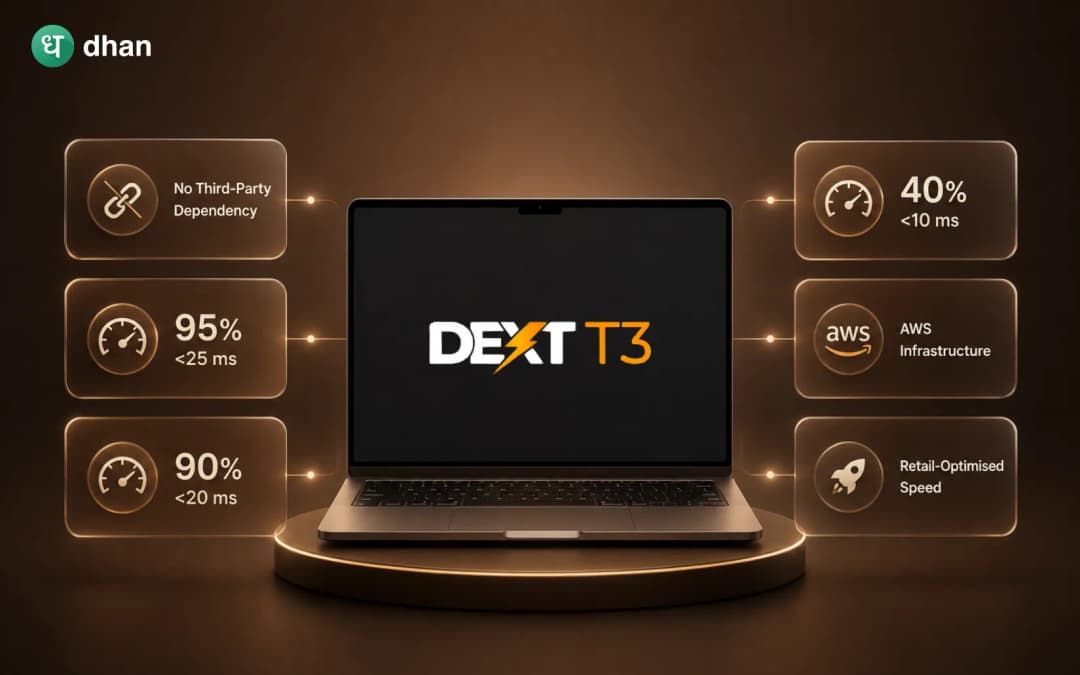
To address this gap, Dhan built its proprietary in-house trade processing system from scratch. Dhan’s trading engine is named DEXT, which stands for Dhan Exchange Trading System. It integrates order management, risk management, and execution into parallel processing and enables Dhan to have absolute control over each stage of the order journey.
This results in a significant difference in execution speed. Before DEXT, end-to-end order execution on Dhan was largely at par with industry standards of 120 to 150 milliseconds. However, today, 95% of all orders processed on Dhan are processed under 25 milliseconds, with 90% of them completing under 20 milliseconds and 40% under 10 milliseconds. Additionally, the infrastructure of DEXT is hosted on Amazon Web Services, making it one of the fastest trading engines for retail traders in India.
How does DEXT offer fast order processing?
Several factors have contributed to the lightning-fast execution speed offered by the DEXT trading engine. Some of those are:
Parallel processing rather than sequential
Most trading systems validate margin availability, KYC compliance, and position limits sequentially, i.e., one after the other, which adds latency to the execution speed. DEXT runs these checks simultaneously across 5 processing layers.
Additionally, the synchronisation only occurs at the final decision point, where the system ensures that all necessary validations have been completed before dispatching the order to the exchange. This architecture of Dhan reduces execution time without compromising the comprehensiveness of risk controls.
Infrastructure held at sub-30% utilisation
DEXT servers are deliberately maintained at under 30% capacity during normal trading conditions. This headroom is reserved for the sharp traffic surges or volatile market conditions, such as at market opening, near major results announcements, or during sessions of unusual volatility.
Therefore, during those times, instead of throttling or queuing incoming orders under load, the system already has spare capacity to absorb the surge in trading volume.
Active-Active multi-region deployment
DEXT operates across multiple infrastructure locations, including Mumbai and Bangalore, rather than from a single data centre. Orders are routed in real time based on which location has the lowest current latency and available capacity. If one region experiences a higher load, the system automatically shifts to another region with less load.
Thus, instead of relying on a static route, the system continuously monitors the network and routes the trades through the geographically closest and fastest available server node, enabling fast execution.
DEXT as the foundation for feature development
Since Dhan has its built-in execution engine, it can directly build features based on its users' needs. For example, Order Slicing, which automatically splits large orders into smaller ones without manual intervention, Scalper Mode, which was designed specifically around sub-20 millisecond fills, reducing slippage for traders looking to take advantage of tight price movements, and Super Orders, where entry, target, and stop-loss are all placed in one go, etc.
Thus, Dhan's built-in trading engine enables it to have complete control over the entire process and act swiftly in case of any issue without relying on or waiting for any third party.
Wrap up
While many brokers in the Indian market compete primarily on pricing structures or features, Dhan has heavily prioritised strengthening the invisible technology backbone that powers every single trade. Dhan’s optimisation of the order execution process is a testament to its commitment to providing an institutional-grade trading environment for retail participants.
To the active trader, this technological edge translates directly into fast execution. It ensures that when traders see an opportunity and decide to act, the Dhan platform offers them all that they need to successfully act on it. By minimising latency and building a system that thrives under pressure, Dhan allows its users to execute their strategies with greater speed, precision, and absolute confidence.