What is BSE (Bombay Stock Exchange)?






For over a century and a half, the Phiroze Jeejeebhoy Towers on Dalal Street have stood as a sentinel of India’s economic aspirations. As the oldest stock exchange in Asia, BSE has played an instrumental role in the development of capital markets in India, as it has provided a platform for companies to raise capital and for investors to participate in the growth story of India. In this blog, we will learn about the history, working, and key functions of the Bombay Stock Exchange.
History of the Bombay Stock Exchange
The story of BSE began in the 1850s when 5 stock brokers gathered under a banyan tree in front of Mumbai's Town Hall. As the number of brokers was growing, the venue changed several times, until 1874, when they settled in a place, which today is Dalal Street (Brokers Street). In 1875, this group formally constituted The Native Share & Stock Brokers' Association, which later became known as the Bombay Stock Exchange.
Over the decades, the BSE had changed from being an association of persons to a corporatised and demutualised association. In 2017, BSE made history by becoming the first stock exchange in India to get listed on a rival exchange (NSE), which marked a new age of transparency and governance.
Key features of the Bombay Stock Exchange
The BSE is characterised by several unique features, giving it a significant role in the Indian financial ecosystem:
Asia's oldest stock exchange
Its experience of more than 150 years gave it an immense institutional knowledge and experience in the operation of financial markets. This longstanding history adds to its credibility and trustworthiness among investors and corporations.
Global standing
The BSE has the highest number of listed companies in the world, with more than 5600 companies from various sectors. This broad listing gives investors a wide range of investment opportunities, from known blue-chip companies to new emerging small and medium-sized enterprises (SMEs).
Speed and technology
The BSE operates on the BSE BOLT PLUS system, which is one of the fastest trading systems in the world. With a response time of only a few microseconds, it ensures that high-frequency traders and retail investors benefit from lightning-fast response times.
Robust regulatory framework
The BSE operates under stringent regulations set down by the Securities and Exchange Board of India (SEBI). This ensures transparency, fairness, and investor protection, which in turn builds investors' confidence in the stock market. This strong framework helps prevent market manipulation and promotes ethical trading practices.
Diverse product offerings
Apart from equity trading, the BSE has a wide range of products and services. These include derivatives, debt instruments, mutual funds, etc.
SENSEX
This is the flagship index of the BSE exchange. Comprising 30 of the biggest and most actively traded companies from a diverse range of sectors, the SENSEX represents the pulse of the Indian stock market.
SME platform
The Small and Medium Enterprises (SMEs) platform was launched by BSE, which was the first such platform in India. This platform is important to growing businesses as it enables them to raise equity capital without the stringent requirements.
Mutual fund platform
Its StAR MF platform is the largest online mutual fund distribution infrastructure in India and processes millions of transactions monthly.
Core functions of the BSE
The BSE performs a multitude of functions which are vital for the smooth functioning and growth of the Indian capital market, like:
Capital formation
The primary role of the BSE is to serve as a bridge between companies that need capital and investors that have surplus funds. Through Initial Public Offerings (IPO's), companies can raise money to either help them expand their company, research, or pay back debt. This process converts private savings into productive industrial capital.
Offering a trading platform
The BSE provides an organised and regulated marketplace for the buying and selling of securities. This liquidity is important to investors so that they can easily enter and exit positions. The electronic trading system is utilised to ensure that price discovery and transaction execution are carried out efficiently.
Price discovery
Through the interplay of demand and supply on its trading platform, the BSE helps in the fair and transparent discovery of prices for listed securities. This reflects the collective judgment of market participants regarding the value of a company.
Investor protection
The BSE operates under the regulatory control of the Securities and Exchange Board of India (SEBI). It upholds a rigid set of listing arrangements and disclosure standards. Furthermore, the BSE maintains an Investor Protection Fund (IPF) to compensate investors for defaults by trading members to ensure the trust of market participants in the system.
Economic barometer
The movement of the SENSEX is considered to be a leading indicator of the country's economic health. A rising SENSEX usually indicates investor confidence and corporate growth, whereas a falling index can be an indicator of macroeconomic headwinds or policy changes.
The segments of BSE
To satisfy a wide variety of financial requirements of market participants, the BSE operates in several segments:
- Equity: Trading in stocks of thousands of public limited companies.
- Derivatives: SENSEX and individual stocks based trading in Futures and Options.
- Debt Market: A platform for investing in government securities, corporate bonds, and commercial papers.
- Currency Derivatives: Enabling participants to hedge against the risk of foreign exchange in pairs such as USD-INR or EUR-INR.
- Commodity Derivatives: Starting from the year 2018 onwards, BSE has also permitted trading on commodities such as gold, silver, and other commodity products.
- EGR: It stands for Electronic Gold Receipts, a SEBI-regulated instrument for trading in physical gold in dematerialised (demat) form, just like shares.
Why investors prefer the BSE
For a retail investor, the BSE offers a wide array of investment choices to the market players, giving them exposure to various sectors. It has more than 5,600 listed companies, which makes it one of the world's largest exchanges in terms of the number of listed companies. It is the only one where investors can get plenty of hidden gems like small-cap and mid-cap companies, which are not listed on any other exchange.
Furthermore, the long track record of the BSE provides a sense of security to the investors. The exchange has withstood world wars, economic depressions, and shifts in technology, proving its resilience and commitment to the Indian investor.
To conclude
With the progress and transformation in the Indian economy to become a $5 trillion economy, the Bombay Stock Exchange is evolving too. Whether it is the implementation of the blockchain-based tracking for securities or the development of its various ESG (Environmental, Social, and Governance) indices, the Bombay Stock Exchange is changing to be relevant in the digital era.
BSE is not only a marketplace, but it is also the pulse of the Indian capital market, where dreams are brought to life through funding and wealth is created.
FAQs on BSE
1. What is the difference between BSE and NSE?
BSE (Bombay Stock Exchange) is the oldest stock exchange in Asia, which was established in 1875, while NSE (National Stock Exchange) was established in 1992. BSE has more listed companies (more than 5600) as compared to NSE (around 2700), and hence it is the preferred listing platform of many companies. However, NSE dominates with respect to trading volumes. Both these exchanges are working in accordance with the norms of SEBI and provide similar products to the market participants.
2. What types of securities can be traded on the BSE?
The BSE facilitates trading in a wide variety of securities such as equity shares, derivatives (futures and options), mutual funds, exchange-traded funds (ETFs), corporate bonds, government securities, and other investment products. This variety provides investors with various opportunities to achieve their financial goals.
3. How can I start trading on BSE?
To trade on BSE, you must open a trading and Demat account with a SEBI-registered stockbroker like Dhan. The process includes submitting KYC (Know Your Customer) documents such as PAN card, Aadhaar card, address proof, bank details, etc. Once your account is activated, you can place buy or sell orders using the Dhan platform (mobile app or website). Then Dhan places the order on BSE on your behalf, and securities are credited to your Demat account.
4. What is BSE SENSEX, and why is it important?
BSE SENSEX is the benchmark stock market index in India, which consists of 30 well-established and financially sound companies from different sectors. Launched in 1986, it accounts for 45% of BSE's total market capitalisation. SENSEX is a barometer of the performance of the Indian stock market and economy.
5. What are the trading hours of BSE?
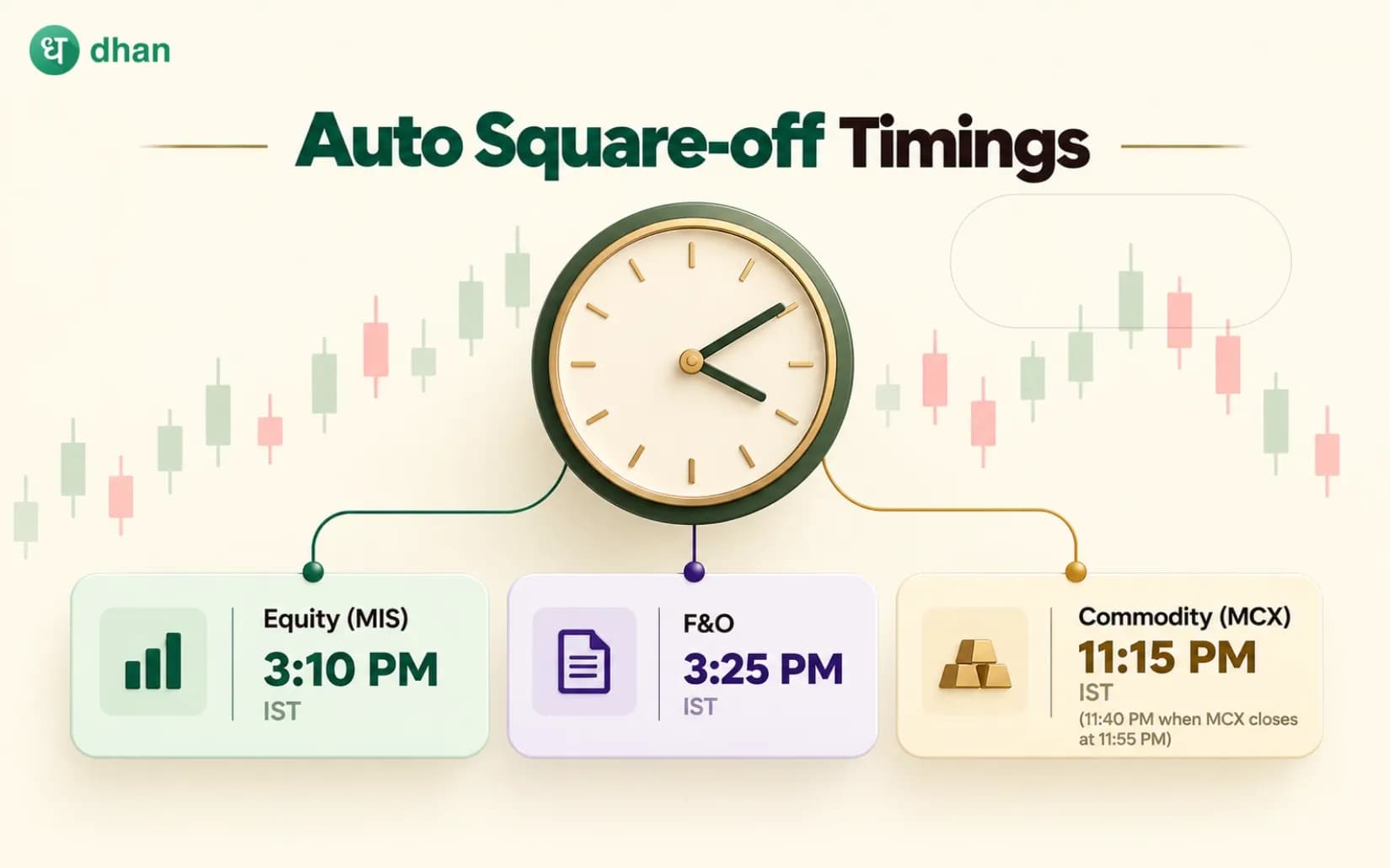
BSE is functional during trading hours, which are between 9:15 AM and 3:30 PM IST, Monday to Friday. The pre-opening session is from 9:00 AM to 9:15 AM for order collection and price discovery. The post-closing session is between 3:40 PM and 4:00 PM for after-market orders (AMOs) at closing prices.