Nifty 50 performance after RBI repo rate decisions: 1, 3 and 6-month returns




Key takeaways:
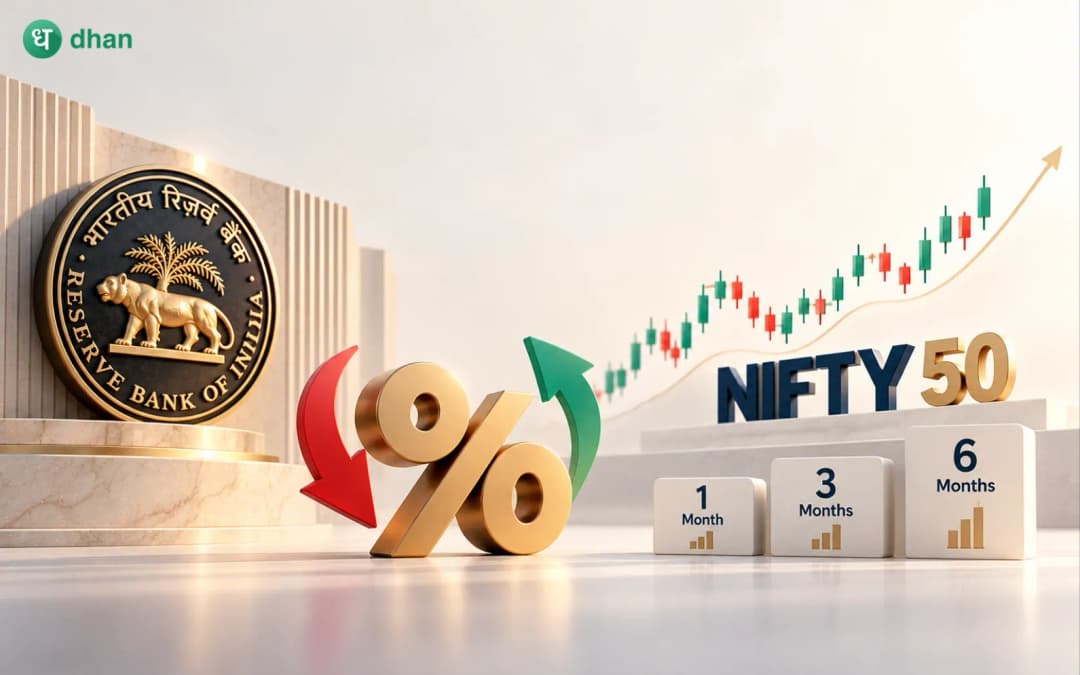
- Nifty gained in 14 of 23 completed one-month periods after RBI policy decisions and fell in 9. The average return was +0.61%.
- Over three months, Nifty gained in 14 of 22 completed periods and fell in 8, with an average return of +2.34%.
- Six-month returns were positive in 15 of 21 completed periods and negative in 6. The average return was +3.98%.
- A rate cut does not guarantee positive returns. After the December 5, 2025 rate cut, Nifty fell 5.42% over three months and 10.77% over six months.
- December 7, 2022 baseline is included in the historical table and averages. RBI raised the repo rate to 6.25% that day, followed by a further 25-basis-point increase to 6.50% on February 8, 2023.
RBI’s latest repo rate decision has once again raised questions about how the stock market reacts to changes in interest rates. But what usually happens after a rate decision? Does Nifty continue to fall, or does the market tend to recover in the months that follow?
On October 7, 2026, RBI raised the repo rate by 25 basis points to 5.50%, its first rate hike since February 2023. The central bank also changed its policy stance to “calibrated tightening”. Nifty 50 fell 0.76% on the same day to close at 22,603.05.
What RBI repo rate decisions are included?
The analysis covers 22 RBI policy decisions from February 8, 2023, to August 5, 2026, along with the December 7, 2022 baseline. The period includes rate cuts and decisions to keep the repo rate unchanged.
Nifty closing price on each RBI decision date is used as the starting point. For the one-month, three-month and six-month periods, the closing price on the target date is used. Where the target date falls on a weekend or market holiday, the previous available trading-day close is used.
Source: Reuters
How did Nifty perform one month after RBI decisions?
Nifty’s one-month performance after RBI policy decisions was mixed. Out of 23 completed periods, the index gained in 14 cases and fell in 9. The average one-month return was +0.61%.
The best performance came after the April 9, 2025 RBI meeting. The RBI cut the repo rate by 25 basis points to 6.00%, and Nifty rose 7.18% over the next month.
The worst performance came after the February 6, 2026 meeting. The RBI kept the repo rate unchanged at 5.25%, but Nifty fell 4.84% over the following month.
This shows that Nifty does not always rise after a rate cut or fall after a rate hike. Other factors, such as global markets, company earnings, inflation and investor sentiment, also influence the market.
The table above shows how the Nifty performed one month after each RBI policy decision.
How did Nifty perform three months after RBI decisions?
Three-month data shows that, out of 22 completed periods, Nifty gained in 14 cases and fell in 8. The average three-month return was +2.34%.
The best performance came after the April 9, 2025 RBI meeting. The RBI cut the repo rate by 25 basis points, and Nifty rose 13.74% over the next three months.
The worst performance came after the December 6, 2024 meeting. The RBI kept the repo rate unchanged at 6.50%, but Nifty fell 8.64% over the following three months.
These results show that market performance can change over a few months. An RBI rate cut or an unchanged rate does not determine where Nifty will move. Global markets, earnings, inflation and investor sentiment also play a role.
The table above shows the complete Nifty performance three months after each RBI repo rate decision.
What was Nifty’s six-month performance?
Six-month results were positive in most completed periods. Out of 21 observations, Nifty gained in 15 cases and fell in 6. The average six-month return was +3.98%.
The best performance came after the October 6, 2023 RBI meeting. The RBI kept the repo rate unchanged at 6.50%, and Nifty gained 14.55% over the next six months.
The worst performance came after the December 5, 2025 meeting. The RBI cut the repo rate to 5.25%, but Nifty fell 10.77% over the following six months.
This shows that a longer holding period does not guarantee positive returns after an RBI decision. Although the average six-month return was higher than the one-month and three-month averages in this sample, individual outcomes varied considerably.
The table above shows the complete Nifty performance six months after each RBI repo rate decision.
What does the historical data tell investors?
The data points to one clear conclusion, there is no simple rule that Nifty will rise or fall after an RBI repo-rate decision.
The average return was +0.61% over one month, +2.34% over three months and +3.98% over six months. These averages include the December 7, 2022 baseline and reflect all available completed returns in the Excel dataset.
The positive and negative counts also show that returns were not consistently positive. Nifty fell in 9 of 23 one-month observations, 8 of 22 three-month observations and 6 of 21 six-month observations.
The analysis includes different RBI decisions, including rate cuts and unchanged rates. The results describe historical market performance; they do not prove that an RBI decision directly caused the subsequent returns.
What should investors watch after the October 2026 hike?
Nifty’s future performance will depend on more than the repo rate. Investors should watch inflation, corporate earnings, liquidity, global markets and the RBI’s next policy signals.
The RBI has shifted to “calibrated tightening”, so future decisions will depend on how inflation and growth develop. The October 7, 2026 hike is excluded from the historical averages because its future return periods have not yet completed.
Its one-month performance can be assessed in November 2026, followed by the three-month data in January 2027 and six-month data in April 2027.
For now, the historical data suggests that investors should avoid assuming that a rate hike automatically means a weaker stock market. The direction over the next three to six months can differ from the immediate market reaction.
Conclusion
Historical data shows that Nifty’s response to RBI repo-rate decisions varies across time horizons. One-month returns were modestly positive on average, while three-month and six-month average returns were higher in this dataset.
However, negative returns occurred at all three horizons. The October 7, 2026 rate hike will provide a new test of this relationship, with its eventual impact depending on inflation, earnings, liquidity and broader market conditions.