


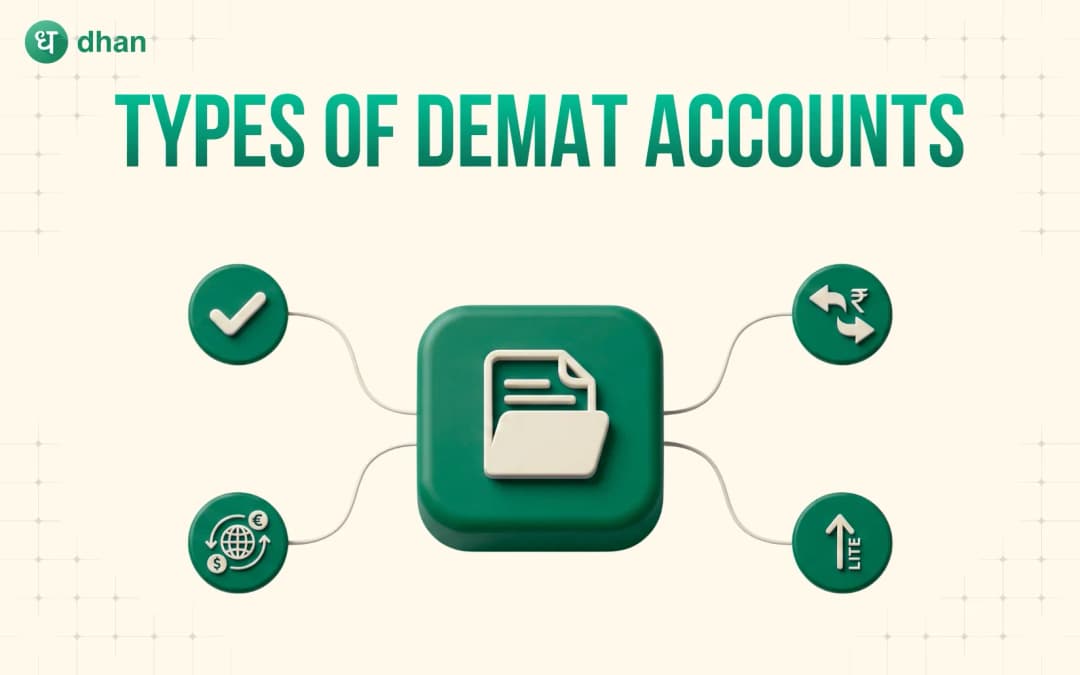
Types Of Demat account







In the rapidly developing Indian financial world, it has become necessary to open a demat account if you want to invest in the stock market. Whether you are an individual investor, a corporation, or an NRI, the type of Demat account you open determines how you will trade, manage funds, and comply with regulations.
In this blog, we are going to learn about different kinds of Demat accounts that are available in India with their features, eligibility to open demat account, and how to choose the one that suits your investment strategies.
Different Types of Demat Accounts in India
Various categories of Demat accounts are available as per the RBI and SEBI rules. Let's discuss them in detail.
Regular (Individual) Demat Account
A regular demat account is for resident Indian individuals who would like to trade or invest in Indian stocks. This is ideal for salaried or self-employed investors who would want to invest in equity or mutual funds through online platforms such as Dhan.
Special features of a Regular Demat account are as follows:
- Most Popular type of Demat account
- It can be linked with a trading and savings account for a hassle-free transfer of funds.
- Eligible to hold securities such as equity, debt, mutual funds, and ETFs.
- It can be opened with any broker who is registered with DP or SEBI.
Joint Demat Account
A joint demat account is for family members, spouses, or business partners for holding joint ownership of securities. In such demat accounts, all the joint holders have equal rights, but the transactions are only permissible with the consent of the primary holder. Joint accounts are popular for family investments and estate planning, as well as partnerships.
Special features of a Joint Demat account are as follows:
- Limited to having three account holders, one primary and two joint.
- All holders have to abide by KYC requirements.
- Corporate actions (dividends, rights, etc.) are credited in the name of the primary holder.
Corporate Demat Account
Corporate demat accounts are held by companies, LLPs, and institutional investors. They are appropriate for businesses that are operating investment portfolios or holding shares in other businesses as part of their business activities.
Special features of a Corporate Demat account are as follows:
- Opened in the name of the organisation and not an individual.
- Requires company docs such as Board Resolution, PAN, Certificate of Incorporation, etc.
- Should be in line with corporate governance and SEBI regulations.
- Used for holding shares, debentures, or mutual fund units of the company.
NRI Demat Accounts
A Non-resident Indian (NRI) demat account is for such Non Residential Indian (NRI), PIO, and OCI who wish to invest in Indian securities. Repatriable or Non-Repatriable Demat accounts can be chosen by them based on their preference.
a) Repatriable Demat Account (Linked to NRE Account)
Repatriable demat accounts are more suitable for NRIs who wish to invest in Indian equities and repatriate the profits abroad.
Special features of a Repatriable Demat Account are as follows:
- Allows making payments overseas.
- Linked to Non-Resident External (NRE) bank account.
- All the gains (like capital gains or dividends) can be repatriated outside India.
- Subject to RBI and FEMA regulations.
b) Non-Repatriable Demat Account (Linked to NRO Account)
Non-repatriable demat accounts are most suitable for NRIs who want to invest using income earned in India.
Special features of a Non-Repatriable Demat Account are as follows:
- Linked to Non-Resident Ordinary (NRO) Account
- No transfer of funds to outside India is allowed; only after-tax income is allowed to be repatriated up to the permissible limits.
- Recommended for NRIs whose sources of income are in India (rent, dividends, etc.).
Basic Services Demat Account (BSDA)
Basic services demat accounts are for small investors or new investors who have low-value holdings. It is suitable for first-time investors or passive investors who don't trade much.
Special features of a Non-Repatriable Demat Account are as follows:
- This was introduced by SEBI for financial inclusion.
- No or low Annual Maintenance Charges (AMC):
- At any one time, only one BSDA can be opened by a person.
Custodial Demat Account
Custodial Demat accounts are for minors or those investors who are incapable of taking care of accounts on their own. The custodial demat account is suitable for parents who are managing the investment portfolio of their children and the institutions that are managing the investments of their clients.
Special Features of a Custodial Demat Account are as follows:
- Maintained for an account holder by a guardian or custodian.
- All fund investments and fund redemptions are processed under the custodian authority until the beneficiary is eligible.
Premium Demat Accounts/Value-Added Services
This type of demat account is for HNIs and high-frequency traders. It is an appropriate choice for active traders and HNIs who require customised service with quick execution.
Special features of a Premium Demat Account are as follows:
- Includes priority customer support, relationship managers, and increased transaction limits.
- Access to cutting-edge research tools, real-time analytics, and investment insights.
- Occasionally, as a bonus for heavy traders, discounted brokerage slabs are available.
What is a Demat Account?
A Demat (dematerialised) account is an electronic account where the securities of an investor, i.e., stocks, bonds, ETFs, mutual funds, etc., are maintained in electronic form. All the holdings and transactions are maintained in an electronic format, and information is maintained digitally by depositories such as NSDL (National Securities Depository Limited) and CDSL (Central Depository Services Limited).
Importance for Investors
A Demat account makes it easy to invest by:
- Removing the hassle of managing physical share certificates, which can get lost, stolen, or tampered with.
- Making it easy to buy, sell, and transfer securities online.
- Providing for quick settlements and notification of corporate action (such as dividends or bonus shares).
How to Choose the Right Demat Account?
Choosing the right Demat account depends on an individual's financial choices. Investors should look out for the following factors before they make their choice:
Key factors:
- Residency Status: Resident Indian/ NRI ( Repatriable/ Non-Repatriable)
- Investment size: Premium or regular accounts are better for larger portfolios; for beginners, BSDA is better.
- Trading frequency: Frequent traders might prefer value-added services.
- Investment objectives: Wealth building, joint holdings, corporate investments, etc.
Documents required to open different types of Demat Accounts
Documents required in India to open different types of demat accounts are:
- Common Documents: PAN Card (mandatory), Aadhaar Card or Other Address Proof, passport-size photographs, Cancelled cheque or Bank Statement.
- Additional documents for NRIs: Passport, proof of overseas address, NRE/NRO account details, FEMA declarations.
- Corporate Accounts: Certificate of Incorporation, Board resolution, PAN of the entity, and KYC of the authorising signatories.
- Custodial Accounts: Minor's documents along with the guardian's KYC information.
Conclusion
Demat accounts are of various types to suit various kinds of specific investment objectives, from retail investors to multinational companies. As a retail investor seeking BSDA or an NRI handling foreign investments or a company owning the shares, being aware of these types of accounts will be a way to ensure compliance and investment efficiency.
Always compare your investment, fund transfer requirements, and trading patterns before deciding on the type of Demat account. Choosing the right way not only simplifies transactions but also saves money on the extraneous charges and paperwork.
FAQ's on Types of Demat Account
Is it possible to have multiple Demat accounts?
Yes, you can have more than a single Demat account, as you can open a Demat account with different brokers, but all Demat accounts are connected to your PAN.
Are there annual maintenance charges (AMC) on Demat accounts?
Yes, most do, except the BSDL at lower or zero AMC when the account is of a small investor.
Is it possible to transfer the resident Demat account into NRI status?
Yes, they may do so by informing their Depository Participant and giving updated KYC and bank information.
Is it possible to convert between one Demat account and another?
Yes, an investor can transfer holdings to a different kind of account under his/her DP by fulfilling the eligibility and documentation criteria.
What happens to the custodial account of a minor upon attainment of 18 years of age?
Once KYC and consent are confirmed, it is transferred automatically to a normal individual Demat account.