Unsystematic Risk




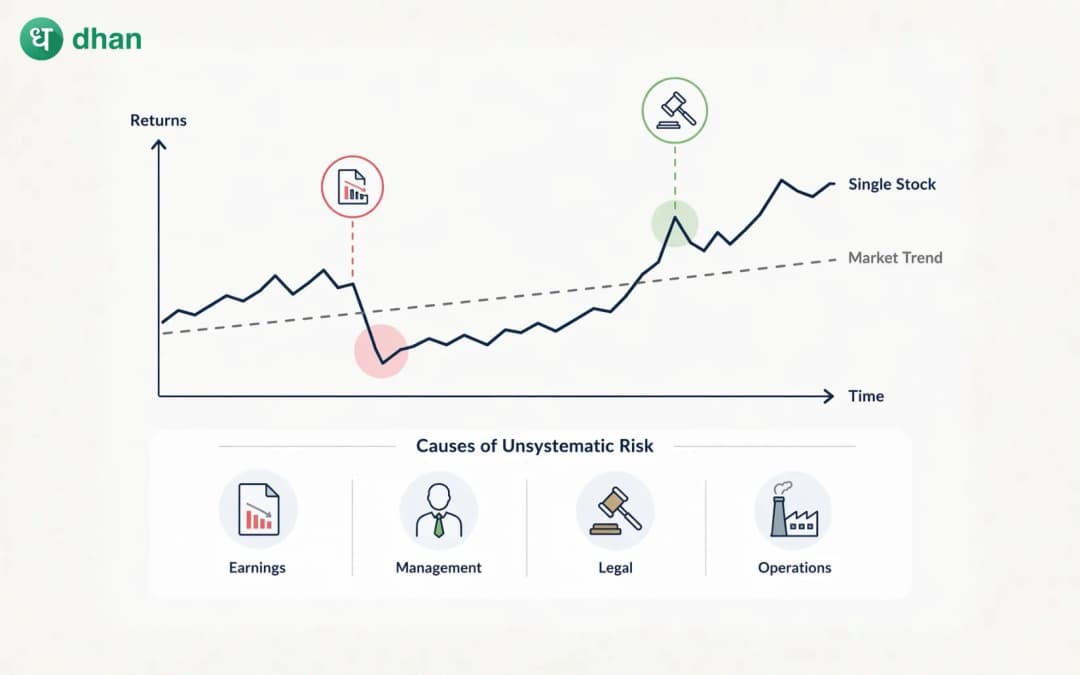




At first, this might feel confusing, particularly when you do not notice any major movement in the broader market. This is where investors must understand different types of risks.
The overall market conditions are not the only reasons that determine price movement. The company itself may be the reason at times. As you delve deeper into investing, you’ll realise that risks are often layered. While some affect the entire market, others influence specific companies.
In this blog, we have discussed how investors can identify and manage these risks, which are unsystematic in nature. A detailed knowledge of this type of risk will help you build a more stable portfolio.
What is Unsystematic Risk?
An unsystematic risk is a risk that is specific to a particular company or industry. It does not threaten the entire market. This type of risk mostly arises from internal factors like:
- Wrong managerial decisions
- Inefficiency in operations
- Financial structure
- Events specific to the company
Often, unsystematic risk is referred to as specific risk or diversifiable risk. The reason is that you can reduce these risks if you spread your investments across different assets. This type of risk is different from broader market risks as they do not affect all the stocks at the same time.
For instance, a company may face internal challenges like low demand for its products. In these situations, its stock price may fall even when the outlook of the industry remains positive. Therefore, unsystematic risk tends to be more concentrated and unpredictable in the short term.
Characteristics of Unsystematic Risk
Investors with a proper understanding of the characteristics that define unsystematic risk are generally better poised to mitigate these risks.
Company-specific in nature
Unsystematic risk is directly linked to specific companies. The extent of this risk depends on how a particular business performs, and the overall market behaviour has little to do with its performance.
Not linked to market movements
Even if the broader market is stable and performing well, unsystematic risks cannot be ruled out. Internal challenges in a company may lead to its underperformance.
Diversifiable risk
One of the key features of unsystematic risks is that they can be reduced. Investors must diversify across different stocks and sectors to minimise their impact.
Unpredictable in the short term
Certain events, like changes in management or operational hurdles, may occur suddenly. As a result, unsystematic risks become difficult to predict.
Varies across sectors and companies
The challenges faced by different industries are unique. For instance, technology companies may face risks related to innovation. On the other hand, supply chain hurdles may challenge manufacturing firms.
Types of Unsystematic Risk
As an investor, you must be familiar with different types of unsystematic risks. The following are the common categories of such risks.
Business risk
Business risks refer to those associated with the core operations of a company. This can be a change in demand, competition, or pricing strategies. Any of these challenges can directly affect the revenue and profitability of the organisation.
Financial risk
The capital structure of a company and its approach to using debt determine the financial risk associated with the organisation. During economic slowdowns, companies with higher debt levels may come under greater financial pressure.
Operational risk
The performance of a company may be affected by operational inefficiencies, system failures, or disruptions in processes. Often, these are internal risks and are related to the company’s management.
Management risk
Decisions made by the leadership of a company significantly shape its future. Poor strategic choices or the lack of direction may negatively impact growth, affecting the confidence of investors.
Regulatory risk
Changes in government policies, taxation, or compliance requirements can affect specific companies or sectors. Businesses operating in heavily regulated industries are particularly susceptible to these risks.
All these risks apply regardless of how the broader market performs. That’s why they are categorised under unsystematic risks.
Examples of Unsystematic Risk
Let’s take a look at some real-world challenges that would help you understand unsystematic risks clearly.
- Suppose the preferences of consumers of a company start changing. This may result in a decline in sales. Even if the overall industry continues to grow, this challenge will directly affect the performance of its stock.
- In other cases, a management controversy or sudden change in leadership may reduce the confidence of investors. This can lead to a decline in stock prices.
- Product failures or recalls may damage the reputation of a company and impact its future earnings.
Unsystematic Risk vs Systematic Risk
Both systematic and unsystematic risks influence investments, but they show up in different ways. As we discussed, unsystematic risks are limited to specific companies or sectors. That’s why investors can manage this type of risk through diversification.
Systematic risks, on the contrary, affect the entire market. Investors cannot avoid these risks entirely. So, it's important for you to understand how systematic risks differ from unsystematic ones. This will help you build your strategies and reduce avoidable risks.
The following table summarises the differences between systematic and unsystematic risks.
How Diversification Helps Reduce Unsystematic Risk?
Diversification is one of the effective strategies to reduce unsystematic risks. Let’s take a look at different diversification strategies that would help you mitigate these risks.
Spreading across stocks
When you invest across multiple companies, it reduces the risk of poor performance from any single stock.
Investing across sectors
Different sectors react in different ways to economic conditions. Investors should spread their assets across different sectors to balance these variations.
Using mutual funds and ETFs
You may consider investing through mutual funds and ETFs. These instruments offer built-in diversification strategies as they spread your assets across a wide range of stocks.
Balancing asset allocation
You may consider combining equities with other asset classes like debt or gold to further manage risk.
Why Unsystematic Risk Matters For Investors?
Why do you think investors should seriously approach unsystematic risk? These factors go a long way in determining your returns from investments.
Individual stock returns
Unsystematic risk can significantly affect the performance of individual investments, even when the market is stable.
Portfolio construction
When you understand this risk, you can construct a balanced portfolio that doesn’t depend solely on a single stock or sector.
Key to long-term investing
When you manage unsystematic risk, your long-term returns remain consistent. In the process, you can stay aligned with your future goals.
Helps avoid concentration risk
If you are overexposed to a single company or industry, it creates vulnerability. However, recognising this risk helps with better diversification.
Manage Unsystematic Risk Effectively
We’ve already discussed diversification strategies to mitigate unsystematic risks. Here are some other practical solutions that should help you manage these risks.
Research before investing
Take time to study the underlying business model of a company, its financial health, and growth prospects to identify potential risks.
Avoid over-concentration
It’s advisable to avoid over-concentration in a specific stock or sector. Balance your allocation across different businesses, sectors, and companies across market capitalisations.
Review your portfolio
Over time, markets and companies continue to evolve. Periodic reviews make sure your portfolio remains aligned with your goals.
Use professional investment products
Mutual funds and ETFs can help you achieve diversification while you benefit from professional management. These are useful tools to manage risks.
Conclusion
As an investor, you need a clear understanding of unsystematic risk to evaluate how individual stocks perform. However, this type of risk is manageable through thoughtful planning.
When you invest, your focus should be on building a balanced portfolio and not relying on a single stock or sector. Combine research with discipline as you diversify your portfolio to reduce the impact of company-specific risks.
When it comes to building wealth over time, effective risk management is as important as identifying opportunities.
FAQs
What does unsystematic risk include?
Unsystematic risk refers to risks that are specific to a particular company or industry. They do not apply to the entire market.
Can unsystematic risk be completely eliminated?
Unsystematic risk cannot be completely eliminated. However, you can significantly reduce these risks. As they are associated with specific companies or sectors, some level of uncertainty is always likely to be present.
What is the difference between systematic and unsystematic risk?
The entire market is affected by systematic risks. On the other hand, unsystematic risk impacts specific companies or sectors.
How does diversification reduce unsystematic risk?
When your investments remain diversified across multiple assets, the impact of poor performance from one company can be balanced by others.
Why is unsystematic risk important for investors?
Investors must understand unsystematic risks to build well-balanced portfolios and avoid concentration. A proper knowledge of these risks helps them make more informed decisions.