Who should use a trading terminal?




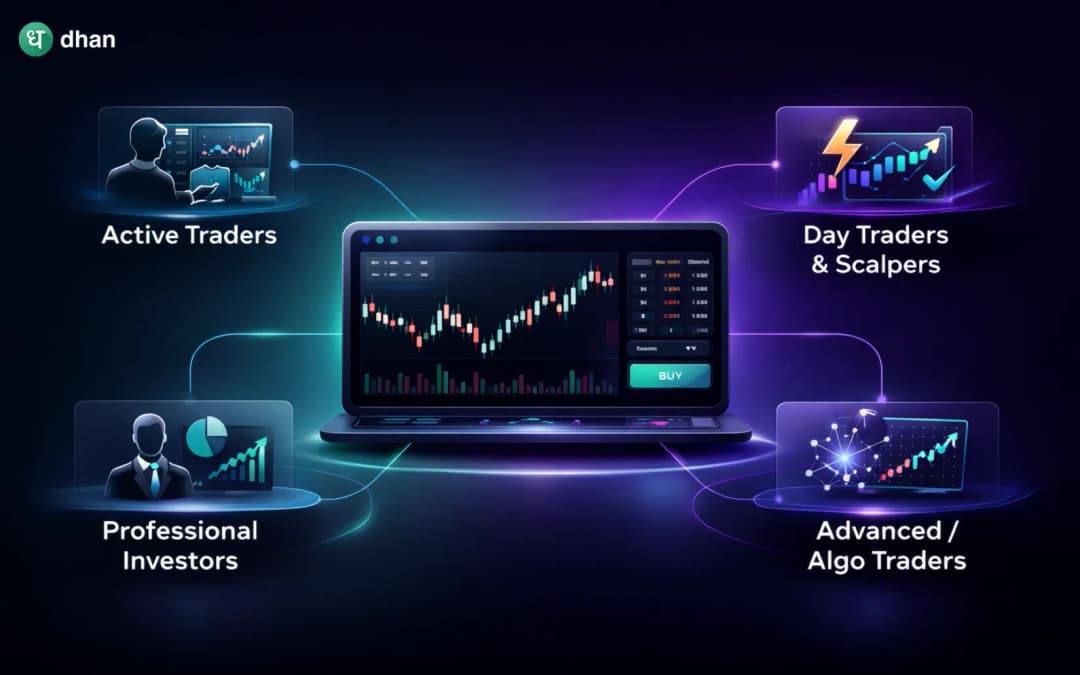


In India's rapidly evolving financial markets, determining who should use the trading terminal is crucial before investing time and money in active investing or trading. A trading terminal is a software that connects a market participant's trading account to stock exchanges and financial markets, allowing them to execute trades, access live data, and analyse price movements efficiently.
What is a trading terminal?
Before we understand who should use a trading terminal, let’s understand its meaning. A trading terminal is the interface through which market participants place orders, view real-time market feeds, monitor positions, and analyse securities using advanced charting and tools. These trading terminals are offered by brokers and connect traders directly to exchanges like the NSE (National Stock Exchange of India) and BSE through secure infrastructure.
Trading terminals vary from simple applications accessible directly via the browser to complex desktop applications offering deep analytics and advanced order types for catering to the needs of different kinds of users.
Who should use a trading terminal in India?
Trading terminals are used by a variety of market participants for several benefits they offer. Some of them are:
Intraday traders (Day traders)
Intraday traders need to square off all positions in the same trading session. They carry out multiple orders in a single day. Every millisecond is important for them. For them, a lagging platform means missing entries and bad exits, and compounded losses across several trades.
This problem for intraday traders is solved by trading terminals, which make it easier to access market sentiment and execute trades, and eliminate the constant friction of using different apps.
Derivatives traders (F&O participants)
India remains one of the world's largest derivatives markets by contract volume. The consistent differentiator between retail traders who manage risk and those who don't is access to the right tools. F&O participants use the advanced analytical tools, technical charts and indicators offered by trading terminals to manage their fast-paced strategies.
Additionally, these platforms allow derivatives traders to seamlessly execute their orders while implementing rigorous risk management measures like stop loss orders to limit their downside in volatile market movements.
Algorithmic traders
Algo traders follow rule-based/predefined, emotion-free trading strategies such as momentum, mean-reversion, volatility breakout, or statistical arbitrage, to make buy and sell transactions. Trading terminals offer algo traders open API connectivity, automated execution capabilities, real-time data feeds, and a sandbox.
Trading terminals save algo traders the pain of moving from one app to another and give them various strategies under a single roof, saving their time and effort. Trading terminals also provide demo trading to algorithmic traders to test their trading strategies against historical data and check their efficiency, and adjust them so as to save them from huge losses in the real-time market.
Swing traders
Swing traders tend to exploit short-term market fluctuations by holding positions from a few days to weeks to make attractive gains. Swing traders often struggle with the constant switching of the charting platform vs the trading app. A trading terminal provides traders with different charts, combined directly with live order placement and after-market orders, forever orders and basket orders to make simultaneous entries across multiple stocks that eliminates this friction and enables traders to act on opportunities at the right time.
Additionally, trading terminals allow them to easily monitor the previous day's close prices against current prices, as a reference point to discern what happened in the market overnight.
High-net-worth individuals (HNIs)
HNIs trade with massive capital investments in the Indian stock market. Their primary concerns often involve security, cost, and risk management. Advanced trading terminals enable the trader to have complete control over their financial transactions without having to rely entirely on professional asset managers.
HNIs use the wide market depth functionality of trading terminals to gauge the supply and demand at different price levels to ensure that their large block orders do not drastically impact the stock's market price. By utilising trading terminals' comprehensive toolkits, these large-scale investors can track their financial transactions with real-time stock prices and minimise the risks associated with latency.
Arbitrageurs
Arbitrage is the practice of purchasing an asset in one market and selling it in another to exploit minute price differences. Low latency is necessary for timely trade execution, especially during volatile trading sessions when arbitrage opportunities arise for only fractions of a second.
This strategy is entirely reliant on the execution speed of the trading terminal, which involves making lightning-fast transactions. Arbitrageurs observe multiple order books across multiple exchanges simultaneously, a task that requires multi-screen analytical toolkits available only on advanced trading platforms.
Commodity and currency traders
Commodity and currency markets are heavily influenced by global macroeconomic factors and are traded over extended trading hours. A trading terminal offers these traders multi-market access, i.e., access to currency, commodity, and derivatives segments all within the same unified platform.
These traders also benefit from trading terminals' live news feeds that keep them abreast of corporate announcements, RBI news, and developments in the global markets.
Wrap up
The progression from physical stock exchanges to online trading terminals has brought the stock market to our fingertips, democratising access to the financial markets. Trading terminals allow traders to move beyond simple investing and engage in Indian financial markets with a sophistication and efficiency that can improve their trading experience.