Understanding the difference in MTF and Margin Pledge







In this evolving landscape of Indian stock markets, investors are always seeking ways to maximise their trading potential and optimise their capital utilisation. Two popular features that help traders to leverage their assets are the Margin Trading Facility (MTF) and Margin Pledge. While they both involve the use of securities as collateral to increase buying power, they have different purposes and operate under different frameworks.
In this blog, we will discuss difference in MTF and margin pledge, what they are, how they are different with respect to each other, key characteristics and risks of investing in both facilities, and which facility investors should be investing in which facility in the Indian stock market.
What is a Margin Trading Facility (MTF)?
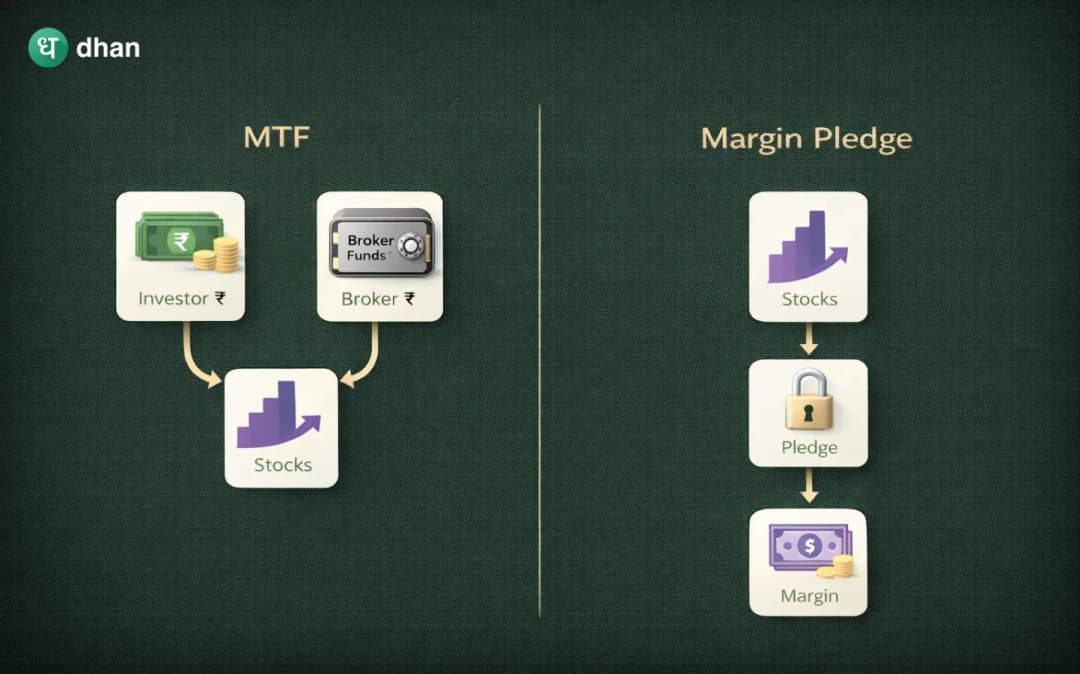
Margin Trading Facility, commonly known as MTF, enables investors to buy securities by paying only a fraction of the total purchase value, and the rest is funded by the brokerage firm.
This facility enables investors to get a loan against the shares being purchased for a short period of time.
The goal of MTF is to allow traders to trade larger positions than their available cash balance allows.
How MTF works
When an investor uses MTF, they have to pay some initial margin, which is a percentage of the total transaction amount and the broker funds the rest of the amount. For example, if a broker is offering leverage of 4x on a stock with a value of Rs. 1000, then an investor has to pay only 25% initial margin (which is Rs 250 per share in advance) and the broker will fund the remaining Rs. 750.
Brokers charge interest on the amount funded, which is often charged each day. Dhan provides MTF on +1700 stocks with 4x leverage starting at 12.49% per annum interest rate (0.0342% per day).
Key characteristics of MTF
MTF is a popular feature among market participants due to its following characteristics:
- Increased buying power: MTF enables investors to purchase more shares than they could otherwise if they only relied on their available funds, potentially amplifying returns.
- Interest charges: Interest is charged on the amount borrowed from the broker daily. Dhan's interest rate structure is between 12.49% to 16.49% per annum, depending on the funded amount.
- Eligible securities: SEBI regulations define a list of eligible securities for MTF. Dhan provides a wide range of stocks for MTF to more than 1700 securities, including large-cap, mid-cap, and small-cap stocks.
- Minimum margin requirement: There is a minimum margin requirement of 20% on Dhan. If the margin drops below this because of market movements, the broker issues a margin call, asking market participants to add more funds, or if they fail to do so, brokers can forcefully liquidate the holdings.
- Ownership: The shares bought through MTF are held in the client's demat account, but are pledged to the broker as collateral.
What is margin pledge?
Margin Pledge, also known as pledging shares or collateral. It entails using existing securities held in an investor's demat account as collateral to obtain additional trading limits or funds.
Unlike MTF, where the loan is taken to buy new shares, Margin Pledge uses the owned securities to gain leverage for trading in segments like Futures & Options (F&O), intraday equity, or even to meet margin requirements for other positions.
How margin pledge works
An investor pledges their holdings to their broker (e.g., in the form of shares or mutual funds). In return, the broker offers a certain percentage of the value of these pledged securities as collateral margin.
For example, if a trader agrees to pledge shares with a value of Rs. 1,00,000, the broker may provide a collateral margin of Rs. 80,000 (80% of the value of the shares) after a haircut of 20%.
This margin can then be used to take new positions in different segments. On Dhan, users can pledge margin on +1450 securities from their portfolio for additional margin.
Key characteristics of margin pledging
Margin Pledging is a popular feature among market participants due to its following characteristics:
- Utilising existing holdings: Margin pledge allows investors to use their existing securities for additional margin.
- Collateral margin: The broker offers investors a margin amount depending on the value of the pledged securities, after applying a haircut (a discount applied to the asset's market value to account for volatility).
- No direct interest on pledge: There are no interest charges levied directly on the pledged amount. However, if the collateral margin is used to finance a trading position, and the latter is on the debit, there might be interest charges on the debit.
- Flexibility of use: Collateral margin can be utilised in different trading segments that include F&O, intraday equity, and for meeting mark-to-market losses.
- Ownership retained: The legal ownership of the pledged shares is also retained by the investor, but the shares are encumbered by the pledge. The shares get transferred from the free holdings of the investor to pledged status in their demat account.
- Release of pledge: The pledge can be released after settling the margin utilised by pledging the shares.
Key difference in MTF and Margin Pledge
While both MTF and Margin Pledge help in increasing the buying power, their basic processes and implementations are different. The difference in MTF and margin pledge is:
Risks associated with MTF and Margin Pledge
Both of these features are beneficial, but they come with their inherent risks, which investors need to be aware of before using them.
Risks in MTF
- Magnified Losses: Just as they magnified returns, they are also susceptible to the inherent risk of magnifying the losses. If the stock price drops, losses for a leveraged position can be significant.
- Interest costs: The daily interest costs of borrowed amounts can add up to significant amounts on extended holding periods, thus eating into the potential profits.
- Margin calls: One of the biggest risks of MTF is a margin call. If the value of the purchased securities falls, and the holding coverage drops below a certain %, the broker will issue a margin call for additional funds. Failure to meet a margin call could lead to the forced sale of positions by the broker.
- Market Volatility: Highly volatile markets can lead to more volatile price swings, which can make MTF positions more prone to margin calls and significant losses.
Risks in margin pledge
- Liquidation of pledged holdings: The biggest risk with margin pledging is that if the collateral margin through margin pledge is utilised for trading and the resulting positions incur losses, resulting in a margin deficit, the broker can liquidate the pledged holdings to recover dues. This means that long-term investments could be sold off against the will of the investor.
- Haircut volatility: Depending on the market value of the pledged shares, the value of the collateral margin is dependent. If the value of these shares decreases, then the value of the effective margin available decreases, which leads to margin calls.
- Brokerage policies: Different brokers may have different policies when it comes to haircuts, eligible securities for pledging and liquidation procedures.
- Opportunity cost: While with margin pledging, investors get additional margin without selling their holdings, but by pledging their holdings as collateral, they have tied up their holdings, implying that investors can't use those holdings for other purposes or sell them without releasing the pledge.
When to use MTF vs margin pledge
Investors are often confused about when to use MTF and margin pledge. They can:
Choose MTF when:
- They identify a high-conviction investment opportunity but don't have sufficient capital.
- They would like to amplify their returns through leverage on short/medium-term trades.
- They're comfortable with paying interest costs and disciplined risk management.
- They want to conduct swing trades and hold positions for a few days to months.
- They possess a strong market view and want to maximise capital efficiency.
Choose margin pledge when:
- They already have a diversified portfolio of securities.
- They need an extra margin for intraday trading/F&O positions.
- They want to avoid interest costs associated with borrowing.
- They prefer holding long-term investments while trading actively.
- They need flexibility without strict deadlines.
- They want to unlock portfolio value without having to sell core holdings.
Conclusion
Margin Trading Facility (MTF) and Margin Pledge are powerful tools that, if used judiciously, can significantly enhance an investor's trading capabilities. MTF is ideal for taking levered delivery positions in new stocks for which investors have high conviction. On the other hand, margin pledge allows investors to unlock trading limits against their existing portfolio without selling assets, predominantly for F&O and intraday trading.
Understanding the difference between the two is important for investors to make informed decisions. Thus, before choosing between the two, investors should consider their risk tolerance, market prospects and liquidity requirements.
FAQs
1. What is the difference between MTF and Margin Pledge?
The main difference lies in their purpose; MTF is used to buy new shares using borrowed funds, which have incurred interest, and Margin Pledge is used to pledge existing shares to get additional trading limits for different segments (like F&O) without incurring direct interest on the pledged amount.
2. What are the interest charges on MTF on Dhan?
Dhan offers a 4x leverage on +1700 shares, with interest charges starting from 12.49% per annum (about 0.0342% per day) on the borrowed amount of up to Rs. 5,00,000 to 16.49% for amounts above Rs. 50,00,000. The interest is charged daily from T+1 day.
3. What are the margin pledge charges on Dhan?
The margin pledge charge on Dhan is a flat rate of Rs 15 + GST per transaction per ISIN. Dhan does not charge any interest on the unutilised collateral margin received from pledging shares. However, if this margin is used for placing a trade and if investors fail to maintain the mandatory 50:50 cash-to-collateral ratio, an interest of 0.0438% will be levied on a daily basis on the utilised margin.
4. What is a haircut in Margin Pledge?
A haircut is the percentage difference between the actual market price of an asset and the amount of the collateral margin that a broker is willing to provide against it. This serves as a safety buffer for the broker and the exchange against sudden volatility in the market.
5. Is MTF allowed for all stocks in India?
No, MTF is not allowed for all stocks. To protect retail investors and to avoid systemic risk, SEBI has mandated that MTF can only be offered on stocks that are highly liquid as well as fundamentally stable stocks, officially classified by the exchanges as Group I securities. Dhan offers MTF on +1700 stocks with 4x leverage on them.