Bear Call Spread







Consistency matters more in options trading than unpredictable profits. Many beginners usually enter options trades for quick profits without any strategy. Experienced traders rely on analysis and structured strategies. One such strategy is the bear call spread, which is widely used to generate income in markets that are not strongly trending upward.
This strategy is useful when the market is expected to remain neutral-to-bearish. It is designed to work on the assumption that the market will stay below a certain level. This makes it one of the most commonly used strategies among option sellers who aim to benefit from time decay and stable market conditions.
What is a bear call spread?
A bear call spread is an options strategy that involves selling a call option at a lower strike price while simultaneously buying another call option at a higher strike price, both with the same expiry. This creates a net credit, meaning the trader will receive a premium upfront while entering the trade.
Let's understand the logic behind this strategy. When you sell the lower strike call, you will receive an upfront premium. But if the market rises above that level, it will create risk. Hence, you take another buy position for another call option with a higher strike price. This limits both your profit and your loss.
How the strategy works in real market conditions
The effectiveness of a bear call spread depends on how the market behaves with respect to strike prices. If the market stays below the lower strike price until expiry, both options will expire worthless, and the trader can keep the entire premium received as profit.
If the market moves upward and closes between the lower strike price and the higher strike price, the position begins to lose its profitability. After crossing the break-even point, the actual loss starts. If the market goes beyond the higher strike price, the loss would be limited as the call bought would offset further losses.
In this strategy, the maximum profit is calculated through the following formula:
Maximum Profit = Premium received by selling call option - Premium paid for buying call option
Also, maximum profit is equal to the net premium received.
The maximum loss can be calculated by below formula:
Max Loss = (Higher Srike Price - Lower Strike Price) - Net premium received
The break-even strike price can be calculated through below formula:
Break even point = Lower strike price + Net premium received
Payoff chart and explanation
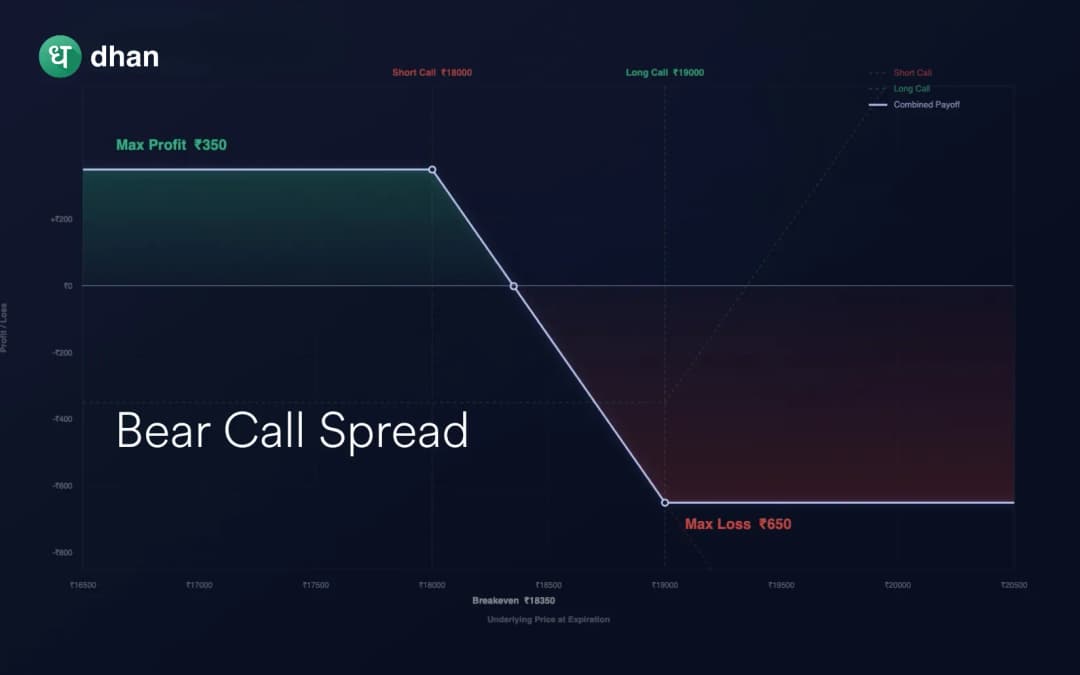
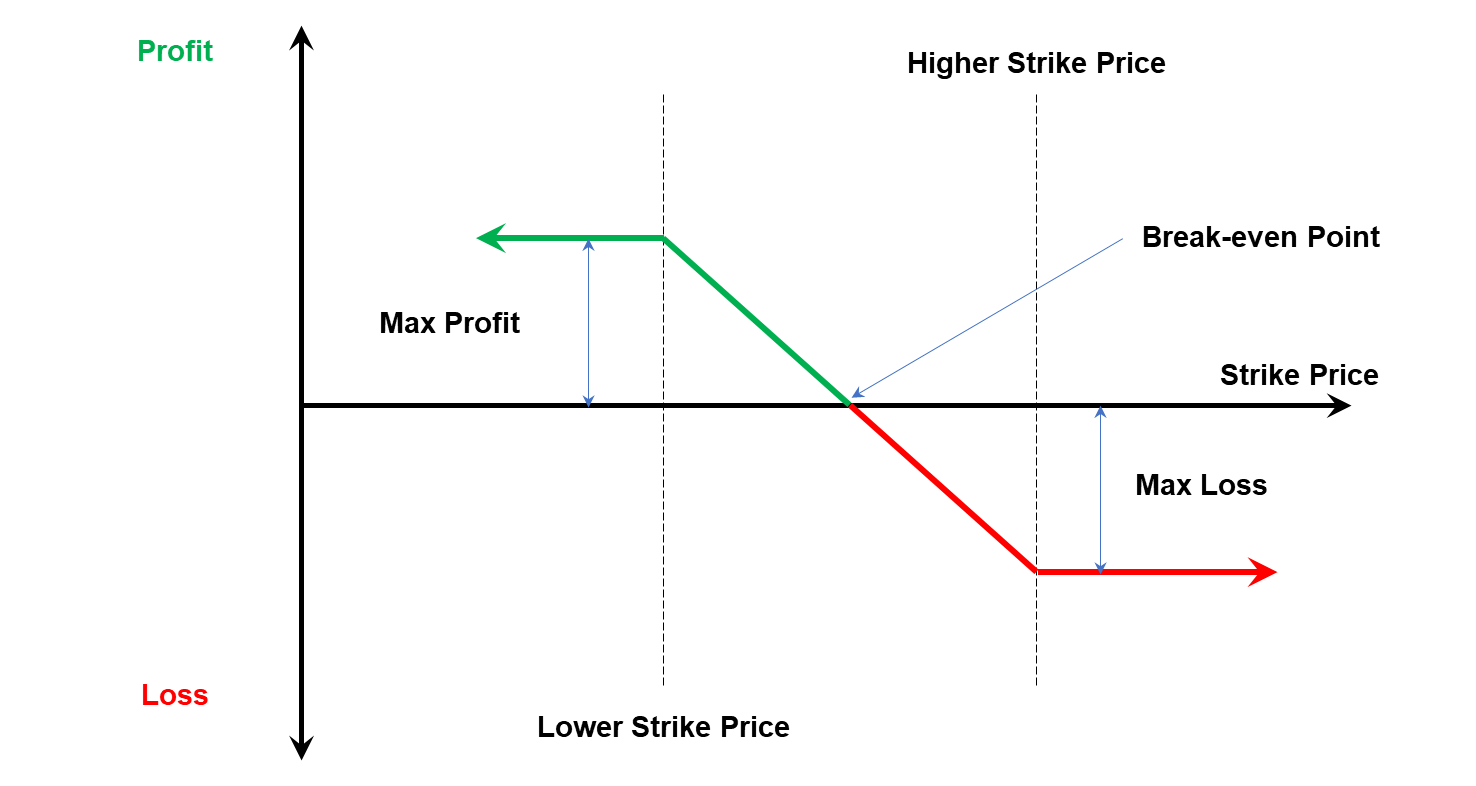
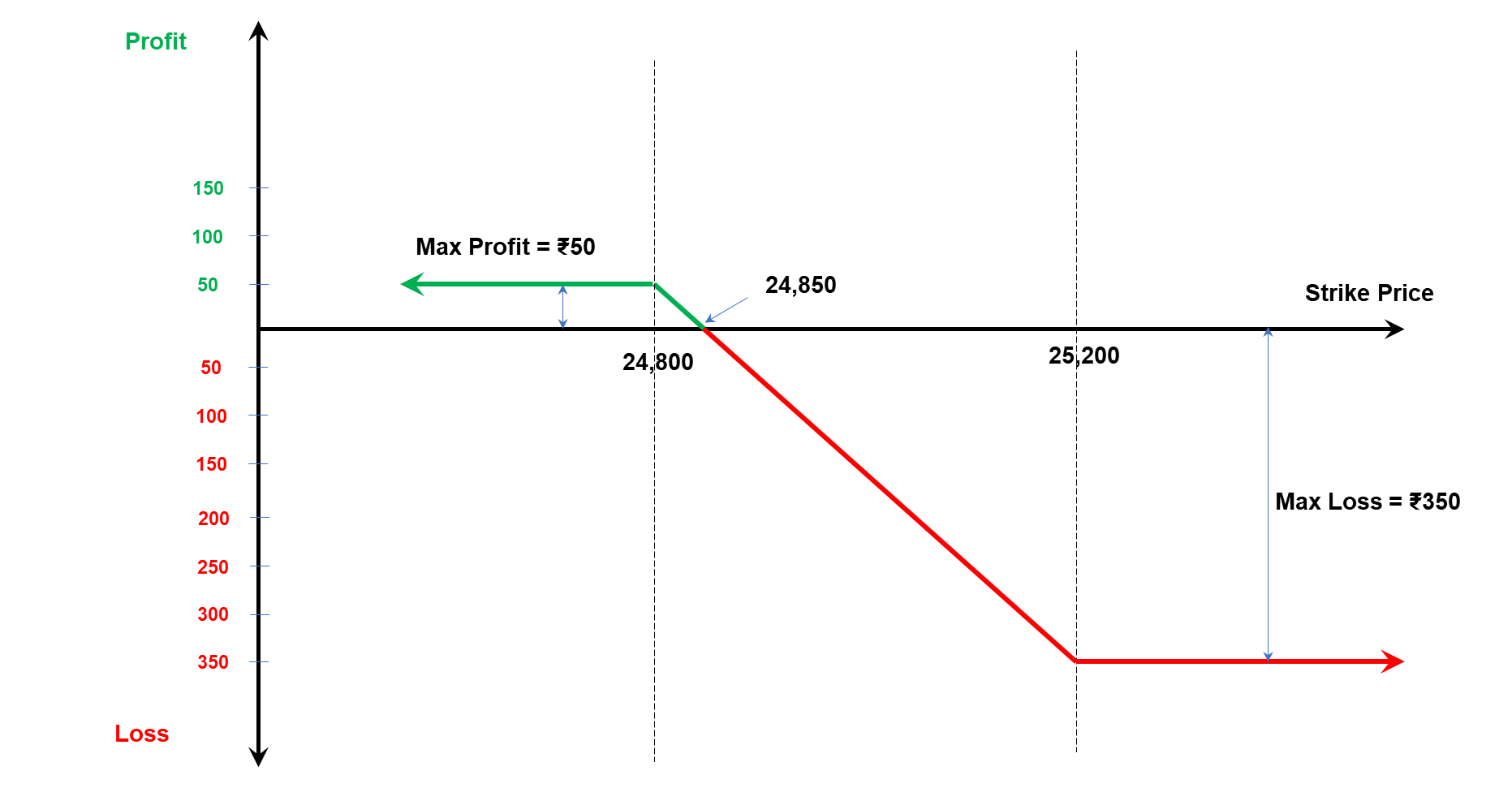
Refer to the figure below for the pay-off diagram of the bear call spread strategy. It clearly states its defined risk nature. On the left side of the chart, where the price is below the lower strike, the line remains flat, indicating maximum profit.
As the price moves upward toward the higher strike, the line slopes downward, showing a gradual reduction in profit and transition into loss. Beyond the higher strike, the line becomes flat again, representing the maximum loss.
Numerical example
Let's understand the strategy with a numerical example. Suppose the index is trading at 24,800 and you believe that it will not move much higher in the near future. So, you sell a 24,800 call option for a premium of ₹110. Also, to manage risk, you buy another call option at the strike price of 25,200 by paying the premium of ₹60.
The Net premium received = 110 - 60 = ₹50.
This is your maximum potential profit as well. Let's see various scenarios with this setup:
Nifty stays below 24,800 at expiry
In this scenario, both options will expire worthless, and you can keep the whole premium as your profit.
Nifty closes between 24,800 and 25,200
In this case, as the nifty crosses 24,800, your profit will gradually decrease. Once it crosses the break-even point, losses will begin to increase.
Here,
Break-even point = 24,800 + 50 = 24,850
So, once Nifty crosses 24,850, losses will start to increase.
Nifty closes beyond 25,200
You will have maximum loss once the Nifty crosses 25,200. Beyond 25,200, your losses will be covered by the bought option. The maximum loss is calculated as the difference between the strikes (400 points) minus the premium received (50), resulting in ₹350.
When to use a bear call spread
The bear call spread is best for the market conditions where prices are expected to remain stable or rise only marginally. It is more effective in range-bound markets where resistance levels are clearly defined. Traders use this strategy when implied volatility is relatively high, as it allows them to collect higher premiums.
This strategy is used as an income-generating strategy, especially in weekly options trading, where time decay plays a significant role.
Advantages of a bear call spread
The advantages of a bear call spread are given below:
- The biggest advantage of this strategy is that you can define your maximum loss by choosing the appropriate strike price.
- The strategy has defined risk, your maximum loss is known upfront. However, the potential loss often exceeds the potential profit, so size your positions carefully..
- Many traders use this strategy to generate income consistently.
- Time decay works in your favour.
- The margin requirement is lower compared to unhedged positions, making it more capital-efficient.
Disadvantages of a bear call spread
Although the bear call spread strategy has many benefits, it has its own limitations as well.
- In this strategy, the profit is limited. Even if the market falls, you cannot make more money.
- While the loss is limited, it can still be substantial if the trade is not managed properly.
- Changes in implied volatility can also impact the pricing of options, affecting the position before expiry.
- Entering the trade too early or too late can reduce the effectiveness of the strategy.
Key factors to consider before trading
The following factors you must consider before trading:
- You must carefully evaluate strike selection, expiry timing, and market conditions. Choosing the right strikes is crucial, as it directly affects the probability of success and the risk-reward ratio.
- You should also consider the implied volatility before executing the trade. Higher volatility generally leads to higher premiums, improving potential returns.
- This should relate strategy to the overall market and not take a position during any major event, which can cause a sharp movement.
Conclusion
A bear call spread strategy is used during a neutral-to-bearish market. In this strategy, you sell a call option with a lower strike price and buy a call option with a higher strike price. It results in a net premium received. This strategy offers limited risk and limited profit.
In a neutral-to-bearish market, this strategy allows traders to generate steady income by controling the risk. To achieve the desired outcome with a bear call spread, one needs to properly understand and execute it in a disciplined manner while monitoring it regularly..
FAQs
What is a bear call spread in options trading?
A bear call spread is an options strategy where a trader sells a call option at a lower strike price and buys another call option at a higher strike price with the same expiry. It is usually used during neutral-to-bearish expectations.
What is the maximum profit in a bear call spread?
The maximum profit is limited to the net premium received. This occurs when the market price remains below the lower strike price at expiry.
What is the maximum loss in a bear call spread?
The maximum loss is calculated as the difference between the two strike prices minus the net premium received. This happens when the market moves above the higher strike price.
When should you use a bear call spread?
This strategy works best in neutral-to-bearish market conditions, especially when there is strong resistance and limited upside expected.
Can you exit a bear call spread before expiry?
Yes, traders usually close the position before expiry to lock in profits or minimise losses. Active management is an important part of this strategy.