Best way to invest in US Stocks as an Indian






It requires the right account, the right path, and tax and compliance orientation.
The US market presents exposure to the world's top names, which don't really exist in Indian markets. Thereby, making the market all the more interesting to include in a diversified portfolio.
Let's examine what actually works for Indian investors.
Direct investment through a foreign brokerage account
A direct foreign account is the clearest option for investors who want ownership and the maximum ability to choose from various options. A number of brokers, such as Dhan, allow international Indians to open accounts and fully trade on NYSE and Nasdaq-listed securities.
How it works:
- Finalise KYC with documents such as PAN, Aadhaar, and proof of address.
- Open foreign brokerage account online.
- Remit money through the RBI's Liberalised Remittance Scheme (LRS) up to USD 250,000 per financial year
- Purchase individual Stocks, ETFs, or pieces of stock directly on US Stock Exchanges.
This path is ideal for investors wanting specific control over their investments and are ready to handle foreign accounts themselves.
Investing through Indian mutual funds and Fund of Funds (FoFs)
For investors who prefer simplicity, domestic mutual funds that invest in US equities are a practical alternative to direct stock ownership. You can access the US market without opening a foreign account or without the need to manage LRS paperwork on each transaction.
There are two common structures under this route:
Foreign mutual funds invest directly in US-listed stocks or index funds without requiring a foreign brokerage account, providing equity exposure without the hassle. FoFs invest in existing overseas mutual funds, including those that follow the S&P 500 or Nasdaq 100, which allows them to invest in the overall US market.
This route is particularly well-suited for salaried investors who want disciplined, recurring exposure to US markets without actively managing a foreign account.
ETFs listed on Indian exchanges, including Nasdaq funds
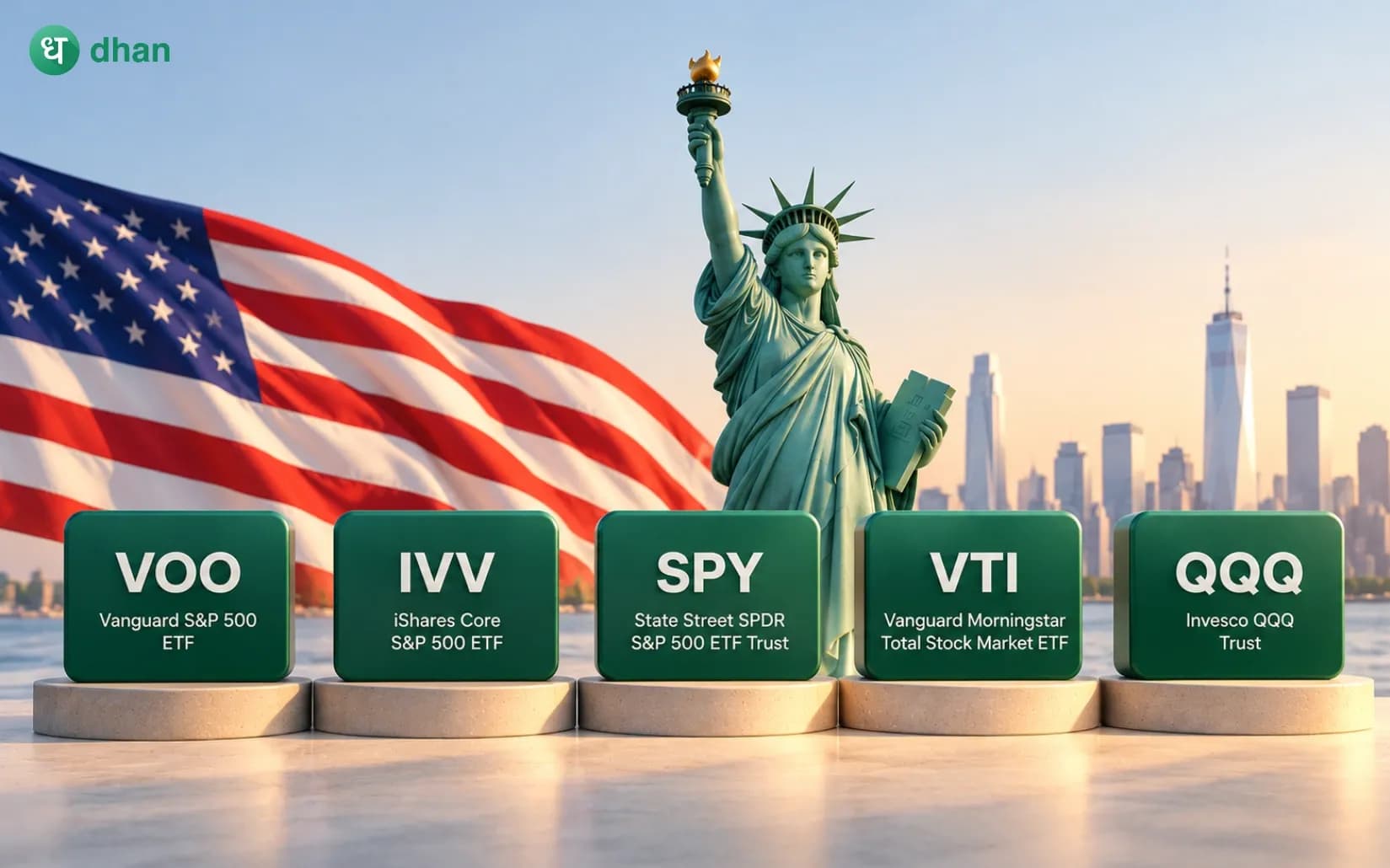
There are a number of ETFs and index funds that are based in the United States and offer Indian investors exposure to various indexes, including the S&P 500, Nasdaq 100, and Dow Jones. These are listed on BSE and NSE and are also like any domestic equity fund from an operational perspective, as they are also traded on the exchange in rupees.
Specifically, Nasdaq 100 ETFs should be studied as a group because they focus all their exposure on the technology sector, which includes companies such as Apple, Microsoft, Nvidia, and Alphabet. If you think that the tech sector will keep on growing and expanding, then a Nasdaq 100 ETF will give you a more targeted and cost-efficient investment.
By comparison, S&P 500 ETFs held 500 companies across 11 sectors, diversifying out to offer more stability and lower volatility. This is the least friction allowing approach for the majority of retail investors with zero foreign account, zero LRS paperwork, and no currency transformation. The advantage is that you won't be buying individual stocks in the USA. You are the owner of units of a fund that reflects an index.
Key factors to evaluate before choosing a route
Every investment path comes with its own set of pros and cons, and the decision on which one to take should rely significantly on your financial background and long-term goals. There are a number of factors to keep in mind before committing:
Investment amount
Larger investors may benefit from a direct brokerage account, while small investors may benefit from mutual funds or ETFs.
Control preference
Direct brokerage means that the person has control over the stock level, but in return for that control, they are giving up simplicity, the way funds do it.
Tax readiness
Compliance requirements are increased with direct investments, as annual disclosure of foreign assets is required to be made in Schedule FA of the ITR.
Currency risk
This is not only true for all routes, but becomes even more apparent on a per-transaction basis in direct brokerage accounts.
Time and involvement
Direct brokerage accounts involve you in researching stocks, keeping an eye on your positions, and taking the initiative to rebalance. Mutual funds and ETFs leave that responsibility to the fund manager.
Repatriation ease
The process of repatriating funds from an offshore brokerage account includes conversion fees, bank processing delay, and documentation for LRS. In the case of redeeming a mutual fund in India, the process takes place within 2-3 business days.
Tax implications you must understand
The tax implications for investing in US stocks are unique and distinct from those on domestic equity investments, and this can lead to penalties or double taxation if it is done wrong. Depending on the route to the US markets, the rules are different.
For direct US stock investments:
- Dividends benefit from a 25% withholding tax in the US, which is reduced under the DTAA between India and the US.
- Short-term capital gains (held under 24 months) are taxed at your applicable income tax slab rate in India.
- The tax rate for LTCG (held more than 24 months) in India is 12.5%.
- Foreign assets need to be disclosed in Schedule FA of your annual ITR.
For Indian mutual funds and ETFs tracking US indices:
- Gains are taxed at a rate applicable to domestic equity or debt funds, depending on the type of fund.
- There is no underlying asset disclosure requirement since the fund deals with underlying ownership, as the fund handles underlying ownership.
Build a US portfolio that works long-term
The best way to invest in US stocks as an Indian is not a single answer. It is the route that aligns with your investment size, tax comfort, and involvement level. Direct brokerage suits active, high-conviction investors who want individual stock ownership, while mutual funds and ETFs serve those who value simplicity and rupee-denominated convenience.
Whichever route you choose, stay invested consistently, disclose all foreign income accurately, and treat US equity exposure as a long-term complement to your domestic portfolio. Not a speculative side bet.