Top 10 AI Stocks in the US






Key Takeaways:
- US hyperscalers are spending over $600 billion on AI infrastructure in 2026, creating upstream and downstream opportunities across chips, cloud, and software for Indian investors.
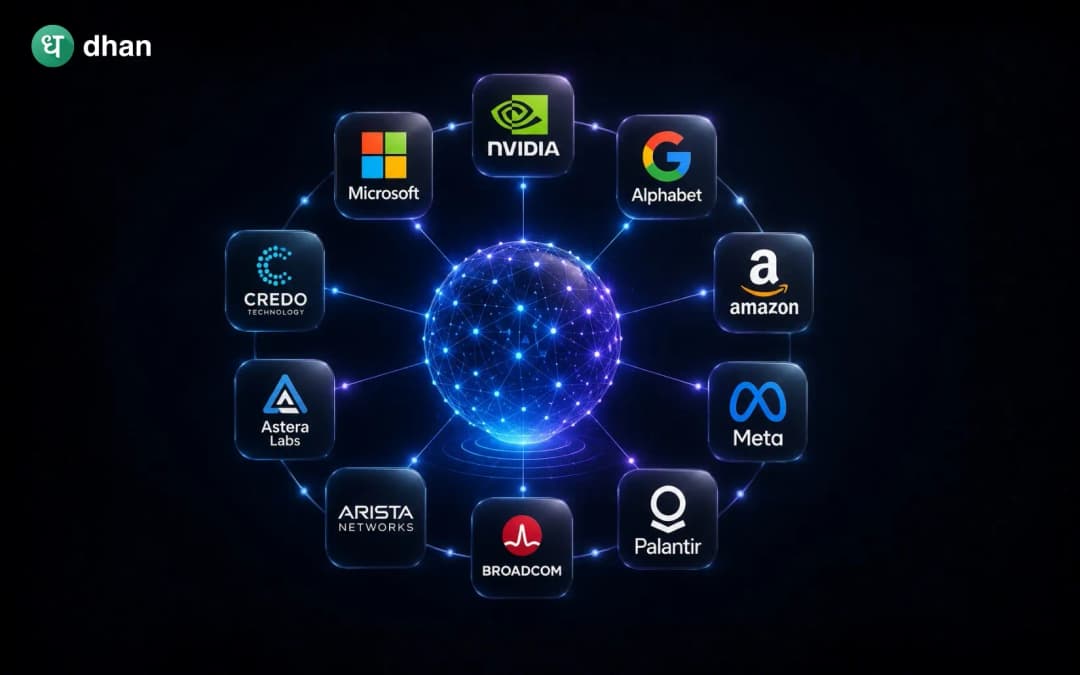
- The ten AI stocks span critical layers: NVIDIA and AMD lead chips, Broadcom handles custom silicon, while Alphabet, Meta, Salesforce, and Palantir drive enterprise and consumer AI applications.
- CoreWeave offers GPU cloud infrastructure, SentinelOne provides AI-native cybersecurity, and Datadog delivers observability tools for AI workloads, each with distinct revenue traction and risk profiles.
- Indian investors can access these stocks via the LRS scheme up to USD 250,000 annually, with 25% US withholding tax on dividends and India-based capital gains taxation.
The US stock market is running on AI capital, and the numbers back that up. Big tech hyperscalers are collectively spending over $600 billion on AI infrastructure in 2026 alone, creating a wide upstream and downstream opportunity across hardware, software, and cloud. For Indian investors researching AI stocks in the US. Understanding which companies sit at the centre of this spending cycle, and which carry real revenue traction rather than just AI branding, matters more than chasing momentum.
Let's examine 10 AI stocks that are generating actual results across chips, cloud, cybersecurity, and enterprise software.
Below are the Top 10 AI Stocks in the US
NVIDIA (NVDA): The leading AI chip supplier
Most of the world's workloads for AI training and inference take place on NVIDIA GPUs. The company is responsible for the biggest share of AI accelerator spending, and GPU purchases are the first component of the capital expenditures plan of every hyperscaler. Apart from chips, NVIDIA has a platform roadmap for the autonomous car and robotics and physical AI that presents several long-term growth opportunities beyond the data centre.
Broadcom (AVGO): Custom silicon and AI networking
Broadcom does not design general-purpose chips like NVIDIA. Instead, it manufactures Application-specific Integrated Circuits (ASICs) designed to specific customer needs, such as custom-made AI accelerators for hyperscalers. It also provides networking solutions for the networking gear that links massive AI clusters, giving it exposure to both the networking and compute parts of AI infrastructure.
Alphabet (GOOGL): AI permeates through its search, cloud, and advertising operations
Unlike most of its peers, Alphabet has had a longer runway since its acquisition of DeepMind in 2014 to construct its AI infrastructure. The Gemini model has been integrated into Google Search, Google Cloud, and enterprise productivity tools. Thereby resulting in AI enhancements that drive revenue across product lines and not just from one product.
Meta Platforms (META): AI powering advertising and consumer apps
Meta's rollout of AI on Facebook, Instagram, and WhatsApp is more widespread than any other company. From content recommendations to creative production, AI has a finger on the pulse in all of its apps, and each advancement of the model has a direct revenue hit. The company's Spark AI model is expected to be a major reason for further enhancing the reasoning power of its advertising systems in the coming quarters.
Palantir (PLTR): Enterprise AI for government and commercial clients
Palantir creates AI platforms helpful to large organisations for handling complex data and automating high-stakes decision-making. Its AIP platform, which was targeted at US defence and intelligence clients, has grown into commercial applications such as manufacturing, health, and financial services. Customer growth has been steady, but over the years, the stock has carried a significant premium over peers, giving rise to valuation risk.
AMD (AMD): A real contender in the AI compute space
With its MI series GPUs, AMD is creating a fair competition with NVIDIA's stronghold in AI accelerators. The leading AI builders, such as OpenAI and Meta, have pledged to deploy AMD, confirming the solution at the top of enterprise demand. AMD's data centre business is its fastest-growing component, and a more competitive AI chip market is structurally better for AMD.
CoreWeave (CRWV): High-growth AI cloud infrastructure
CoreWeave offers AI developers and businesses a need for massive compute without owning a data centre or GPU cloud infrastructure. In the last couple of years, the company has gone from having virtually nothing in the way of revenue to billions of dollars in annual sales, with nearly all of that coming from demand for AI infrastructure. A significant portion of revenues is tied to one hyperscaler customer, posing a significant risk to investors, and in reality, that is a risk.
Salesforce (CRM): Agentic AI within enterprise workflows
Salesforce is shifting its focus from a CRM software firm to an agentic AI platform by introducing its AgentForce product, which automates multi-step business workflows from sales and service to operations. It has an existing customer base of enterprise customers, which provides it with an advantage in distribution over the pure play AI start-ups. Salesforce has a more moderate valuation when compared to its more comparable, large-cap growth stocks in the AI space.
SentinelOne (S): AI-native cybersecurity at scale
SentinelOne's security platform has been designed from the ground up using AI, not simply a collection of machine learning technologies grafted onto an existing system. It automates threat detection, investigation and response for endpoints and cloud environments through its Singularity platform. Enterprise demand for AI-native defence platforms is structurally growing alongside the fall in the cost of launching high-end cyberattacks with AI technology.
Datadog (DDOG): Monitoring and observability for AI workloads
Datadog provides the infrastructure monitoring and analytics tools that engineering teams use to build, deploy, and manage AI applications at scale. As enterprises move from AI experimentation to production deployment, the need for robust observability tooling grows alongside it. Datadog's AI-native customer segment has been its fastest-growing cohort, and a rising share of its revenue is now coming from customers building AI-first products.
How to approach AI stocks in the US as an Indian investor?
Indian investors can access US-listed AI stocks through the Liberalised Remittance Scheme (LRS), which allows remittances of up to $250,000 per financial year. Several Indian brokerage platforms offer direct US stock investing through this route. When choosing a platform, look for one that offers fractional share investing, low foreign exchange conversion costs, and clear disclosures on remittance fees, since these charges erode returns over time.
On the tax side, dividends from US stocks are taxed at 25% at source under the India-US Double Taxation Avoidance Agreement (DTAA), and you can claim credit for this against your Indian tax liability. Capital gains from US stocks are taxed in India as per your applicable income slab for short-term holdings, or at 20% with indexation for long-term holdings. Filing Form 67 before your ITR deadline is mandatory to claim the foreign tax credit.
Build your AI stock watchlist before you invest
The 10 AI stocks in the US covered here span chips, cloud infrastructure, enterprise software, and cybersecurity, and each one has revenue data that supports the AI thesis. That said, valuations vary sharply across this list, from NVIDIA's reasonable forward multiples to Palantir's aggressive pricing.
Studying quarterly earnings, competitive positioning, and concentration risks before committing capital is non-negotiable. The opportunity to participate in the AI infrastructure cycle from India is more accessible than ever, but the quality of your research will determine the quality of your returns.