How to pledge ETFs for margin: Rules, benefits, and risks explained


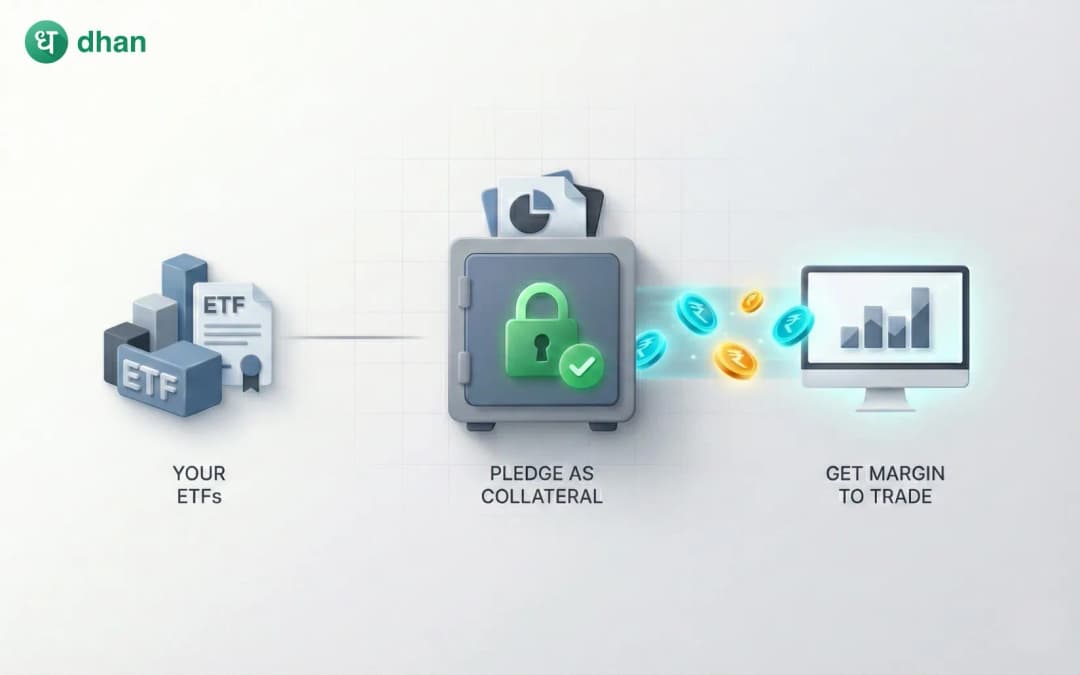


Using your Exchange Traded Funds (ETFs) as collateral for margin is a smart way to gain more trading power from the ETFs you already own. You can use your existing ETF holdings as collateral to get the extra margin you need for new trades, without having to sell them.
It can boost your buying power, but it also comes with rules, benefits, and risks you should know before you dive in.
In this blog, we will explore the process of pledging and unpledging ETFs, together with their risks and benefits.
Understanding margin pledge
Margin trading pledge is a feature that enables traders to use their existing ETF holdings as collateral to get additional margin for trading. On Dhan, traders can pledge various types of securities, including ETFs, and get instant margins across all trading segments. This means that instead of selling their ETF holdings to free up funds, traders are leveraging them to make new positions in the market. Dhan allows instant pledge margin facility on more than 100+ ETFs.
Dhan charges a nominal fee for margin pledge ETF transactions: The charges for margin pledge are Rs 15 per transaction per ISIN plus GST.
The eligibility to pledge a specific ETF is determined by different factors, which include regulatory guidelines and the internal policies at Dhan. Some examples of ETFs that are eligible for pledging on Dhan are Nippon India Gold ETF, Kotak Nifty 50 ETF, and Kotak Nifty IT ETF, among others.
How to pledge ETFs?
Pledge ETFs on Dhan is an easy process, and the following steps will help in doing so.
- Login: Open the Dhan application and log in with your credentials.
- Pledge Stock & MF: In the 'Money' section, click on 'Pledge Stock & MF' to pledge your ETFs.
- Select Holdings: On the 'Money' page, there's an option leading to "Get Instant Margin". It shows the margin benefit that you can avail by pledging your ETF holdings.
- Select ETFs to Pledge: Choose particular ETFs from your portfolio that are eligible and that you want to pledge.
- OTP Verification: On selecting any ETF, a CDSL web page will open, where you need to enter the OTP that you received on your phone and email.
- Confirmation: After confirmation through OTP, your pledge request will be sent, and you will get confirmation of the added pledge margin benefits within a few minutes.
For ETFs, the pledging happens instantly on Dhan, and the margin benefits get credited in a few minutes.
How to unpledge ETFs?
Unpledging of ETFs is similar to the pledging process and involves the following steps:
- Login: Open the Dhan app; log in to your account.
- Access the 'Money' Section: Proceed to the 'Money' section and then click on "Get Instant Margin".
- View Pledged ETFs: Click "Pledged" to see the list of all the ETFs you have pledged.
- Choose ETFs to unpledge: You are at liberty to choose the ETFs to unpledge any time between 9 am and 3 pm.
- OTP Verification: Confirm the unpledge request and open a CDSL page to enter the OTP.
- Processing: Your ETFs will be unpledged by the next working day after validations.
NOTE: You cannot unpledge ETFs on the same day they were pledged, or if the pledge ETFs have already been used for leverage.
Benefits of pledging ETFs for margin
Pledging ETFs for margin on Dhan provides several advantages to traders, like the following:
- Instant Margin: Traders can get immediate pledge margin on a wide range of ETFs, thus being able to use the funds instantly for trading.
- Increased Trading Capital: Pledging ETFs allows traders to make use of their existing holdings as collateral in order to get more margin for trading, hence increasing their purchasing power.
- Flexibility Across Trading Segments: The instant margins received through pledging can be used by traders for trading in all segments.
- BTST and Intraday Trading: Pledged margin can also be used for Buy Today Sell Tomorrow trading and intra-day trading.
- Interest-Free Margins: Intraday traders are offered interest-free margins on BTST trades.
- Optimise Existing Holdings: Traders can pledge their holdings instead of selling them to take new positions, hence reaping the benefits from market fluctuations with only a limited amount of initial funds.
Risks associated with ETFs pledging
While beneficial, pledging ETFs for margin comes with significant risks. Here are some risks associated with the pledging of ETFs:
Amplified losses
When traders pledge their existing holdings of the ETF, along with magnifying the gains, they also magnify the losses. Suppose the market moves against the trader's strategy, then their losses become considerable due to extra pledge margin and can even exceed their initial investment.
Margin calls
If there is a sharp decline in the value of pledged securities, then the broker has the right to issue a margin call. It means traders would need to add more funds or securities to meet the minimum margin requirements. Inability to fulfill this requirement may lead to forced liquidation of their holdings.
Haircut impact
Sometimes, the haircut applied reduces the actual margin received; this reduces leverage during volatile periods.
Market volatility
Sudden and erratic market fluctuations can quickly diminish the value of the pledged assets, therefore increasing traders' portfolio risk and the likelihood of margin calls.
Liquidity challenges
Some ETFs, especially less liquid ones, might not be easily liquidated during forced sale scenarios.
Interest on borrowed funds
Pledged margins incur ~0.0438% daily interest on utilised amounts, which can erode profits over time if the trade doesn’t yield sufficient returns.
To sum up
Pledging ETFs for margin on Dhan can be a potent tool for traders to optimise their capital and expand their trading opportunities. Traders can use their existing ETF holdings to leverage various trading strategies. But this advanced strategy comes with inherent risks of amplifying the losses along with gains, and also presents the risks of margin calls and forced liquidation if the margin requirements fall below the required level.
Therefore, it is important that traders know the risks involved and maintain sufficient capital to be able to cover any margin calls that may arise, keeping in mind one's risk appetite before using the margin pledge facilities.
FAQs
1. What is considered a "haircut" in the case of pledging of ETFs for margin?
Haircut refers to the percentage reduction in the market value of securities, such as ETFs, if pledged as collateral for margin. The concept of this reduction is to account for the volatility and risk of the security, which would imply that the margin traders will get less than the 100% market value of their pledged ETFs. For example, assume that your ETFs are worth Rs 1,00,000, and a 20% haircut is applied; the broker may only lend against Rs 80,000.
2. Are all ETFs pledgeable for margin on Dhan?
No, not all ETFs are pledgable. Only approved ETFs are available for pledge margin benefit on Dhan. The eligible ETFs are decided by Dhan along with exchanges, and hence it is important to check the approved ETFs list before pledging a particular ETF.
3. What if the value of the pledged ETFs starts falling sharply?
If the price of the pledged ETFs falls below a prescribed level, called the maintenance margin, then the broker will declare a "margin call". This requires the trader to add more funds or pledge additional securities in order for their account to be put back at the necessary level. If they cannot meet a margin call, then brokers may sell some or all of the pledged ETFs, often without consulting, to cover the shortfall.
4. What are the pledging charges for ETFs on Dhan?
Yes, Dhan charges a certain nominal fee for pledging shares. The charge is Rs 15 per request per ISIN plus GST. These charges are part of the overall cost of using margin benefits.
5. What is the minimum cash requirement using pledged ETFs for F&O trading in India?
The Indian exchange regulations, however, require that 50% of the margin for F&O positions should be in cash or cash-equivalent collateral, and the remaining 50% can be in non-cash collateral like pledged ETFs.