


Dividends in Mutual Funds








Have you ever wondered what happens to any dividend gain you receive from your mutual fund investment? Most people consider dividends or IDCW as “additional gains,” but in reality, dividends are just a part of the gains earned by the mutual fund itself.
This article helps you understand what happens to dividend in mutual fund and how to make the most of them.
What happens to Dividends in Mutual Funds
When you invest money in a mutual fund, you essentially buy units of the mutual fund scheme, which represent your share of the total investment in the mutual fund. The mutual fund makes money in various ways, including interest earned on its debt securities, income in the form of dividends from its stock investments, and capital gains from the sale of its securities at a profit.
Some of this money earned by the mutual fund can be paid out as income if you have opted for the income distribution option.
In India, the former term used for the Dividend Plan is now officially known as IDCW or Income Distribution cum Capital Withdrawal, coined by the Securities Exchange Board of India (SEBI), which is more in line with the reality that the dividends distributed back to the investors are not necessarily “extra” income earned by the fund or the investor in the form of capital.
It is important to understand the difference between realised and unrealised gains:
- Realised gains are the profits that have been made by the fund. These include interest received, dividends received from stocks, and money received from selling investments. These can be distributed to investors as dividends (IDCWs).
- The unrealised gains represent the profits which have not been earned by the fund. The unrealised gains remain with the fund and therefore impact the NAV. They cannot be distributed as dividends.
This distinction helps readers understand that dividends received by a mutual fund investor (IDCW) are actually earned and received by the fund and not the unrealised appreciation in the value of the portfolio.
How Mutual Fund Dividends are Generated and Distributed
The manner in which mutual fund dividend income (now IDCV) is distributed is as follows:
- Income and gains accumulate: As the fund makes money on its investments in the form of interest, dividends on equity investments, or profits on the sale of securities, the income and gains build up.
- Declaration of IDCW: The fund’s trustees may declare IDCW at regular intervals, such as monthly, quarterly, semi-annually, or annually. This entails determining the amount of money to be distributed per unit, as well as the record date/ex-dividend date, which determines the eligible shareholders.
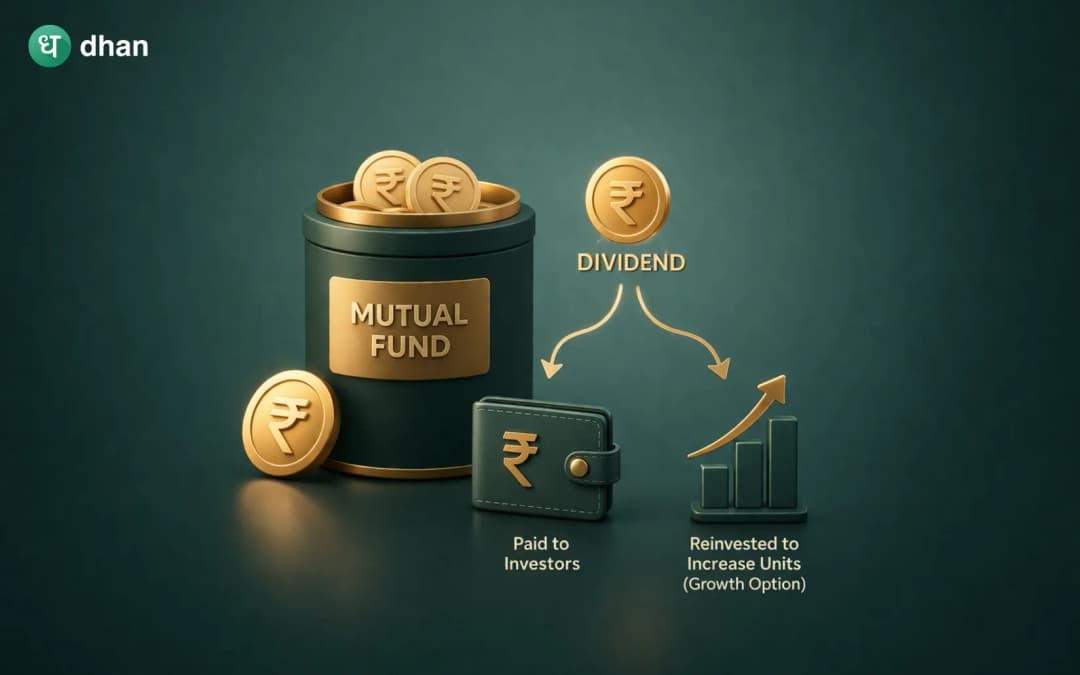
- Payout or reinvestment: If the investor has opted for the payout option of IDCW, the amount is credited to their bank account on the due date. If you opted for the IDCW reinvestment option, the amount will be automatically reinvested in more units of the same fund at the new NAV.
- NAV adjustment: After the payment of the IDCW, there is a general reduction in the NAV of the mutual fund. This is because the amount has been paid out from the mutual fund’s portfolio. This is just an adjustment for the IDCW payout, and it does not mean you are losing any investment. It is simply your investment reduced by the IDCW payout.
Dividend Options - Payout, Reinvestment, and Growth
When you invest your money in a mutual fund, you are usually asked to select an option for how your earnings are going to be handled. These options determine how your dividend affects your investments.
Dividend payout option
In this plan, the announced dividend is paid in cash directly into your bank account on a stated date. This is beneficial for investors who require a regular return on their investments.
Dividend reinvestment option (IDCW Reinvestment)
Instead of receiving the money, the number of shares of the same mutual fund is automatically increased by investing the dividend amount at the new NAV after the payment of dividends. In the long run, this would increase the number of shares and thus increase the overall return on investment through a compounding effect.
Growth option
Under this option, the dividend is not paid out. Instead, the amount is added to the mutual fund corpus, and the investment increases solely through the rise in the NAV.
Note: The dividend payout and dividend reinvestment options fall under the category of IDCW or Income Distribution cum Capital Withdrawal. It is defined as the mechanism of paying dividends or capital to the investors.
Dividends Payment Impact on NAV
The dividend has a direct impact on the NAV in mutual fund scheme. Since the dividend is a distribution of assets of the mutual fund scheme, it reduces the NAV of the mutual fund scheme by a similar amount.
For example, if the NAV of the mutual fund is ₹100, the fund pays out a dividend of ₹5 per unit, the NAV will be adjusted to around ₹95.
Although this may seem like a loss, it is only an accounting measure. The investor either receives the ₹5 as cash or receives an equivalent value through reinvestment in his/her units. The overall value of the investment does not change significantly at the time of distribution.
Impact of Dividend Payments on Wealth
The most common myth is that dividends increase the fund's investment returns. However, the truth is that the dividend is already part of the fund’s total return.
When a dividend is received, it simply means that the amount is being taken away from the fund and given to the investor. Whether it is taken in cash or reinvested, there is no gain in wealth.
The correct way to look at an investment is by total return, which is the appreciation of the NAV and dividends received or reinvested.
Taxation of Mutual Fund Dividends
As per the current tax regulations in India, the dividends received (IDCW) by you from your mutual fund investments will be included in your income and will be taxed at the applicable tax rate of your income tax slab. The tax will be applicable irrespective of whether you receive the dividends or go in for the option of reinvestment. This is an amendment to the Dividend Distribution Tax (DDT) system, whereby taxes were deducted at source on behalf of investors.
However, if the total amount of dividends (IDCW) received by you in a year is more than ₹10,000, the mutual fund will deduct TDS at the rate of 10% before actually paying the dividends.
In the case of the growth option, you will not be required to pay taxes on the dividends at the end of each year. The tax will be deducted only at the time of redemption of the investments in the form of capital gains..
Evaluate Mutual Funds based on Dividends
Not all dividends are equal; here’s how you can make sure you get consistent and sustainable dividend income from your investments:
1. Don’t rely on dividend yield alone
The investor should not rely only on the dividend yield to measure the performance of the fund. It is true that a high dividend yield is always attractive, but it should not be the only reason.
2. Examine historical track record
You also need to check the history of dividend payments of the mutual fund and whether it has the potential to increase dividend payments over a period of time.
3. Align dividend strategy with your goals
Your investment objective will determine your selection criteria, such as:
- If you are an income seeker, look for funds that provide regular dividends
- If you are a growth seeker, look for the option to reinvest the funds
4. Evaluate total return, not just yield
While yield is a critical factor, the best way to assess the performance of the mutual fund is to look at the total return, which includes the gain in the NAV and the dividends received or accrued.
Dividend Reinvestment vs. Payout
With regard to long-term investments, dividend reinvestment and growth options may prove to be more effective than payout options. This is because, in reinvesting dividends, you are buying more units of the fund, and thus, your money is growing faster through the power of compounding. The growth options go one step further in helping your money grow faster by reinvesting all the dividends and deferring taxes.
Payout options give you money in hand, and thus, they are suited for regular income and for meeting immediate needs. However, when you choose to receive dividends in the form of payouts, you are reducing the power of compounding for your investments.
Key measures for dividend-focused investing
When it comes to investing in dividend-paying funds, here’s how you should approach the investment:
- Check for sustainability rather than yield: Funds with very high dividends may be taking on extra risk or distributing income in a way that isn’t long-term viable.
- Avoid timing tricks: There is no point in buying funds just before the ex-dividend announcement, as the overall tax and fund value swings will offset the benefits.
- Maintain portfolio balance: It is always important to maintain a balance of investments; you should not only invest in dividend yield funds but also in other types of funds depending on your financial goals.
- Review regularly: It is essential to keep track of the performance of the funds, dividend consistency, and your personal financial needs to ensure proper alignment of investments.
Conclusion
It is important to understand that mutual fund dividends are not an additional profit but only a return of the fund’s own earnings. Dividends have an impact on NAV, taxation, and long-term investment returns and need to be assessed as part of the total return rather than in isolation.
The choice between payout, reinvestment, and growth options is based on investors’ objectives, their tax status, and their investment time horizon. Proper planning and choosing the right option of dividend payment, along with monitoring the investments, can convert the dividend option of mutual funds into a powerful tool for wealth creation.
FAQs
Can consistently high dividend-yield funds indicate hidden risks?
Yes. It is possible that the high-yielding funds might be taking higher risks or paying out unsustainable dividends. Careful analysis of the fund's asset allocation, expense ratios, and consistency is essential.
Do dividend payments have any impact on the portfolio rebalancing strategy?
Yes, dividend payments can be useful in portfolio rebalancing. This is due to the cash inflow received. This cash inflow enables the portfolio to be rebalanced without having to sell existing units. In addition, reinvesting the dividend increases the portfolio’s exposure to the same fund.
How should investors interpret irregular or skipped dividends?
Irregular or omitted dividend payments should not be seen as a bad sign for mutual funds. It is possible that mutual funds only distribute realised gains and therefore omitted payments may be due to a lack of opportunities to book profit rather than poor performance of the mutual fund.
What is the key difference between dividend payout and growth option?
Payout provides regular income, whereas the growth option allows the income to be invested with a focus on capital growth.