What is an Arbitrage Fund?








As an investor, you might be looking for lucrative avenues that offer better returns compared to savings accounts or fixed deposits without taking on high risks. Particularly, you might want to put away some surplus money or prefer stability over aggressive growth. In these circumstances, arbitrage funds emerge as a viable investment option.
With arbitrage funds, you get an opportunity to invest in the equity market while keeping risk low. The goal of these funds is to generate a steady income, taking advantage of differences in price across various market segments, rather than depending on the direction in which the market is moving. The returns may not be too high, and the strategy prioritises consistency along with protecting your capital.
In this blog, we have comprehensively discussed what is arbitrage fund. Read on to understand the kind of returns investors can enjoy, along with the risks associated.
Arbitrage fund explained
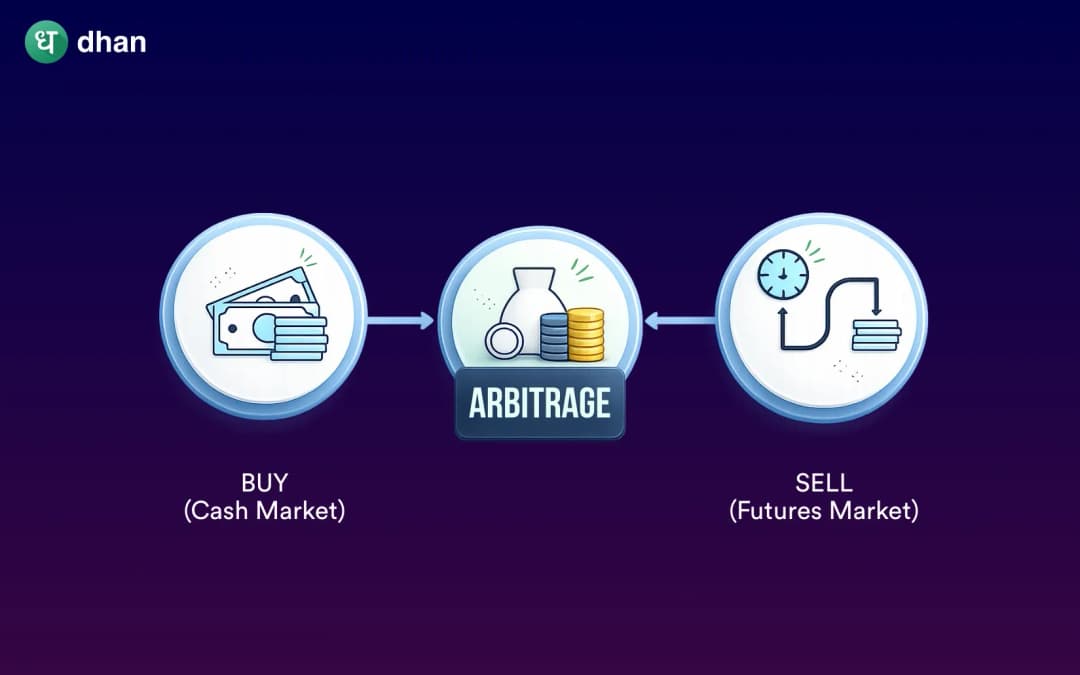
An arbitrage fund is a kind of mutual fund through which investors can generate returns by taking advantage of the price differences across different asset markets. In general, this difference exists between the cash markets and the futures markets.
When a stock is available at a lower price in one market and a higher price in another, the mutual fund buys it at a lower price and sells it at a higher price simultaneously. Therefore, profit comes from the price difference when the trade is executed efficiently.
Arbitrage funds are a type of equity mutual fund, as a large portion of their portfolio is connected to equities and equity derivatives. However, they are different from typical equity funds since they are not dependent on the appreciation of the stock price to generate returns.
Now that you know what an arbitrage fund is, you should know who they are meant for. Those seeking relatively stable returns with lower volatility can choose an arbitrage mutual fund. Often, short to medium-term investors use these funds, particularly when markets are uncertain.
How arbitrage funds work
The same stock sometimes trades at different prices in the cash market and the futures market. This difference occurs as a result of factors like:
- Demand
- Interest rates
- Time to expiry
- Market expectations
For example, a stock may be trading at ₹1,000 in the cash market and ₹1,020 in the futures market. This ₹20 gap creates an arbitrage opportunity.
An arbitrage fund may take advantage of the gap by buying the stock in the cash market and selling it in the futures market at the same time. Both these transactions take place together. This implies that the profit is largely locked in, regardless of the direction in which the price of the stock moves later. As a result, arbitrage emerges as a neutral strategy in the market. Fund managers do not focus on when the prices may rise or fall. They try to capitalise on the price difference of stocks.
Role of a fund manager
Experienced fund managers handling arbitrage mutual funds scan the market for potential opportunities. Some of the crucial factors that impact the returns are:
- Speed of execution
- Transaction costs
- Discipline of the fund manager
Efficient fund managers prioritise consistency and small gains, rather than large profits that often look speculative.
Types of arbitrage opportunities used by funds
When you understand what an arbitrage fund is, you must also be interested in knowing the types of arbitrage opportunities these funds use. Some of these opportunities are more common than others.
Cash-futures arbitrage
Cash-future arbitrage is the most extensively used strategy. Fund managers buy stocks in the cash market and sell them in the futures market to capture the price spread.
Index arbitrage
Here, returns are generated from the differences between index futures and the underlying index stocks.
Dividend arbitrage
The dividend arbitrage strategy involves capitalising on price movements when dividends are announced. However, this strategy is used less frequently.
The cash-futures arbitrage strategy is preferred by fund managers as it offers:
- Better liquidity
- Clearer pricing
- Lower risk during execution
How much return should investors expect from arbitrage funds?
As an investor, you must understand that the purpose of arbitrage funds is to deliver steady and predictable returns. Those seeking high growth might not find these mutual funds suitable for them. The returns from arbitrage funds over short to medium periods generally come under a moderate range. This is often similar to low-risk debt-oriented instruments.
The returns depend on the availability of arbitrage opportunities. If the market remains highly volatile, the price differences between the cash and futures markets tend to widen. This creates more opportunities for fund managers. However, when the market remains calm, the spreads may narrow. During these periods, the returns may be lower.
Arbitrage funds may sometimes offer slightly better outcomes compared to liquid or ultra-short-term funds. However, investors do not get returns like the equity market from arbitrage funds. These mutual funds work best to preserve your capital while offering modest growth potential.
Risk profile of arbitrage funds
Compared to equity funds, arbitrage funds involve lower risk. This is because the strategy of this fund does not depend on the direction of the market. Since fund managers take buy and sell options simultaneously, the exposure to price movements is limited.
However, arbitrage funds are not completely free from risk. Some of the concerns include:
- Execution risk
- Liquidity issues
- Unexpected disruptions in the market
These factors can affect the outcomes. In rare cases, arbitrage opportunities can dry up, which may result in fluctuations in returns.
Compared to equity funds, arbitrage funds experience much lower volatility. Naturally, conservative investors looking for market-linked returns without excessive volatility find these funds a good choice.
Who should invest in arbitrage funds?
Arbitrage funds may be suitable for you under the following circumstances:
- You want to park surplus money for a short to medium term
- You prioritise stability over high returns
- You are looking for an alternative to traditional options involving low risk
- You don’t want to invest in volatile equity funds
However, arbitrage funds are not ideal for creating wealth over the long term. Therefore, investors must understand what an arbitrage fund is and its purpose before opting for these funds.
How to choose a good arbitrage fund
Investors must focus on the following aspects while choosing a good arbitrage fund.
- Funds with a lower expense ratio can help you improve your net returns
- Funds that are extremely small or excessively large may face challenges during execution
- Consider the fund consistency, choosing one that performs stably across different phases of the market
- Invest in funds with smoother return patterns and limited volatility
The final call
With arbitrage funds, you get a simple strategy to earn steady returns by capitalising on the inefficiencies of the market and not its direction. They serve as a useful tool for investors who prioritise protecting their capital over aggressive growth.
Arbitrage funds should not replace equity funds for long-term goals. However, they fit well in a balanced portfolio for short to medium-term investment purposes. Now that you know what an arbitrage fund is and how it works, you can set realistic expectations and invest efficiently.
FAQs on arbitrage fund
Are arbitrage funds completely risk-free?
No. Arbitrage funds involve low risk, but execution issues and market disruptions may affect returns. They are safer compared to equity funds, but not completely free from risk.
Can arbitrage funds give negative returns?
Negative returns from arbitrage funds are rare. However, it is possible when arbitrage opportunities are low or when the market comes under sudden stress.
Is an arbitrage fund better than an FD for short-term goals?
It depends on your need for liquidity and expectations. Arbitrage funds offer flexibility, while FDs provide certainty.
How long should one stay invested in an arbitrage fund?
Arbitrage funds are suitable for short to medium horizons. Typically, you can stay invested in these funds for a few months or up to a year.
Do arbitrage funds work in all market conditions?
Arbitrage funds perform the best when markets are volatile. However, in calm markets, the returns may be lower as price differences tend to be fewer.