Straddle Option Strategy explained: Can you really trade both sides?







What if you could profit whether the market moves up or down?
Many traders try to predict the market direction. Professional traders typically examine market volatility. They try to gauge the market's movement. They employ a straddle option strategy to profit from both sides.
The straddle option strategy is one of the most popular neutral option strategies. This strategy is usually used during budget announcements, central bank policy meetings, corporate earnings, expiry days, or during breakout setups.
In this article, we will try to answer the above question and explain how traders use this strategy.
What is a Straddle Option Strategy?
A straddle is an option strategy where a trader takes two positions with one put option and one call option with the same strike price and the same expiry.
There are two types of straddle option strategies:
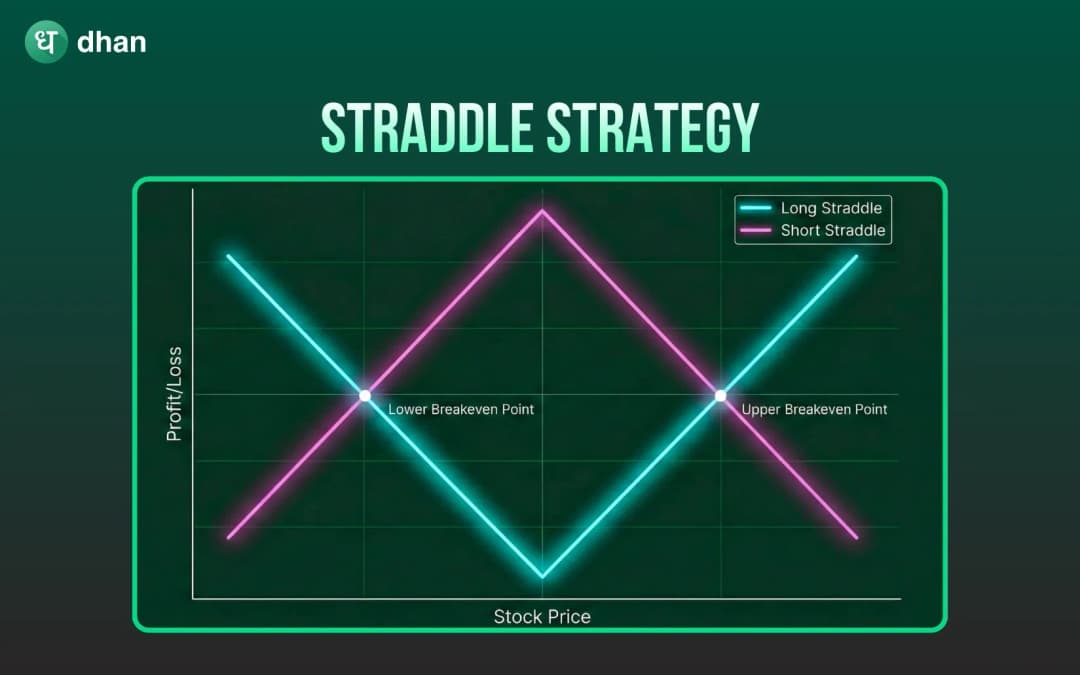
- Long Straddle - In this type of straddle, traders buy one call option and one put option with the same strike price and same expiry.
- Short Straddle - In this type, traders sell one call option and one put option with the same price and expiry.
In both types, options are placed at the At-The-Money (ATM) strike. This strategy is not dependent on the direction. It depends on the volatility, which is how much the price moves. We will explore how these strategies are dependent on volatility in the upcoming sections.
Long Straddle Option Strategy
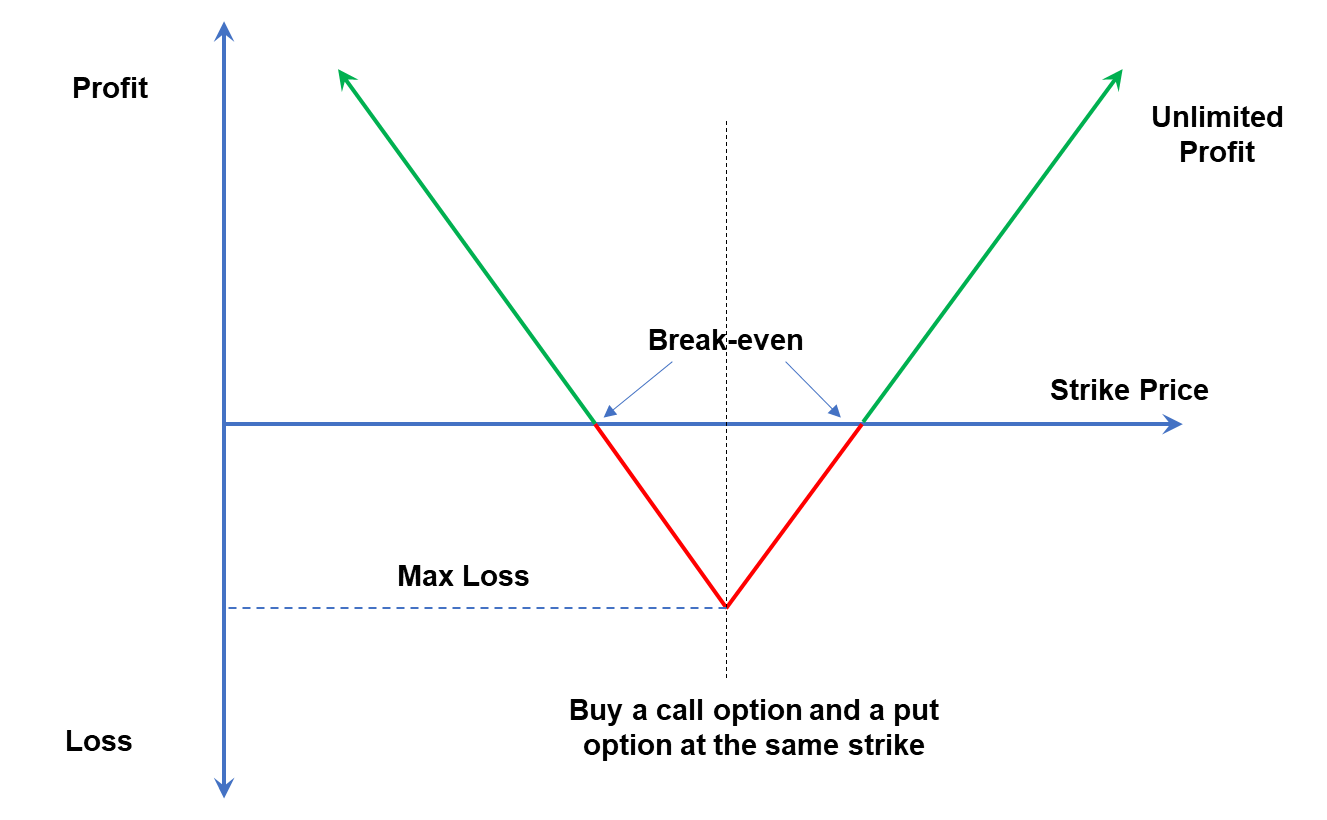
This strategy is used to profit from the high volatility. It is a non-directional, delta-neutral strategy that benefits if the price moves sharply in either direction. In this strategy, traders buy both put and call options at the same ATM strike price with the same expiration date. The maximum loss in this strategy is limited to the premium paid at the time of buying the options.
Structure:
- Buy one ATM call option
- Buy one ATM put option
For example,
Suppose the nifty is trading at 22,000, and the call premium for the ATM price is ₹200, while the put premium is ₹180.
So, the total premium you paid to buy the put and call option = ₹380
Your maximum risk is 380.
Let's calculate your break-even points,
Upper Break-even = 22,000 + 380 = 22,380
Lower Break-even = 22,000 - 380 = 21,620
The market needs to move beyond these prices to make your position profitable. If the market stays between 21,620 and 22,380 till expiry, then you will lose the money.
This strategy has the following key characteristics:
- It has limited risk and unlimited profit potential.
- This strategy is ideal during the volatility expansion.
- Although it is a limited risk strategy, time decay always works against you.
- As you are buying ATM options, the total premium paid can be expensive.
Short Straddle Option Strategy
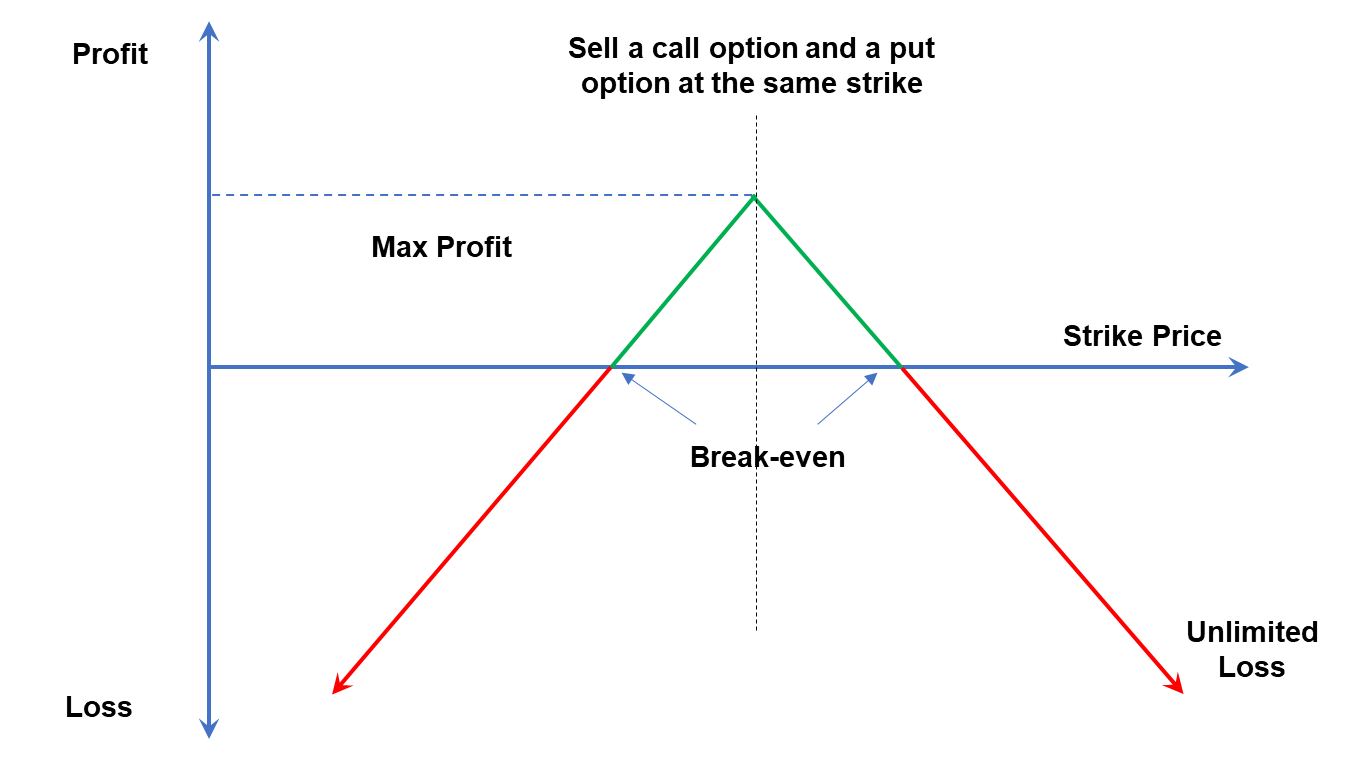
When you expect the sideways market, this strategy is very useful. A short straddle is a neutral, high-risk option strategy. In this strategy, the traders profit from the time decay and the stable underlying price. The maximum profit is the premium you receive by selling the two ATM call and put options. If the market makes a sharp move in any direction, it will cause a huge loss, theoretically unlimited.
Structure:
- Sell 1 ATM Call
- Sell 1 ATM Put
By using the previous example:
You have to sell one 22,000 call option for ₹200 and one 22,000 put option for ₹180. You will receive a net premium of ₹380, which is your maximum profit.
This strategy has the following key characteristics:
- Time decay works in your favour.
- Best strategy for range-bound markets.
- It offers unlimited risk on sharp market moves on either side.
- This strategy also requires high margins.
Can you really trade both sides?
This is where many beginners misunderstand. The reality is you are paying double the premium to buy two options. If the market moves very little, you will lose both premiums. Even if it moves slowly, time decay will eat your profit.
One thing traders need to understand is that this strategy is not a directional strategy, but the results are dependent on the volatility. In order to win the long straddle strategy, the move must be big and fast. Otherwise, you will lose money.
Difference between Straddle and Strangle
Many traders get confused between a straddle and a strangle. Refer to the table below for the key difference between these two.
Risk management rules you need to know
For long straddle:
- It is very important to enter the trade when IV is comparatively low.
- Avoid entering a long straddle when implied volatility is already extremely high before a major event.
- Consider partial exit after a strong move.
- Use event-based logic.
For Short Straddle:
- Use stop-loss at all times.
- For protection, think about switching to Iron Fly.
- Keep a healthy margin.
- Don't hold overnight when things are unclear.
Modern trading platforms like Dhan allow you to easily construct this strategy and provide a visual payoff chart that clearly shows your potential profit and loss.
Advantages and disadvantages
A straddle option strategy involves buying (long) or selling (short) a put and a call with the same strike price and expiration. But both strategies have their own positive and negatives.
Advantages
- There is no need to predict the market direction.
- You gain profits through volatility.
- In the case of a long straddle, maximum loss is fixed.
- It is the best strategy for event trading.
Disadvantages
- Since a straddle involves buying two ATM options, the premium cost is higher compared to other strategies.
- Short straddle has unlimited risk.
- For a long straddle, time decay works against the trade.
- The strategy requires a good understanding of Greeks.
Common Mistakes Traders Make
Here are some of the mistakes traders should be aware of.
- Traders usually ignore IV and enter the trade. If the IV is already spiked, you should not enter the trade.
- Many traders hold the long straddle till expiry without a strong move. Professional traders exit the trade if they collect a certain % of the maximum profit.
- Traders sell naked short straddles without a hedge. It will cause you heavy losses if the market moves sharply.
- During sharp trading days, traders avoid adjusting their positions. The straddle option strategy requires some level of active risk management.
Final Verdict
The answer to the question: Can you trade both sides? Yes, but if you use the strategy correctly. Straddle does not guarantee profit, but it gives exposure to movement. To use the straddle strategy, you must be well-versed in the Greeks of option trading.
If you understand volatility, track IV levels properly, and actively manage the risk, then a straddle can become a powerful tool.
FAQs on Straddle Strategy
What is the maximum loss in a straddle strategy?
If you trade with a long straddle strategy, your maximum loss is limited to the premium you paid. If you are trading with a short straddle without a stop-loss, then theoretically you can have unlimited loss.
Is a short straddle safe?
No. Naked short straddle carries unlimited risk. Instead of a short straddle, traders use an iron fly strategy.
Is the straddle strategy good for beginners?
The straddle strategy requires a good understanding of Greeks. For beginners, it is recommended to learn the basics of option trading and then try some demo trades before putting real money. It will help you understand how the strategy behaves in different market conditions.
Which is better: Straddle or Strangle?
Both are used in different conditions. Straddle strategy involves ATM options, due to which it reacts faster, but it is expensive. On the other hand, the Strangle strategy uses OTM options, due to which it is cheaper but needs a big move.
What is the breakeven point in a Straddle?
Breakeven is calculated by adding and subtracting the total premium from the strike price:
Upper Breakeven = Strike Price + Total Premium
Lower Breakeven = Strike Price – Total Premium
The market must move beyond these levels for profit.