Stock Market Participants in securities market


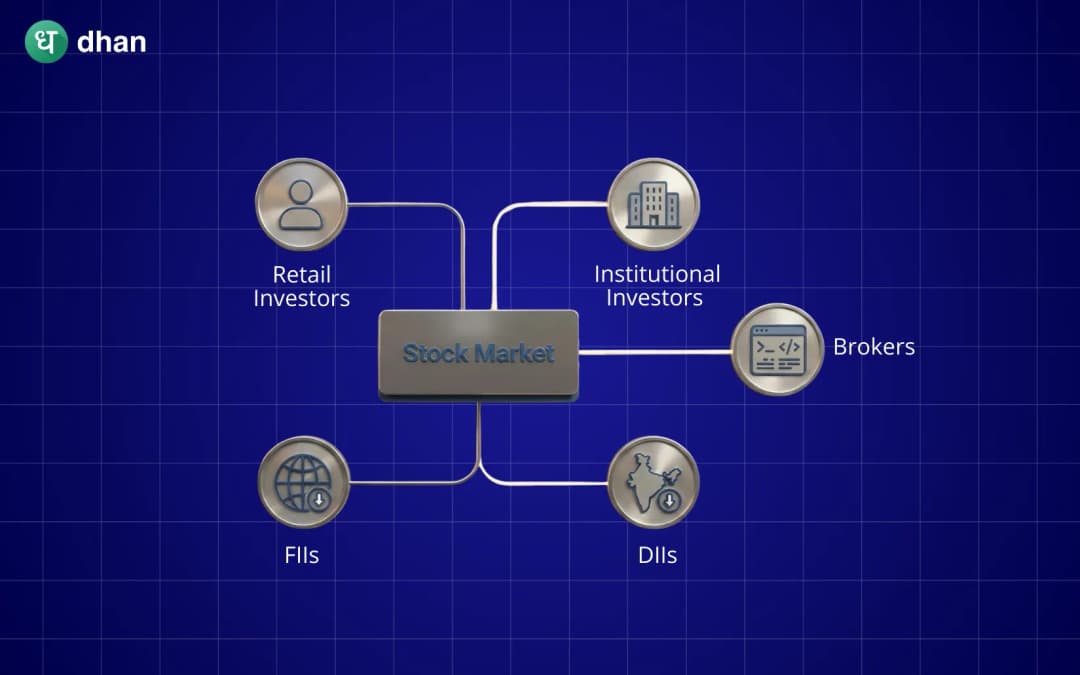



When you invest or trade in the stock market, your transactions are limited to buying and selling. So, do you have the conception that the stock market only consists of buyers and sellers? Well, that’s not exactly how the money market works. The ecosystem is much broader than you might think, and there are different contributors that keep the system functional.
If you have just got started with investing in the stock market, you will find it interesting to understand who these participants are. This approach will make it easier for you to understand the concepts of market sentiment and volatility.
In this blog, we have comprehensively discussed the role of stock market participants and how they work in the system beneath the surface.
Why understanding stock market participants matters?
The stock market rarely behaves randomly. So, when you see the price of a stock on the screen, it is actually the result of several actions from different participants. Each of these actions has an impact on:
· Liquidity
· Sentiment
· Price discovery
For instance, foreign institutional investors often move Indian markets sharply in the short term. On the contrary, domestic institutional investors step in during corrections, restoring balance in the market.
Again, traders and long-term investors behave in a different way. For instance, being a trader, you know how you react to chart patterns and intraday news. On the contrary, business fundamentals matter more to long-term investors. When you know how stock market participants contribute to the ecosystem, you can interpret the market signals better.
Primary vs. secondary market participants
Let’s get a clear idea of the primary and secondary markets before understanding who the participants are.
Primary market
The primary market is the space where companies directly raise capital through:
· IPOs
· FPOs
· Rights issues
In the primary market, the key participants are:
· Promoters
· Investment banks
· Underwriters
· Qualified institutional buyers (QIBs)
· Retail subscribers
The goal of the primary market is to channel money to companies from investors. This allows businesses to grow and expand.
Secondary market
The secondary market is the space where shares that have already been issued are bought or sold. This market consists of:
Retail investors
· Traders
· HNIs
· FIIs
· DIIs
· Market makers
Secondary market investors do not directly fund companies. Instead, they trade among themselves based on news, analysis, and their expectations.
The behaviour between primary and secondary market investors also significantly differs. For instance, in the primary market, participants evaluate valuations and growth prospects. On the contrary, stock market participants in the secondary market react to price movements and market conditions.
The flow of money shifts from companies in the primary market to traders and investors in the secondary market through daily trading.
Major types of stock market participants
Now, take a look at the major stock market participants in India.
Retail investors
Retail investors are individuals who regularly buy and sell stocks. These investors usually put in small amounts themselves. However, their cumulative investment significantly contributes to the daily trading volume.
Retail investors make their decisions based on:
· Trends
· News
· Social media updates
· Research tools
· Long-term financial goals
With online investing making access to the money market easier, retail investors are also putting their money in SIP, ETFs, and index funds.
High-Net-Worth Individuals (HNIs) & Ultra-HNIs
HNIs and ultra-HNIs are investors who put substantial capital and take sizable positions in equity markets. These are large investors who frequently participate in:
· IPO
· Large transactions
Since these transactions involve significant capital inflows to the market, their actions influence price movements in the short term. The financial strength of these stock market participants is high. Often, they work with wealth managers, portfolio management services, and private advisory firms.
Usually, HNIs build high-conviction portfolios and enjoy access to exclusive investment products that may not be widely available to retail investors. These large orders can also impact the momentum of stocks, particularly in midcaps and niche sectors.
Domestic Institutional Investors (DIIs)
DIIs include mutual funds, insurance companies, pension funds, and banks. All these institutions manage large pools of capital pouring in from domestic sources. DIIs play a crucial role in stabilising the stock market, particularly when it turns volatile. In many instances, DIIs buy shares when FIIs sell them, which balances the overall flow of funds.
Within DIIs, portfolio managers follow extensive research processes. They also analyse asset allocation guidelines and understand regulatory norms established by SEBI.
Often, DIIs leave an impact on broader market trends, particularly through long-term flows of investment from mutual funds and insurance companies. They consistently support the market and keep it relatively stable when the global sentiment weakens.
Foreign Institutional Investors (FIIs / FPIs)
FIIs refer to large global funds. These funds invest in emerging markets like India. The cash inflows and outflows of FIIs have a significant impact on Nifty and Sensex. Markets tend to rally when FIIs buy heavily. However, the selling of stocks by FIIs is often followed by corrections.
Different factors influence how FIIs behave in the Indian stock market. These include:
· Global interest rates
· Inflation
· Currency fluctuations
· Geopolitical events
· Risk appetite
These stock market participants usually prefer large-cap and liquid stocks. That’s why their actions reflect in sector leaders and benchmark indices quickly.
Analysts closely track FII data as it often sets the short-term sentiment in the market. Although FIIs put in substantial investments, the cash flow can be volatile. This is the reason why long-term investors prefer not to evaluate their activities in isolation.
Mutual Funds
Millions of retail investors in India contribute to mutual funds. Once these stock market participants pool in money, they allocate it across equities, debt, and hybrid instruments.
Fund managers carry out extensive research and evaluate companies to assess risks. In the process, they build diversified portfolios. A disciplined and methodical approach goes a long way in reducing emotional decisions in the stock market.
SIP inflows significantly contribute to the stability of the market. Regardless of the market conditions, they contribute to its stability. Mutual funds play an important role in long-term wealth creation, adding to the depth of the market.
Hedge Funds & Private Equity Investors
Hedge funds and private equity (PE) investors are some of the sophisticated stock market participants. Often, hedge funds use aggressive strategies like:
· Long-short positions
· Derivatives-based trades
· Arbitrage
These activities significantly influence liquidity and volatility in certain sectors.
On the other hand, private equity and venture capital investors usually fund unlisted companies. Their actions shape the startup ecosystem, impacting the valuations of IPOs.
Day, Swing & F&O Traders
The key goal of traders is to profit from short-term gains using:
· Technical analysis
· Derivatives
This is a broad category of stock market participants, which includes intraday traders, swing traders, arbitrageurs, and F&O traders. These investors make quick decisions, which makes the market liquid.
Stock market traders are highly sensitive to market news, volatility, and intraday events. Often, you’ll find their actions leading to sharp price swings and spikes in volume. These traders focus more on momentum than fundamentals.
Market Makers & Proprietary Trading Firms
Market makers are important stock market participants. They ensure the market has enough liquidity for trading smoothly, particularly in derivatives and stocks that are less active. These participants continuously place buy and sell orders, thereby maintaining narrower bid-ask spreads.
Proprietary trading firms, on the other hand, use their own capital for trading. They are heavily reliant on quant models, arbitrage, and algorithmic strategies. The activities of proprietary trading firms strengthen the market with stable liquidity and faster execution.
Brokers & Trading Platforms
Brokers like Dhan serve as a bridge between investors and stock exchanges. Their role involves:
· Facilitating trades
· Offering analytical tools
Regulators & Stock Exchanges
Regulatory authorities like SEBI are responsible for maintaining transparency in the stock market and protecting the interests of investors. They ensure that the market practices remain fair.
Exchanges like NSE and BSE provide the infrastructure for trading.
Clearing corporations guarantee the settlement of trades and reduce counterparty risk.
Together, they create a secure and transparent environment for all the stock market participants.
How beginners should interpret participant activity?
If you are just getting started with stock trading or mutual funds, it’s imperative to track key data like:
· Volumes
· Participation of each sector
However, there’s no point copying their strategies blindly. These insights help you understand the market sentiment. However, the goal of each investor is different, and their risk appetite can vary. So does their time horizon, depending on their short and long-term goals.
Therefore, new investors must prioritise their asset allocation and stay disciplined in the money market.
To conclude
The stock market presents you with a vibrant ecosystem where every participant has a specific role to play. When you know how each of these stock market participants makes a difference, you can understand trends, volatility, and market sentiment with clarity.
Being informed and patient are some of the essential virtues of successful investors. Observe the activities of different participants and keep learning. This will help you make decisions that align with your long-term goals.
FAQs
Do FIIs invest only in equities?
No, FIIs invest across different segments like equities, debt instruments, hybrid securities, and sometimes derivatives.
Does participant behaviour change during bull and bear markets?
Yes, market cycles largely influence the behaviour of different participants in the stock market. During bull runs, retail participation, along with risk-taking activities, increases. However, during bear runs, institutional investors tend to be more cautious and defensive.
Do regulators influence stock prices?
Regulators don’t influence the prices of stock directly. However, they create rules that help the market operate with fairness and transparency.
How do algorithmic traders influence everyday stock price movements?
The computer-based strategies help algorithmic traders execute large volumes of trades at high speed. This significantly influences liquidity and bid-ask spreads in intraday trades.
Why do large players impact the market more?
Large players have a greater impact on the market as they trade in high volumes. As a result, their buying or selling actions have a significant impact on price and liquidity compared to small individual traders.