Trigger Price in Stop Loss Order




Key takeaways:
- When the market moves against you during trading, the trigger price automatically activates your stop loss.
- The right approach to placing your trigger price in stop loss order can protect your capital and reduce emotional trading decisions.
- The volatility in the market, your trading strategy, and risk tolerance determine where you must place the trigger price.
As a trader, you enter the market hoping for profits. However, successful trading involves something more than just choosing the right stock. Equally important is your strategy to control losses when the market moves against you. That’s why stop loss orders are a vital part of your risk management strategy.
However, many beginners feel confused between the stop loss price and the trigger price in stop loss orders. Both these are connected, but they have different purposes to serve when a trade is executed. We have explained how trigger prices work in stop losses in this blog. This will help you manage risk better and avoid emotional decisions as you stay disciplined during your trades.
What is the trigger price in stop loss order?
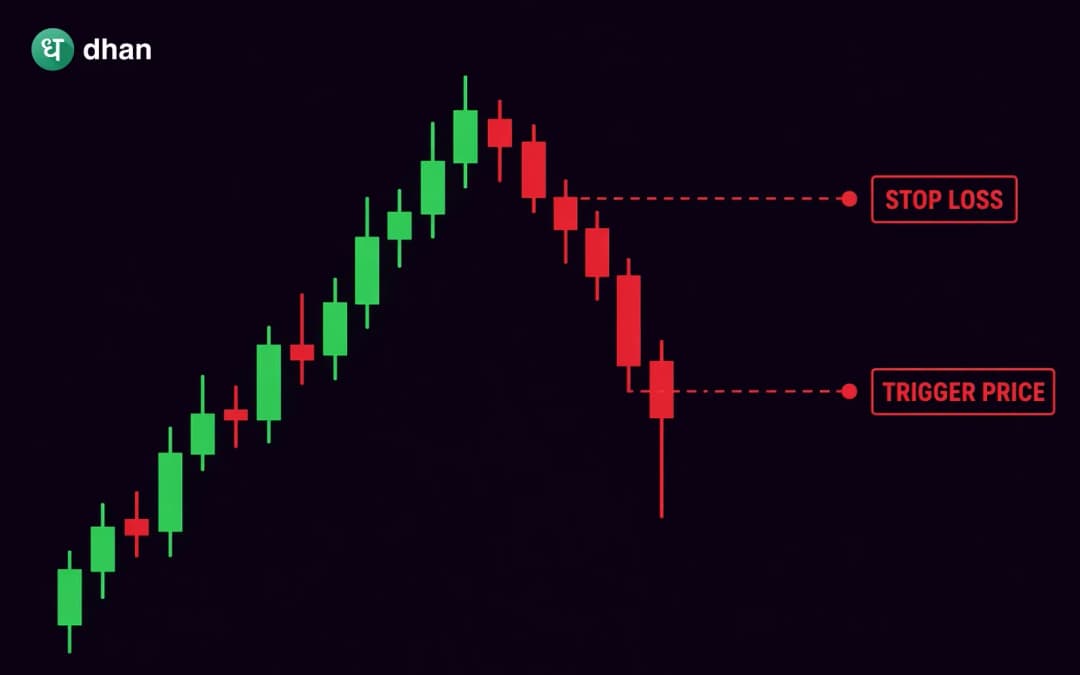
The trigger price in stop loss is the price level at which your stop loss order becomes active in the market. Therefore, the stop loss order remains inactive until the stock reaches the trigger price.
However, when the market price touches or crosses the trigger price, the order is automatically sent for execution by the system.
For instance, you purchase a stock at INR 500, and want to limit the downside risk to INR 480. So, set the trigger price at INR 480. If the price of the stock falls to that level, the stop loss order will get activated automatically.
Remember, the trade may not always be executed at the trigger price. After the order is activated by the trigger, certain factors determine whether the trade will be executed. These include
- Liquidity
- Volatility
- Type of stop loss order
Often, brokers and exchanges use trigger prices to automate risk management.
How stop loss orders work in trading
The purpose of a stop loss order is to automatically reduce potential losses in a trade. You do not have to manually exit a trade when prices fall. Instead, you just have to define a preset level of risk before you enter the position.
With this approach, you can reduce emotional decision-making when markets are volatile. When you follow an organised exit strategy, it improves your consistency. Stop losses are one of the most important tools in risk management for both beginners and experienced traders.
What happens when the trigger price is reached
When the trigger price is reached, the stop loss order becomes active. The system converts the order into a market or limit order, based on the type you had selected. In case you have chosen a market order, the trade will be executed at the best available market price. For limit orders, trades are executed within the specified limit price.
Difference between stop loss market and stop loss limit orders
The goal of a stop-loss market order is to ensure the certainty of execution. When the trigger price is reached, the order gets executed at the best available price in the market. Therefore, it improves your chances of exiting a position instantly.
You gain better price control with a stop loss limit order. Once the trigger activates the order, it executes only at a specified limit price, or better.
While execution is more important in market orders, limit orders prioritise your control over the price.
The trade-off is simple. Market orders prioritise execution, while limit orders prioritise price control.
Why trigger price matters so much in trading
Apart from helping traders control emotions while trading, a trigger price can protect capital and keep trading strategies consistent.
Helps control emotional decision-making
There’s no denying that handling emotions during volatility is one of the biggest challenges in trading. Often, panic or fear grips traders, which eventually leads to poor decisions when prices move sharply.
However, with a properly planned trigger price in place, your emotional pressure is reduced. You already have an exit strategy in place.
Traders must follow a methodical plan instead of reacting on impulse. This significantly improves discipline and creates more consistency over time.
Protects capital during sudden market moves
During the announcements of earnings or economic events, markets can move extremely fast. Losses tend to increase quickly without proper risk management. You can automatically exit your trades when you have a proper trigger price in place. This prevents your losses from becoming unbearable.
Improves consistency in trading strategies
Compared to occasional big profits, consistency matters more in successful trading. Traders benefit from trigger prices as they can stick to their predefined risk-reward setups. There’s no need to constantly change your decisions when the market is live. This is a consistent approach that significantly improves long-term discipline while trading. It helps traders avoid taking unnecessary risks.
How to choose the right trigger price
You can choose the trigger price based on technical levels, volatility, and risk tolerance.
Based on technical levels
Many traders use technical analysis to decide trigger prices. Some of the common methods are placing stop losses below:
- Support levels
- Trendlines
- Important chart patterns
Your goal must be to avoid the trigger price too close to normal fluctuations in the market. If the range is too tight, small movements in price can trigger unnecessary exits, although the broader trend remains intact.
Based on volatility
The price movement of different stocks shows some differences. While some tend to remain relatively stable, you may notice sharp swings in the price of other stocks. If you’re trading with a highly volatile stock, your stop losses must be wider, as normal fluctuations in price can be larger.
Many traders study average price movement or volatility indicators before deciding where to place their trigger price. This is a more realistic approach as it aligns with the actual market behaviour.
Based on risk tolerance
The risk appetite varies from one trader to another. If you are conservative with your approach to trading, you may prefer tighter stop losses. This can minimise your exposure to downside. However, aggressive investors may leave more room for price movement.
Your position size also matters when you trade. Depending on how much capital you are willing to risk during a trade, you may adjust the trigger price.
Ultimately, the goal is to align the trigger price with your risk tolerance and trading strategy.
Common mistakes traders make with trigger prices
Here are three common mistakes traders tend to make with trigger prices.
Setting the trigger too tight
Don’t place the trigger price too close to the entry price. Even small fluctuations in the market can lead to unnecessary exits. This can lead to frustration, repeated losses, and overtrading. Make sure to leave reasonable room for normal price movement.
Ignoring volatility
The same strategy wouldn’t work for every stock. Therefore, approach highly volatile stocks with more room for price fluctuations. Follow the average fluctuations and price swings of a stock before trading.
Confusing trigger price with limit price
Many beginners think that trigger price and limit price are the same. They’re not. The order is activated by the trigger price. On the other hand, the limit price controls execution. If you accidentally place the wrong value, the order may not execute properly.
Trigger price in stop loss for different trading styles
Trigger price can be used in intraday trading, swing trading, and even long-term investing.
Intraday trading
Price movements during intraday trades are usually fast. The holding periods are also shorter. That’s why you need more precise and quicker risk management strategies. In intraday trades, the trigger prices are often tighter, which limits your losses during volatile sessions.
Swing trading
If you’re a swing trader, you may hold your positions for several days or weeks. In these situations, you must place wider stop losses. Within the broader range, you may notice short-term fluctuations. Here, the priority is to avoid unnecessary exits and protect your capital against major reversals.
Long-term investing
Compared to active traders, long-term investors are more selective with their approach to using stop losses. They tend to protect their capital during major downturns in the market or long-term trend reversals instead of reacting to short-term volatility.
Advantages and limitations of using trigger prices
Now, take a look at the benefits and drawbacks of using trigger prices in stop losses.
Advantages
- Trigger prices help to improve your discipline. It automates decisions related to risk management. This way, you can refrain from emotional trading and follow your planned strategies with consistency.
- This feature helps execute trades faster when the market undergoes sudden movements.
Limitations
- Trigger prices are not always perfect. If there’s a sudden price gap, your trade may be executed at a level different from your expectations.
- False breakouts may also activate stop losses unnecessarily before prices recover again.
Conclusion
The trigger price in stop loss orders largely defines your risk management in trading. Consider technical levels, volatility, liquidity, and your personal risk tolerance when you choose a trigger price. With correct execution, trigger prices become a powerful tool in disciplined trading. After all, you must protect your capital to sustain longer in the market.
FAQs
Where is a trigger price set in a stop loss order?
The trigger price in a stop loss order is set at the predefined level based on your risk profile. The stop loss order becomes active at this level and is processed for execution in the market.
Is it mandatory to use a stop loss in intraday trading?
A stop loss order is not mandatory in intraday trading. However, if you’re using margins, your broker may require you to place a stop loss order.
Can a stop loss execute at a different price?
Yes. During volatile conditions or price gaps, the order may be executed at a slightly different price than where you had placed it.
Should beginners always use stop loss orders?
Yes. Stop loss orders are a safety strategy for beginners. It helps them control risk and avoid making emotional decisions when markets fluctuate suddenly.
What happens if the market gaps below the trigger price?
If the market gaps below the trigger price, the order still activates, but execution may occur at the next available market price.