What is a Rights Issue?








Key takeaways:
- A rights issue is a type of financing where a company issues new shares to existing holders.
- Participating in a rights issue is optional.
- A company can use the raised proceeds to repay loans and reduce interest expenses.
- Rights shares are usually issued at a rate lower than the existing market rate.
When a company requires finances for expansion, repayment of debts, or operating costs, there are several ways it can generate these funds. One such way is through a rights issue, whereby the firm sells new shares to its existing stockholders.
If you own shares in a company announcing a rights issue, you may wonder whether you should invest more money. Understanding how the offer works, its impact on share prices, and its potential risks can help you make an informed decision.
Understanding a rights issue
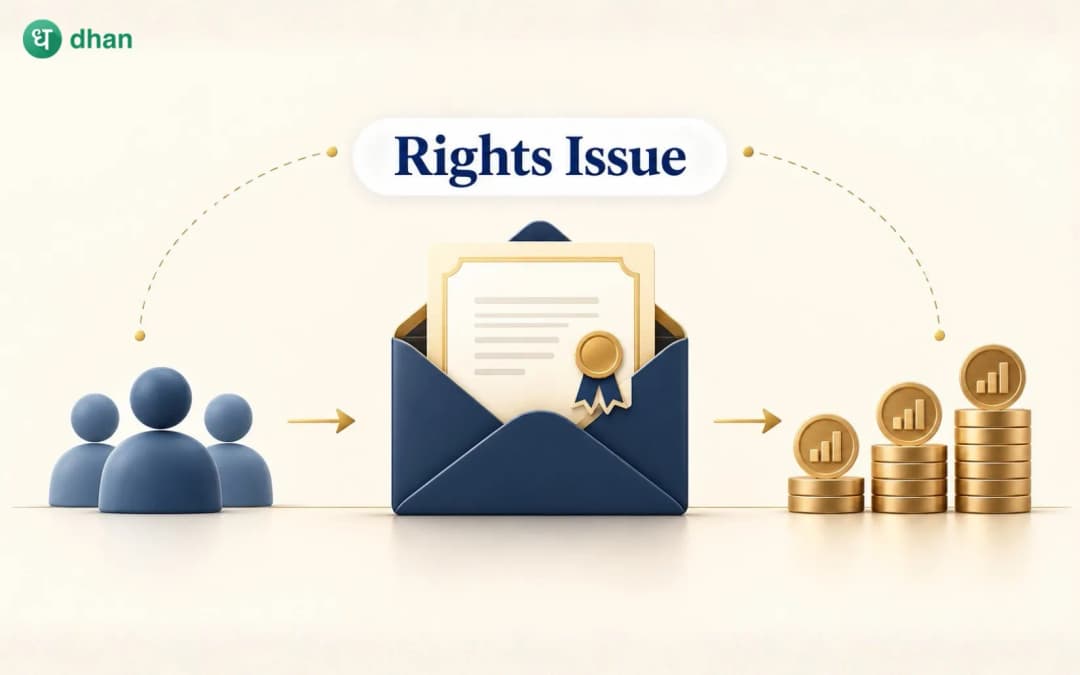
A rights issue is a type of financing wherein the company makes new share allotments to existing stockholders at a predetermined price and ratio.
For instance, the company initiates a rights issue in a ratio of 1:5 at a price of ₹8 per share. It implies that you, being the stockholder of the company, have the right to apply for one more share for every 5 shares held by you.
Suppose you possess 300 shares; then, you will be able to buy 60 more shares. The total expenditure will come to ₹480.
A rights issue gives existing shareholders an opportunity to increase their holdings. They can also choose not to participate. Rights issues in India, by the listed companies, are governed by the Companies Act, 2013 and the regulations of SEBI.
How does a rights issue work?
A rights issue follows a defined process, from the company's announcement to the allotment of shares.
- Announcement: The firm announces the price of the shares, entitlement ratio, reason for raising money, and crucial dates.
- Record date: The company determines who is an eligible shareholder under the required criteria.
- Rights Entitlements (REs): Eligible shareholders generally receive REs in their demat accounts. These represent their right to apply for shares, not the shares themselves.
- Investor's decision: Shareholders can apply for shares, sell transferable REs if permitted, or let the entitlements lapse.
- Application and allotment: Investors apply through the permitted process and complete the required payment. Once allotment is finalised, the allotted shares are credited to their demat accounts.
Investors may apply through ASBA (Application Supported by Blocked Amount), where the application money remains blocked in their bank account until the application is processed.
Pay attention to the deadlines. If you neither apply nor sell transferable REs within the permitted period, they may lapse without value.
Different types of rights issues
Companies structure rights issues in a few different ways depending on their requirements:
Why do companies bring rights issues?
Companies raise funds through rights issues for several business needs.
- Business expansion: Funds may support new factories, product launches, acquisitions, or entry into new markets.
- Debt repayment: A company may use the proceeds to repay loans and reduce interest expenses.
- Working capital: The cash could be used to settle suppliers' bills, buy materials and maintain inventory, among other expenditures.
- Financial needs: The firm could need more money for financial reasons or others as provided in the offering memorandum.
Purpose is important because it's one thing to raise money for expansion while it's another to raise money to cover the ongoing losses in the business. Read the disclosure documents to learn about how the company intends to use the money raised.
How does a rights issue change the share price?
When a company issues new shares at a discount, the total number of shares in the market increases. Due to the increased supply, the price of the stock is expected to fall after the ex-rights date.
This adjusted price is referred to as the Theoretical Ex-Rights Price (TERP).
Taking our earlier example of XYZ Ltd.:
- Starting Portfolio Value: 300 shares ₹10 = ₹3,000
- Cost to Exercise Rights: 60 shares ₹8 = ₹480
- Total Portfolio Value Post-Issue: ₹3,000 + ₹480 = ₹3,480
- Total No. of Stocks after Issue: 300 + 60 = 360 shares
Theoretical Ex RightsPrice(TERP)= RevisedPortfolioValue / TotalShares= ₹3,480/ 360=₹9.67
On paper, the average stock price adjusts from ₹10 down to ₹9.67.
- If you participate: Your overall portfolio value stays balanced because the discount on your new shares offsets the price drop on your old ones.
- If you choose not to participate: The market price of your existing holdings drops from ₹10 to ₹9.67 per share, and your overall ownership percentage in the company gets diluted.
Rights issue vs. bonus issue: What is the difference?
It is easy to get confused between these two corporate actions since both give extra shares to existing shareholders, but they are quite different:
For example, a 1:5 rights issue allows an eligible shareholder to apply for one new share for every five existing shares. A 1:5 bonus issue provides one bonus share for every five existing shares held.
Benefits and risks of a rights issue
A rights issue can help investors increase their holdings, but a discounted price does not guarantee returns.
Benefits
1. Opportunity to buy at a discount: Rights shares are usually issued at a rate lower than the existing market rate. But the market rate may fluctuate, and therefore just the discounted rate is not sufficient for a good investment.
2. Keeping ownership percentage: Subscription to the share entitlement in the stipulated ratio would enable the shareholders to keep their ownership proportionate, subject to allotment and any other necessary conditions.
3. RE Sale Option: When the offer allows for transfers and the REs can be traded, investors who don’t wish to commit any more money can choose to sell their REs within the allowed time frame.
Risks
1. Share price fluctuations: The price may drop below the issuing price, resulting in a loss for the investors.
2. Financial weakness: A company that is trying to raise money to finance losses or debts can have substantial investment risks.
3. Concentration risk: Buying more shares increases your exposure to the same company. This may make your portfolio more vulnerable if its performance weakens.
4. Expiring REs: If you fail to exercise or sell transferable REs before the deadline, they may lapse without value.
Should you apply for a rights issue?
Before investing, consider these four factors.
- Purpose of fundraising: Determine whether the proceeds are for growth, paying off debts, or compensating losses.
- Financial performance: Look at the revenue, profitability, liabilities, and cash flow to assess the financial situation of the organisation.
- Issue price: Compare the issue price with the market price, while remembering that a discount does not guarantee gains.
- Your financial position: Consider whether you can afford to invest more money and whether the additional shares would make your portfolio too dependent on one company.
Also, check the application and RE trading deadlines. If you decide not to subscribe, find out whether you can sell your entitlements before they expire.
The decision should depend on the company's financial health, the offer terms, and your investment goals, not just the discounted price.
Conclusion
A rights issue is a method for a company to gain money by selling new shares to existing investors. Nevertheless, an offer of shares does not necessarily translate to profits. Consider the financial health of the company, reasons for the fundraising, and whether the investment suits you.
FAQs
What if I acquire REs but don't apply for shares?
REs may lapse if you do not make a valid application and pay the payment within the stipulated time limit. You will end up losing your money spent on their purchase.
Is it possible for me to apply for additional shares despite my entitlement?
Yes, you can apply for extra shares in case the offer allows it. But the allotment of shares will depend on the issue details and the availability of shares.
Are rights entitlements taxable when sold?
It depends on the nature of acquisition of REs and the sale and relevant tax laws. Refer to the relevant tax laws or take advice from a tax expert before accounting for the transaction.
When will rights shares be credited to my demat account?
The credit date varies based on the allotment process followed in that particular rights issue and the completion of the process. You can find out the expected dates in the official announcement from the company.
Is it possible to make an application for a rights issue if my demat account is frozen?
For receiving Rights Entitlement (RE), your account needs to be in compliance with the KYC norms. If your account is frozen, there could be an issue of RE not being credited to the account, which would eventually lead to rejection of the application.