Hikkake Pattern





Key takeaways
- A Hikkake pattern is used in trading to spot false breakouts, as well as potential trend continuation or reversal opportunities.
- The term ‘Hikkake’ originates from a Japanese word meaning ‘trap’ or ‘trick’, indicating how the pattern tricks traders so that they make entries that follow the false breakout.
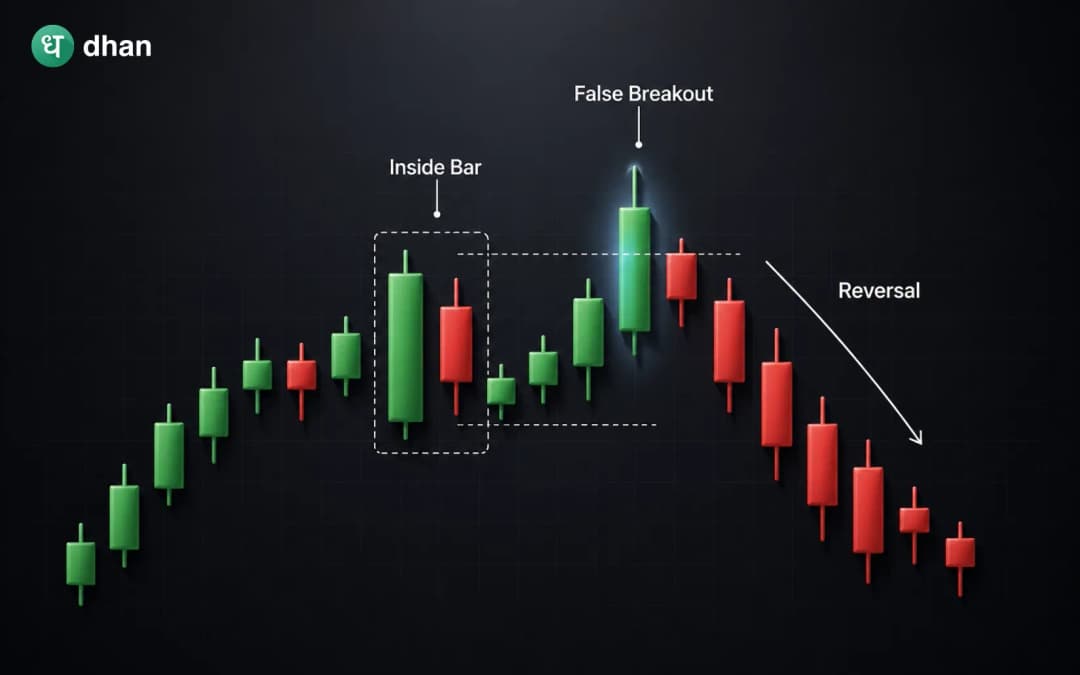
- The pattern starts with an inside bar, then a fake breakout and a confirming candle.
- There are two types of Hikkake patterns: bullish and bearish Hikkake patterns.
- Confirmation is necessary. Entering a trade based on the initial breakout without confirmation usually results in false signals.
- Hikkake patterns give good results when used along with support and resistance levels, trends, volumes or momentum indicators rather than being used alone.
Breakouts are among the most commonly used trading signals by market participants. If a stock price crosses above resistance or below support levels, investors expect a strong trend in that direction. But not all breakouts create new trends. Many breakouts fail right after their occurrence, leaving traders with positions on the losing side of the market.
Traders face tough times when they take positions before confirmation and encounter false breakouts. The Hikkake pattern identifies such situations by highlighting the time when the market makes a misleading move before reversing the direction.
Understanding how this pattern forms and what it represents allows traders to improve their ability to analyse price movements and avoid responding to every breakout.
What is a Hikkake Pattern?
The Hikkake pattern is a price action pattern which identifies a failed breakout. The term ‘Hikkake’ comes from the Japanese word meaning 'to trap' or 'to trick,' showing how this pattern attracts traders who get into positions because of a false market signal.
The pattern was first identified by technical analyst Daniel L. Chesler and is based on the idea that markets sometimes create false signals to trick traders before making their actual move.
How does a Hikkake Pattern work?
The Hikkake pattern works by identifying a failed breakout, where prices move beyond a key level but fail to move in the same direction.
The pattern usually occurs after a period of consolidation when traders wait for a breakout opportunity. When prices move above resistance or below support, many traders enter positions anticipating that the existing trend will continue. But if momentum fails and prices reverse, those traders can become trapped.
This failure to reverse forms the Hikkake setup. A failed upward breakout may be a sign of a bearish move, whereas a failed downward breakout points towards a possible bullish reversal.
Hikkake pattern is based on the fact that markets often move against the initial expectation before establishing their true direction. Traders generally wait for confirmation before making a trade as not all breakout failures are followed by significant price movements.
Formation of Hikkake Pattern
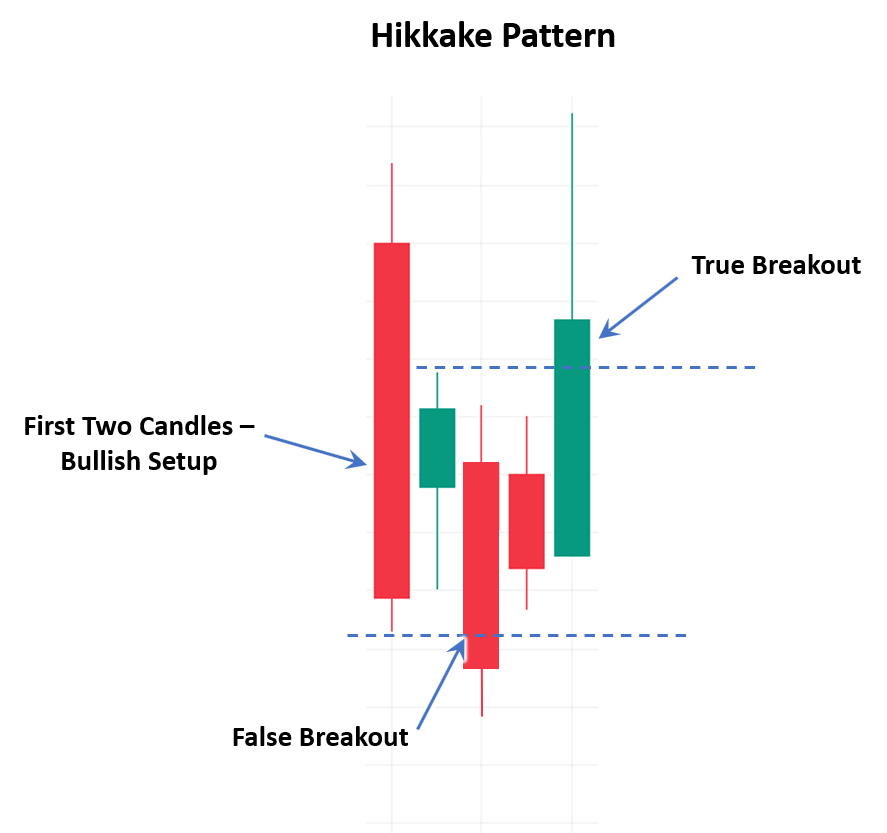
The Hikkake pattern usually forms through a sequence of four price actions:
Setup candle: The setup candle sets up the initial price range and serves as the reference point for the pattern.
Inside bar: An inside bar forms inside the trading range of the setup candle. This shows a period of consolidation and also a reduction in market volatility.
False breakout candle: The false breakout candle forms above or below the inside bar's range, creating the illusion of a genuine breakout and drawing traders’ interest to enter trades.
Confirmation candle: The confirming candle then creates a price reversal on the false breakout over the next few bars and closes at the opposite end of the inside bar, creating a signal that the initial breakout attempt failed and the Hikkake pattern is complete.
Types of Hikkake Pattern
The Hikkake pattern has two main types:
Bullish Hikkake pattern
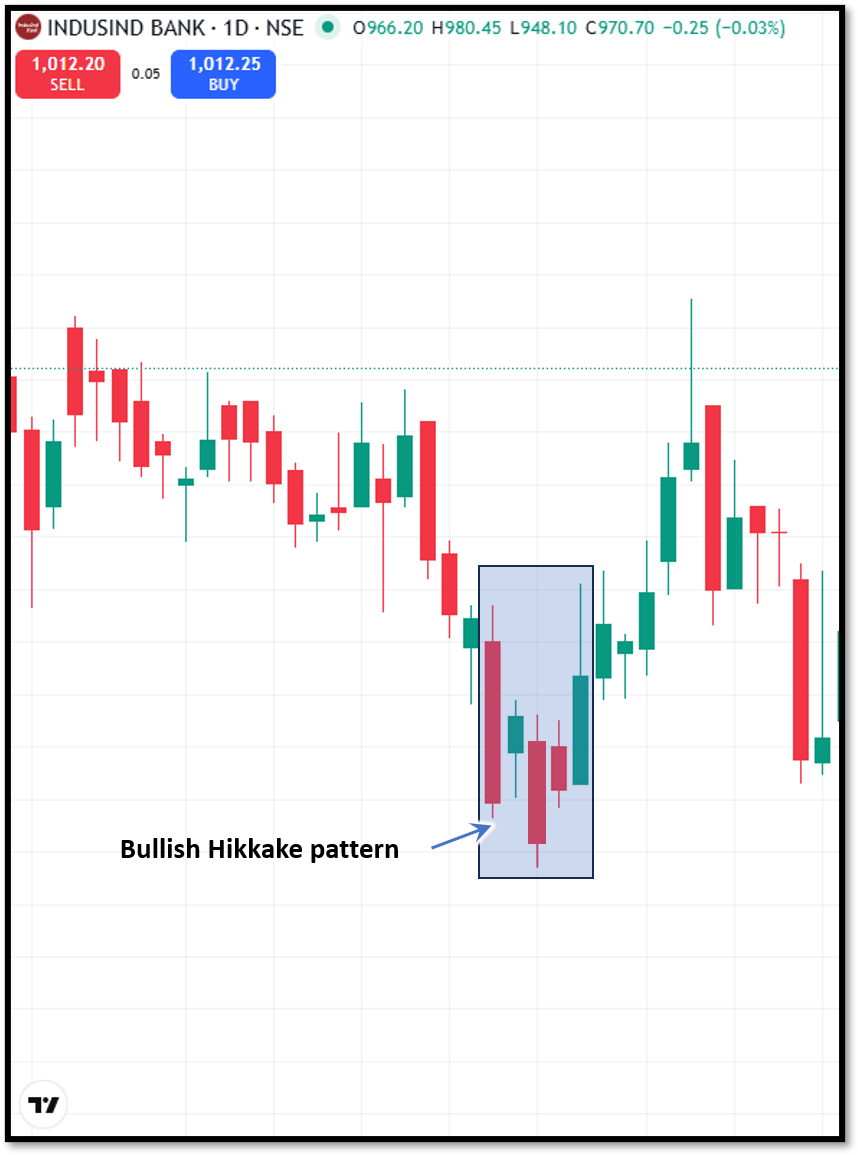
A bullish Hikkake pattern forms when sellers try to drive the price lower but can't sustain control. The price initially breaks below the inside bar, setting up opportunities for short positions. However, rather than continuing to fall, buyers come into play and drive the price back above its preceding range.
This reversal implies that sellers may be trapped and there is an increase in buying pressure. Bullish Hikkake patterns are generally considered stronger when they emerge close to support levels or within a broader upward trend.
Bearish Hikkake pattern
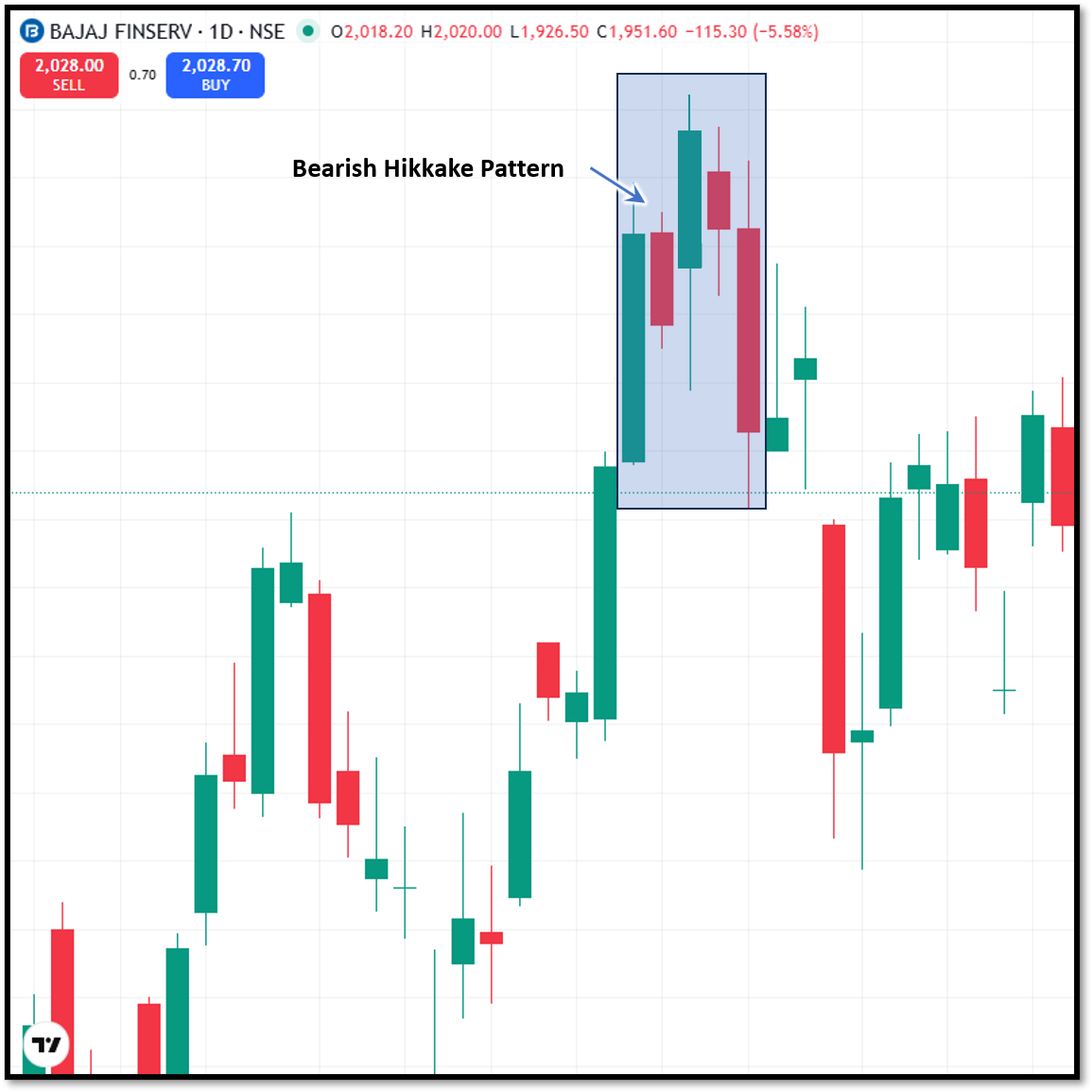
A bearish Hikkake pattern forms when buyers try to create a breakout but fail to maintain momentum. Price action goes above the inside bar, attracting buying pressure during a breakout attempt. However, the market reverses, returns to its earlier trading range and then drops below the inside bar. This suggests that buyers who entered may be trapped and there is an increase in selling pressure.
How to trade the Hikkake Pattern
The following steps explain how traders can use the Hikkake pattern to enter and manage trades.
Setting up a trade
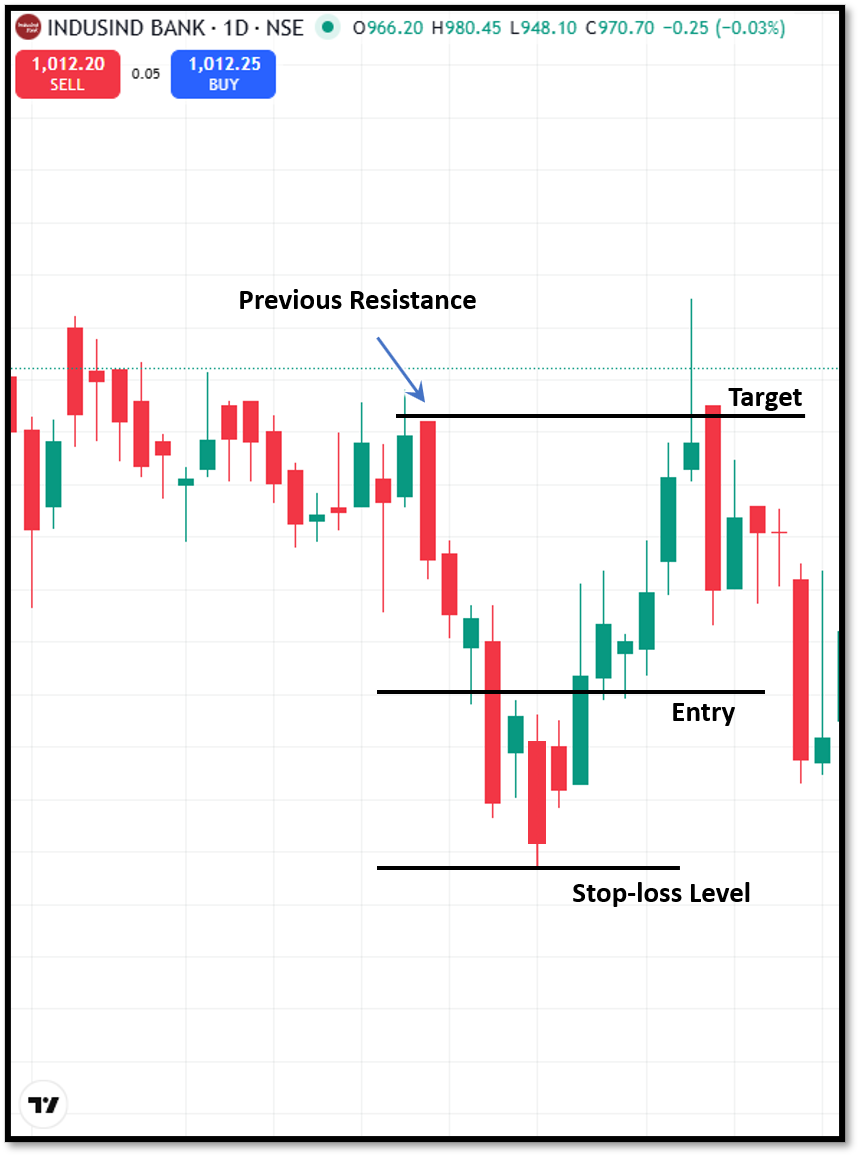
Identify the Hikkake pattern and then wait for confirmation. Place a bullish trade when the price jumps over the high of the inside bar and place a bearish trade when it breaks down below the low of the inside bar.
Stop loss placement
Proper risk management is essential. For a bullish pattern, put a stop loss below the low of the confirmation bar, and for a bearish pattern, place a stop loss above the confirmation bar.
Profit targets
Traders using the Hikkake pattern often set profit targets based on risk-to-reward ratios. Many traders prefer to use the 2:1 risk-to-reward ratio, where they expect double the profit of what they risked. However, these targets can vary depending on factors such as the trader's risk tolerance and current market conditions.
Risk management
Adequate risk management strategies are essential for all trading methods, including the Hikkake pattern. It is important for one to consider elements such as stop-loss orders, potential profit targets, as well as position size.
Additionally, traders should also pay attention to any upcoming market news or financial data that may lead to unpredictable price changes and disrupt the trading strategy
Advantages of the Hikkake Pattern
Some advantages of the Hikkake pattern are:
- The Hikkake pattern enables traders to identify situations where what appears to be a successful breakout fails, and the market moves against it. It helps traders avoid common breakout traps.
- The pattern is based on candlestick patterns and market sentiment rather than complicated indicators. Traders can use it easily by just checking out price movements and market patterns.
- If confirmed correctly, the pattern lets traders get into positions early in a reversal, giving them a chance to capture bigger price moves.
- The pattern becomes more reliable when combined with indicators such as RSI, MACD, moving averages, and volume analysis to confirm the trend reversal.
- The pattern can be used across different time frames, making it relevant for intraday, swing, and position traders.
Disadvantages of the Hikkake Pattern
Some disadvantages of the Hikkake pattern are:
- Although the pattern is made to spot false breakouts, sometimes it produces false signals which do not lead to successful reversals.
- Beginners may find it difficult to spot real Hikkake patterns because regular market swings appear quite similar to the setup.
- Starting a trade before the breakout will increase the chances of failure. But waiting for confirmation also means missing some of the initial price movement.
- Trading solely on this pattern can lead to inaccurate trade entries. The pattern is more effective with the support of volume, resistance levels, or technical indicators.
- During high volatility, frequent breakouts and reversals make the Hikkake pattern less reliable.
Common mistakes when trading the Hikkake Pattern
While trading, traders make some mistakes that can cause them to lose heavily. Some common mistakes include:
1. Entering before confirmation
Most traders frequently jump into positions right after the initial breakout without waiting for the reversal signal. As a result, they may experience false movement traps.
2. Ignoring the overall trend
A Hikkake pattern performs better if it's following the overall market trend. Going against the trend will decrease your chances of success.
3. Misidentifying the pattern
Not all inside bars set up a Hikkake pattern. It is advisable for traders to be patient and see a failed breakout as well as get confirmation before entering into any trade.
4. Poor risk management
Some traders concentrate only on the pattern and overlook stop-loss placement. Without adequate risk management measures, one unsuccessful trade could end up causing huge losses.
5. Trading without additional confirmation
Rely solely on the Hikkake pattern as a standalone trade signal rather than combining it with other technical indicators or volume analysis.
Wrapping up
The Hikkake Pattern is a technical analysis tool that helps identify possible market reversals or breakouts. It comprises a setup bar, an inside bar, and a confirmation bar, all of which indicate an initial breakout in one direction before reversing to trap the traders.
The Pattern is known for being simple and adaptable in different markets and timeframes with well-defined entry and exit. Nevertheless, it might generate false signals, and its performance differs with varying volatility levels.
FAQs
What is a Hikkake uptrend?
This is a situation where the price initially drops below the support level but then turns around and begins rising steadily, offering a chance to open long positions.
Can the Hikkake Pattern be used on various markets?
Yes, the Hikkake Pattern is flexible and can be applied across all types of markets like equities, foreign exchange, commodities, as well as indices.
How does market volatility impact the Hikkake pattern's effectiveness?
The Hikkake Pattern operates effectively under all market conditions; however, it is more effective during times of high volatility because of larger price movements.
How many candles form a Hikkake pattern?
The core pattern consists of four candles, which include a setup candle, an inside bar, a false breakout candle, and a confirmation candle. Traders also use extended versions with five or six candles for extra confirmation before executing a trade.
What's the difference between an inside bar and a Hikkake pattern?
An inside bar is simply one candle contained within the previous candle's range; it does not indicate direction. The Hikkake pattern uses this inside bar as its foundation and consists of a false breakout and confirmed trend reversal on top of it. Every Hikkake pattern has an inside bar included, but most inside bars never turn into a Hikkake.