ETF vs Mutual Fund






Key takeaways
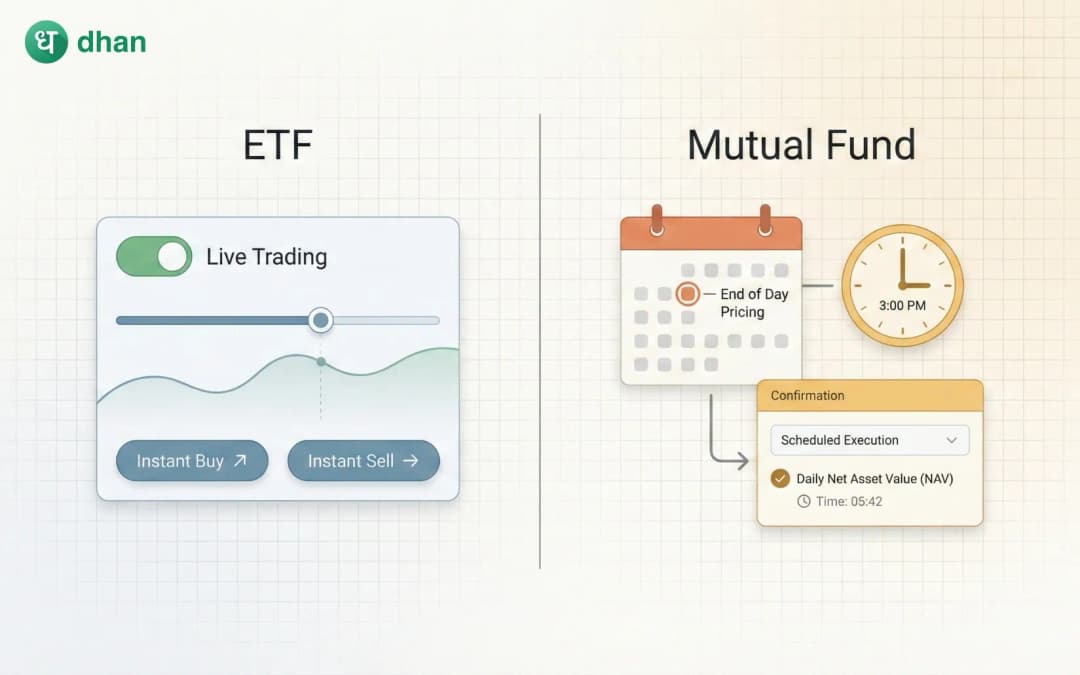
- The main difference between ETFs vs mutual fund is that ETFs are traded on the stock exchange like regular equities, whereas mutual funds are transacted at a single, fixed NAV declared at the end of the trading day.
- Purchasing an ETF unit requires an active Demat and trading account, whereas mutual funds can be directly purchased through an AMC without needing a Demat account.
- Mutual funds and ETFs both offer SIP investments.
When it comes to investing in the Indian stock market, there are a variety of options available to investors. Among those two of the most popular options are ETFs and Mutual Funds, known for their wide basket of securities, professional management, and risk management.
However, they differ significantly in terms of flexibility, liquidity, cost structure, and trading mechanism. In this blog, we'll explore how ETF vs mutual funds differ and which offers greater flexibility for your portfolio.
What is an Exchange Traded Fund (ETF)?
An ETF is a tradable security that tracks an index, sector, commodity, or basket of assets and is traded on stock exchanges just like shares. For example, if you purchase a Nifty 50 ETF, it mimics the performance of the Nifty 50 index.
ETFs combine the features of mutual funds (diversification) with the trading convenience of stocks.
Key features of ETFs
- Traded on exchanges: Like any stock, you can buy or sell an ETF during market hours.
- Market-linked returns: Their value fluctuates in real time based on the underlying index.
- Low expense ratio: Most ETFs are passively managed, hence expenses are minimal.
- Transparency: Holdings are disclosed daily.
- Demat account requirement: The investors need to have a trading and demat account to transact.
For example, if Nifty 50 increases by 1%, a Nifty 50 ETF will increase by the same percentage, considering minimal tracking error.
What is a mutual fund?
A Mutual Fund pools funds from several investors to invest in a diversified portfolio of stocks, bonds, or other securities. Unlike ETFs, units of a mutual fund are not traded on the exchanges. An investor buys or redeems units directly from the Asset Management Company at the end of the trading day at the Net Asset Value (NAV).
Some mutual funds are actively managed, while others are passively managed, such as index funds.
Key features of mutual funds
- Professionally managed: The fund managers actively select securities to optimise returns.
- NAV-based pricing: Units are priced once a day at the end of the trading day at the Net Asset Value (NAV).
- Systematic Investment Plan: It allows investing fixed amounts periodically for disciplined wealth creation.
- No demat required: It can be invested through various platforms like Dhan or directly through fund houses or asset management companies.
- Different categories: Different categories to suit investor goals include equity, debt, hybrid, and ELSS, among others.
ETF vs Mutual Fund
Now that you know the meaning of an ETF and mutual funds, you need to understand the differences between them to make an informed decision. A comparison between ETFs and mutual funds is given below:
How flexible are ETFs compared to mutual funds?
ETFs vs mutual funds offer different flexibility to investors. For example, ETFs are easy to trade on exchanges; the same is not true for mutual funds. Apart from that, some key factors comparing ETFs and mutual funds are given below:
Trading flexibility
ETFs can be traded at any time during the market hours. Prices fluctuate throughout the day as investors can have complete control over entry and exit points. On the other hand, mutual funds process transactions only once daily at the NAV calculated post-market close.
Liquidity and access
ETFs provide high liquidity, and investors can either sell or buy ETFs anytime during trading hours. Conversely, once a day is the maximum number of redemptions that can be made in mutual funds.
Cost efficiency
ETFs tend to have lower expense ratios, as they track indices passively. Mostly mutual funds, unlike ETFs, are actively managed funds; thus, they are relatively expensive investments.
Transparency and control
Prices of ETFs fluctuate in real time and reflect the market demand. Intraday movements can be monitored and capitalised through ETFs by investors. However, mutual funds do not offer real-time visibility because they only disclose NAV once a day.
Investment flexibility
In ETFs, there is no limit for investment amount; they can even buy a single unit at its current price. Mutual funds, however, have a minimum SIP or a lumpsum requirement but give automatic periodic investment that many ETFs do not offer.
Taxation on ETFs and mutual funds
Both ETFs and mutual funds follow similar tax rules based on their underlying asset category:
For Equity-oriented Mutual Funds & Equity ETFs
- Short-Term Capital Gains (STCG) — holding period ≤ 12 months: taxed at 20%.
- Long-Term Capital Gains (LTCG) — holding period > 12 months: taxed at 12.5% (for gains above ₹1.25 lakh per year).
- Dividend income from such funds/ETFs is added to the investor's total taxable income and taxed at their applicable slab rate.
For Debt ETFs & Debt Mutual Funds
For investments made in debt-oriented funds, LTCG and STCG are taxed at the investor's income tax slab rate.
For Gold ETFs / Gold Mutual Funds
Treated as non-equity for tax purposes. Taxed as STCG (holding ≤ 12 months) at investor's slab rate. Whereas LTCG (holding > 12 months) is at 12.5%.
TDS / Dividend distribution
Dividend income above ₹10,000 from mutual funds and ETFs attracts TDS at 10% for residents.
ETF vs mutual fund: Which is better for you?
There are many factors to be considered, such as your goals, risk appetite, preferences, etc., to make a choice between an ETF vs mutual funds. To help you, here are a few pointers.
Investors should choose ETFs if:
- Have a demat and trading account.
- Seeks low-cost, passive investing.
- Looking for intraday liquidity and control over timing.
- Have a deep understanding of market volatility.
Investors should choose mutual funds if:
- Prefer simplicity and would not like to track markets actively.
- Prefer to invest regularly through SIPs.
- Seeking professional management and goal-focused investment.
Summing it up
When choosing between ETFs vs mutual funds, the key to making the right choice is to match the investment instrument with your investment objectives. ETFs are a preferred option if you want to actively manage your portfolio, track markets, and trade flexibly. On the other hand, mutual funds are best suited if you want a hands-off approach, automatic investing through SIPs, and focus on long-term wealth creation. You can invest in both these instruments on Dhan.
Ultimately, most of the successful investors often opt for a combination of both, employing ETFs to get low-cost market exposure and mutual funds to do disciplined wealth building.
Your questions, answered by us
1. Do I need to have a Demat account to buy ETFs and mutual funds?
A demat and trading account is required to purchase ETFs. They trade like stocks on exchanges, whereas mutual funds can be purchased from a fund house, broker like Dhan, or through various online platforms without the requirement of a demat account.
2. Can I buy or sell an ETF at any time during the market hours?
Yes, ETFs, as they trade like stocks and can be sold or bought at any moment of the day at current prices, which makes them more flexible than mutual funds that only trade once per day at the net asset value calculated post-market close.
3. Do the expense ratios differ between ETFs and mutual funds?
Yes, the expense ratio of an ETF is usually lower since it's passively managed, while mutual funds tend to be expensive with a higher expense ratio, as most of them are actively managed and distributed.
4. Which one provides better liquidity, ETFs or Mutual Funds?
ETFs have higher liquidity since they are traded throughout the day during trading hours on the stock exchange. On the other hand, mutual funds settle the transactions at the end of the day, and they can take a day or two for completion, decreasing the liquidity.
5. Can a mutual fund be purchased through SIPs?
Yes, mutual funds are SIP-friendly in that investors can invest small sums at periodic time intervals.