US-Iran-Israel Tension: 5 things to expect from the Indian stock market





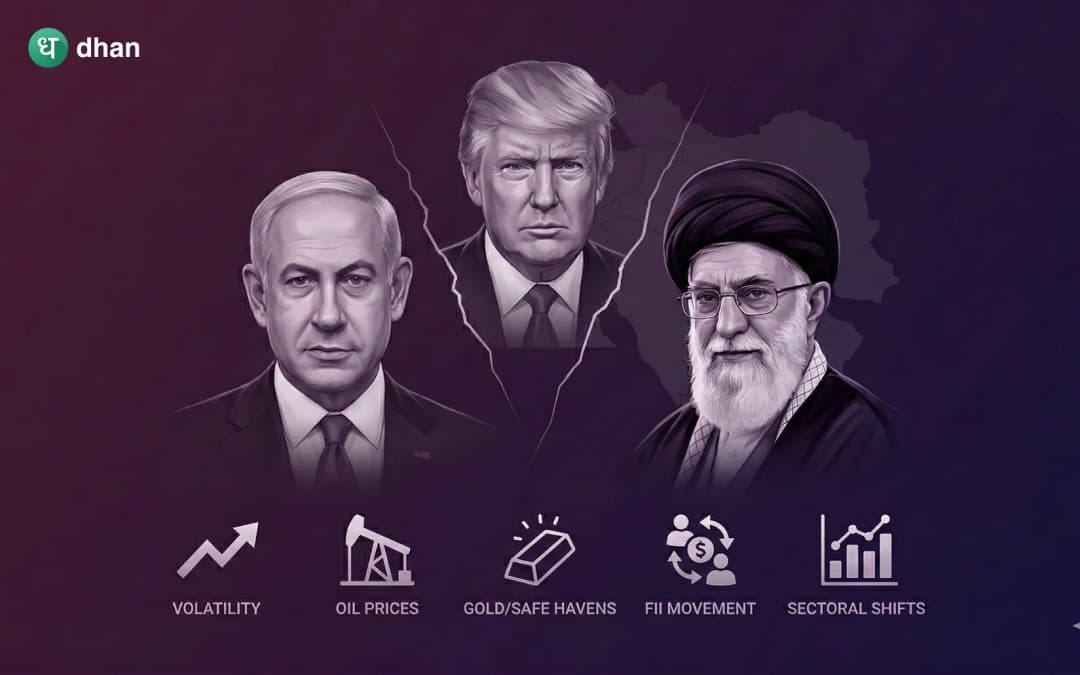



The situation has worsened this weekend with the death of Iran's Supreme Leader, Ayatollah Ali Khamenei, under the targeted bombardments in Tehran. This has triggered widespread expectations of volatility in the global markets, including India. This development is at a time when the Indian equities are already going through a period of volatility.
As the trading begins again on Monday, 2nd March 2026, the investors in India are keenly watching the situation. Here are five things to look out for in the Indian stock market in the wake of these growing geopolitical events.
1. Spike in crude oil prices
The big concern in this case is the increase in the prices of crude oil, and the key to this is the Strait of Hormuz, which is the vital chokepoint in the world oil supply that carries around 20% of the global oil supply and also a significant portion of India's imported oil. If the flow is disrupted or diverted from the Strait of Hormuz, then the ships would have to go around the longer route of the Cape of Good Hope in Africa, which would increase the price of the oil. It is also forecasted that the closing of the Strait of Hormuz would see the price of oil jump to $100 a barrel.
Oil imports constitute the largest import in India, and an increase in oil prices would instantly affect the Indian economy, and the import bill would be worth billions of dollars. Analysts hold different opinions on this issue, and some analysts believe that the price of the WTI would remain below $75 per barrel, and the price of the Brent would remain below $80 per barrel, while others believe that the closure or disruption of the Strait of Hormuz would pose great risks to the energy stability in the world.
2. Anticipated market volatility and knee-jerk reaction
Analysts expect a knee-jerk reaction on opening on 2nd March with an increase in volatility throughout the week for the Indian stock market. This immediate reaction is one of the direct causes of the rising tensions in the Middle East, which coincides with the hectic schedule of macroeconomic data releases in the US (NFP and ISM PMI data). SENSEX and NIFTY50 are likely to come under downward pressure due to renewed geopolitical concerns.
While the near-term outlook seems cautious due to geopolitical stress and global macro uncertainties, markets will continue to be highly data-dependent.
3. FII Capital outflows from Indian markets
Foreign Institutional Investors (FIIs) have only recently turned back to the Indian market after the India-US trade deal, being the net buyers in February 2026 with an investment of Rs. 22,615 crore in the Indian stock markets. But as the Middle East conflict escalates, this trend may change.
During a global conflict, Foreign Institutional Investors tend to withdraw their funds from the emerging markets such as India and repatriate their capital to their home country. Thus, experts are anticipating an aggressive FII selling to start from the beginning of the week.
4. Increased safe-haven demand for Gold and Silver
When there is an increase in geopolitical tensions, it is a common phenomenon that investors increase safe-haven assets like gold and silver. Market experts have also predicted an increase in the price of both gold and silver on Monday. For gold trading on COMEX, the prices are currently below a key resistance level at $5,300 per ounce. If gold prices on COMEX rise and move above this level, then it is likely to inflate the prices of gold in India by as high as Rs 1,68,000 to Rs 1,70,000/10 grams.
Furthermore, if this becomes a dragged-out conflict like the Russia-Ukraine war, domestic gold could touch the mark of Rs 1,80,000 per 10 grams. In extreme, longer-term scenarios, structural movement towards $6000 globally or even ₹200000 per 10 grams domestically cannot be completely discounted, though achieving the ₹2 lakh threshold would need sustained macro stress, a weaker rupee and higher domestic premiums.
For silver, COMEX closed on Friday above $93 an ounce. If it manages to hold the price over $95 an ounce, it is also likely to move forward towards the $100 mark. In case this happens, the silver prices in India may head to Rs 3,00,000 per kg.
5. Sector-specific impacts
Geopolitical conflicts don't strike all sectors equally, and the market will quickly rotate capital depending on who is benefiting and who is suffering from the crisis. Oil Marketing Companies (OMCs) such as HPCL, BPCL and IOCL, along with aviation and paint stocks, are likely to come under severe downward pressure as soaring crude oil prices squeeze their margins.
On the other hand, the defence industry tends to see speculative buying during global conflicts. Additionally, export-heavy sectors that receive a large share of their earnings in US dollars may experience defensive buying.
Conclusion
The abrupt and severe escalation in the Middle East, marked by the death of Iran's top leadership, brings a violent wave of uncertainty and volatility to Dalal Street. While it is likely the immediate response by the market will be fear-driven, leading to gap down openings, foreign capital outflows and rapid sectoral rotations, it is important for investors not to succumb to panic selling.
Historically, geopolitical shocks tend to lead to sharp and short-term market corrections rather than prolonged bear markets. For investors, the best defence is a well-diversified portfolio. Ultimately, staying informed, not making highly levered speculative trades, and sticking firmly to the long-term financial goals will be the best anchor through this geopolitical storm.