How Closing Auction Session Works: SEBI New F&O Timings








Key takeaways
- The Closing Auction Session will replace the Volume Weighted Average Price with an auction-based system to determine the closing prices of F&O stocks.
- The equilibrium price is the one reflecting the maximum matched buy and sell orders during the auction.
- Active traders need to adapt to the revised timings and rules for placing their orders, and get familiar with auction procedures.
For traders who regularly buy and sell stocks that have F&O contracts, the last 45 minutes of their trading day are likely to look different from 3rd August. The new market closing mechanism in India, the Closing Auction Session (CAS), will change the way the official closing prices of stocks are calculated. This is something every trader must understand. We have comprehensively explained what the Closing Auction Session is all about in this guide.
Why is the closing price calculation changing?
At present, the closing price of F&O stocks is calculated using the Volume Weighted Average Price (VWAP) of all the trades that are executed between 3:00 PM and 3:30 PM. This closing price has an important role to play across the market. For instance, it is used to:
- Settle futures and options contracts
- Determine the official closing values of benchmark indices like Nifty and Sensex
- Calculate the Net Asset Value of mutual funds
Index funds and ETFs also rely on the closing price to track their benchmarks.
The VWAP method averages trades over the last 30 minutes and doesn’t rely on a single transaction. Still, it has some limitations. During this window, a few large or well-timed trades can influence the final average, particularly if a stock records relatively lower trading activity.
The purpose of introducing the Closing Auction Session is to reflect the actual demand and supply through the closing price. The new mechanism doesn’t depend on the average price of trades over a fixed period. Instead, it determines a single closing price, matching the highest possible number of buy and sell orders through an auction.
With this move, India is aligning its closing price discovery process with several leading global markets. Exchanges like the New York Stock Exchange and London Stock Exchange already use auction-based closing mechanisms to maintain transparency in the market.
Still confused? You must read How is Closing Price Calculated after CAS?
What is the Closing Auction Session (CAS)
The CAS is a dedicated auction window that has been introduced to determine the official closing price of F&O eligible stocks. This mechanism differs from the existing method, which uses the average of trades over a 30-minute period to calculate the closing price.
CAS pools all eligible buy and sell orders, and then matches them at a single price. This price is known as the equilibrium price, the level at which the highest number of shares can be traded. It becomes the official closing price of the stock for the day. All successful trades in the auction are executed at this price.
Continuous trading for stocks eligible for F&O trading now ends at 3:15 PM instead of 3:30 PM. Then the market moves into the Closing Auction Session, where the orders are collected before they are matched to determine the final closing price of a stock.
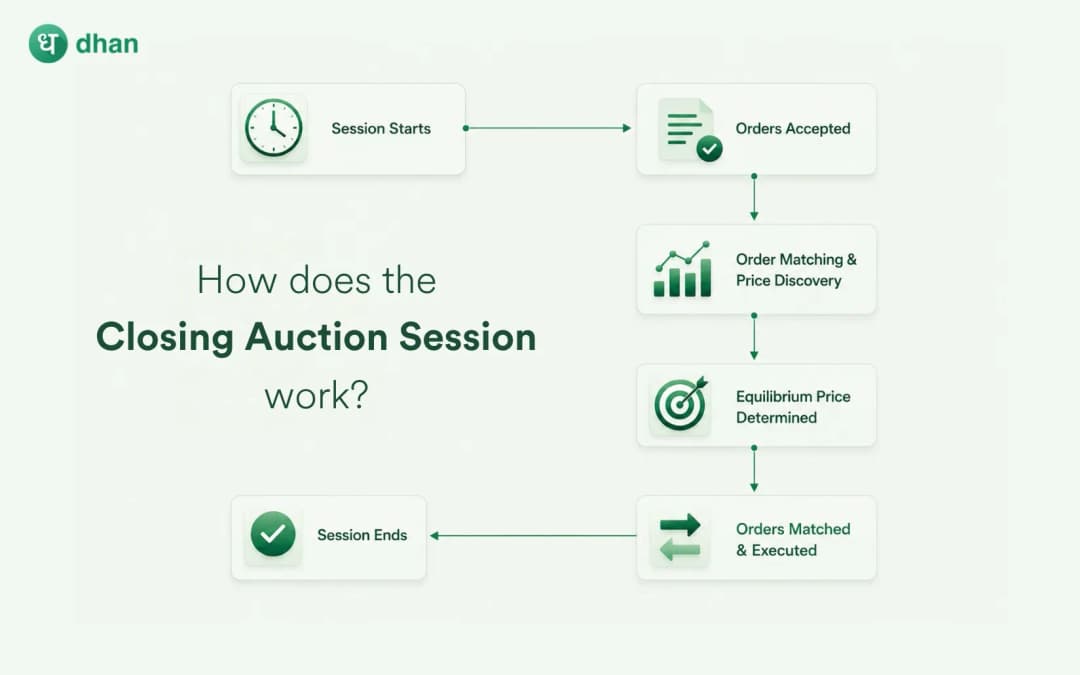
How Closing Auction Session works?
Have a look at the new CAS timeline step by step to understand the concept better.
3:00 PM to 3:15 PM
The usual trading session continues during this phase. In this window, the Volume Weighted Average Price of trades serves as the reference price. It is the anchor around which the whole auction is built.
3:15 PM to 3:20 PM
This is a short transition when no new order can be placed. The exchange sets a ±3% price band around the reference price, and eligible pending orders are carried forward. During this phase, stop loss orders and disclosed quantity orders get cancelled.
3:20 PM to 3:25 PM
During this short span of five minutes, order entry opens up. This means traders can place orders, modify them, and cancel both limit and market orders. This is pure bidding, not matching. So, traders will start seeing an Indicative Equilibrium Price, which would be a live preview of where the price may close.
3:25 PM to 3:30 PM
The last five minutes allow only limit orders, and market orders cannot be touched any more. If any new market order is placed, it automatically gets converted into a limit order at the indicative price. Then, the window closes at a random moment between 3:28 and 3:30 PM. Nobody can time the final tick.
3:30 PM to 3:35 PM
No more orders can be placed, and every trade matches at the equilibrium price, which becomes the official close.
3:35 PM onward
This is the post-close session. It would be working exactly as it does today.
With regard to the new Closing Auction Session, two things are worth noting. Stocks without F&O contracts remain unaffected and will close on the basis of the old VWAP method. The equity derivatives segment now remains open till 3:40 PM, which provides the cash market auction time to finish.
How is the Equilibrium Price picked?
During the matching window (3:30 – 3:35 PM), the exchange collects all eligible buy and sell orders and determines the single price at which the largest quantity of shares can change hands. This price becomes the equilibrium price and the day's closing price. The tie-breaking hierarchy involves the following:
- Maximum executable volume: The price at which the most shares can be matched is the Equilibrium Price.
- Smallest imbalance: If two prices allow the same maximum volume, the one with the least unmatched quantity (difference between total buy and sell quantities) wins.
- Closest to reference Price: If still tied, the price nearest to the reference price is chosen.
- Reference price as midpoint: If the reference price sits exactly between two candidate prices, the reference price itself becomes the equilibrium price.
- No equilibrium found: If no equilibrium price can be discovered at all, the reference price becomes the closing price.
Crucially, every participant who trades during CAS trades at the same single equilibrium price; therefore, no one gets a worse fill because their order arrived later. This is a fundamental structural difference from continuous trading.
What CAS means for F&O traders
CAS brings a few practical changes bundled together.
- Stop loss orders and IOC orders won’t work during the auction window. Therefore, traders no longer have the option to depend on a stop loss in the last few minutes of the day.
- Market orders can be placed only between 3:20 PM and 3:25 PM. Stock futures also get their own ±3% band reset around this window. These are computed from their own reference price, and not that of the cash market.
- It’s important to focus on intraday positions here, too. Since the structure of the trading day has shifted, traders must check the updated auto square-off timings for both cash and derivatives of their brokers. This ensures that an open MIS position doesn’t get caught off guard with the new schedule in place.
Here is a video explainer on How CAS Works
To wrap up
The Closing Auction Session, once introduced in August, will mark an important change in how the Indian stock market determines the official closing price of F&O-eligible stocks. The new mechanism will replace the existing VWAP-based method with an auction-based system. The goal is to make closing price discovery more transparent and align it to the actual demand and supply in the market.
This change is unlikely to affect day-to-day investing for long-term investors. However, those trading intraday or in the F&O segment must adapt to the revised trading schedule.
It’s a small-looking change with a big purpose. The goal is to establish a fairer and more transparent way to decide where a stock closes each day.