Closing Auction Session (CAS): Key Timelines & Rules







Key takeaways:
- CAS will be implemented from August 3 2026, for F&O eligible stocks only. The closing price of non-F&O stocks will remain unchanged and continue to be calculated on the basis of the existing methodology of 30-minute VWAP.
- The Continuous Trading Session for CAS eligible stocks is from 9:30 AM to 3:15 PM. The auction order entry window is from 3:20 PM to a random close between 3:28 and 3:30 PM, followed by trade matching and price confirmation from 3:30 to 3:35 PM.
- The Equilibrium Price is the price at which the most orders can be matched between the entire order pool of buyers and sellers and is the official closing price.
- The Reference Price (VWAP of 3:00 to 3:15 PM) is used to determine the price range of CAS order entry (±3%) and is also used as a fallback closing price if no equilibrium can be found.
- Stop Loss, IOC, disclosed quantity and Super Order targets are cancelled at 3:15 PM and will not carry into or trigger during CAS. Market orders are only accepted during the 3:20-3:25 PM time window, and then they are automatically changed to Limit orders at the IEP.
- Equity and index derivatives continue trading until 3:40 PM. The derivatives closing price is based on the VWAP of the last 30 minutes, which is now calculated from 3:10 PM to 3:40 PM.
- The MIS auto square-off timings will be 3:10 PM for all equity cash positions and 3:25 PM for index and equity derivative positions.
From August 3, 2026, all F&O eligible stocks listed on NSE and BSE will have a different closing time. The official closing price of Indian stocks will be determined by a dedicated Closing Auction Session (CAS). The introduction of CAS by SEBI is one of the most important changes in the Indian market microstructure in recent years, as it will replace the current VWAP-based closing price calculation with a transparent, auction-based mechanism.
This is not a change that only impacts institutional players; it impacts everyone who trades in the Indian stock market in one way or another and adds more transparency to the Indian markets. Before August 3, it is important for retail investors, intraday traders and F&O participants to know what is changing, what is not and what needs to be done.
Let’s explore the Closing Auction Session (CAS) in detail.
Why does the closing price matter?
Before understanding CAS, it's important to understand what the closing price actually does. The daily closing price of a stock is used for:
- Futures and Options settlement: F&O contracts settle against it.
- Index computation: The official closes of NIFTY 50, Nifty Bank, and SENSEX are computed from constituent closing prices.
- Mutual Fund NAVs: The value at which investors buy and redeem mutual fund units.
- Passive fund execution: Index funds and ETFs transact at the closing price to track their benchmarks accurately.
Currently, the closing price of a stock is calculated as the Volume Weighted Average Price (VWAP) of all trades executed in the last 30 minutes (3:00 PM to 3:30 PM). It is a backwards-looking average of whatever happened to trade in that window.
Why did SEBI introduce CAS?
In major jurisdictions around the world, the closing price of stocks is calculated using CAS, which pools market interest together and thus provides a fair and transparent closing price and enhances the efficiency of closing large orders. CAS makes India follow the suit of the London Stock Exchange, Euronext, SGX and Nasdaq, which all have closing auctions to determine end-of-day prices.
CAS is aimed at ensuring a more robust and manipulation-resistant closing price discovery mechanism. It aims to capture the actual demand and supply by consolidating all the buy and sell orders at the end of the trading day. SEBI formally introduced CAS through a circular on January 16, 2026.
How is the closing price calculated today? (The old method)
Currently, the closing price of a stock is calculated as the Volume Weighted Average Price (VWAP) of all trades executed during the last 30 minutes of the Continuous Trading Session, from 3:00 PM to 3:30 PM.
In theory, this smooths out the final 30 minutes to avoid a single trade distorting the closing price. In practice, however, the VWAP method has a vulnerability, i.e. a few well-timed, large orders near the end of the session can still meaningfully shift the average.
In stocks with lower liquidity, particularly, the final 30-minute VWAP can be tilted by institutional-sized trades, which was a major concern that SEBI has flagged as one of the motivations for this change.
What is the Closing Auction Session (CAS)?
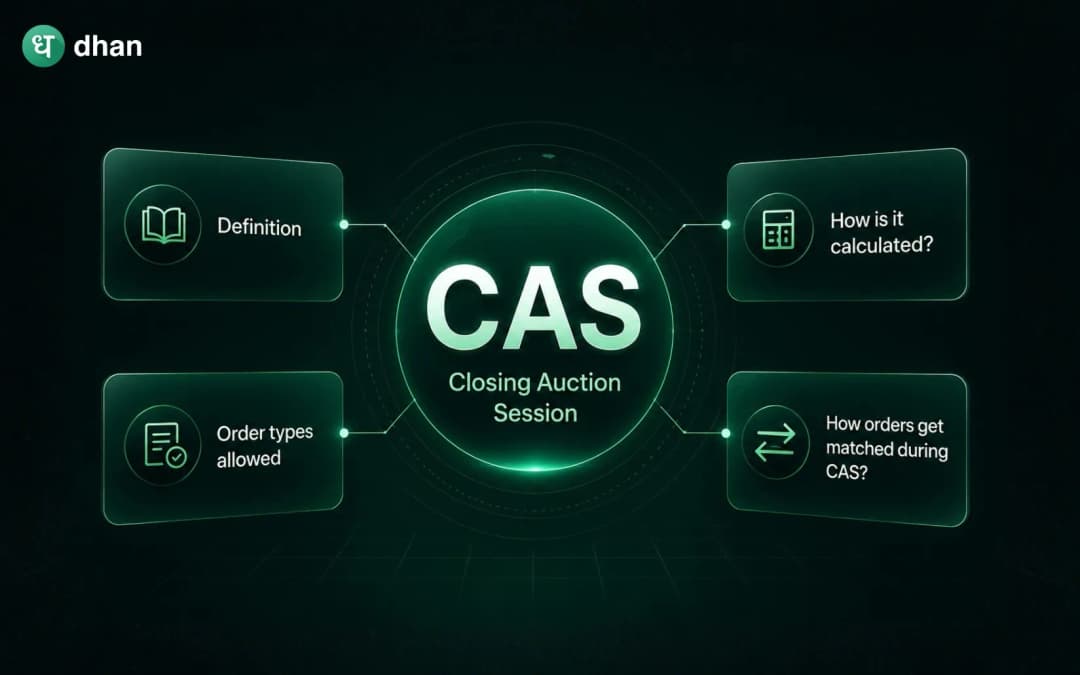
The Closing Auction Session (CAS) is a dedicated call auction session for F&O-eligible stocks in the equity cash segment, from 3.15 PM to 3.35 PM on each trading day. Introduced by SEBI via a circular on January 16, 2026, CAS replaces the VWAP method as the mechanism for discovering the official closing price of covered stocks.
It is a call auction; unlike continuous trading, where orders are matched one by one as they arrive, it matches orders at a single price at which the maximum volume can be matched. That price is known as the Equilibrium Price and is the official closing price for the stock for that day. The session is applicable for NSE, BSE and MSEI as per the circular issued by SEBI.
SEBI rolls out the implementation of CAS in stages. Phase I begins on August 3 2026, and Phase II will take place on September 7, 2026, with further changes to be implemented, such as a new morning Pre-Open Auction Session framework. The CAS timeline consists of the following sessions:
- 3:15 PM – 3:20 PM: Transition Phase (5 minutes)
- 3:20 PM – 3:25 PM: Order Entry (Limit & Market Orders) (5 minutes)
- 3:25 PM – 3:30 PM: Order Entry (Limit Orders Only + Random Close) (5 minutes)
- 3:30 PM – 3:35 PM: Order Matching & Trade Confirmation (5 minutes)
- 3:35 PM – 3:50 PM: Transition Phase (15 minutes)
- 3:50 PM – 4:00 PM: Post-Close Session (10 minutes)
How does the Closing Auction Session work?
SEBI has introduced CAS with effect from August 3 2026, initially for stocks on which F&O contracts are available. Non-F&O stocks continue using the existing VWAP method unchanged. Here is what happens minute by minute on every trading day from August 3:
3:00 PM to 3:15 PM - Final Continuous Trading Session (CTS):
- Regular market trading continues as usual.
- The Volume Weighted Average Price (VWAP) calculated during this 15-minute period becomes the reference price for the Closing Auction Session (CAS).
3:15 PM to 3:20 PM – Transition Phase:
- Continuous trading ends for CAS-eligible stocks.
- The allowable price band narrows to ±3% of the reference price.
- Pending Limit Orders are carried forward.
- Stop Loss and disclosed quantity orders are cancelled.
- No new orders can be placed during this period.
3:20 PM to 3:25 PM – Order Entry (Limit & Market Orders):
- Traders can place, modify, or cancel both Limit and Market Orders.
- No trades are executed during this phase.
- The exchange displays the Indicative Equilibrium Price (IEP), indicating the likely closing price based on current order demand and supply.
3:25 PM to 3:30 PM – Limit Order Entry & Random Close:
- Only Limit Orders can be placed.
- Any Market Orders submitted during this period are automatically converted into Limit Orders at the IEP.
- The order entry window closes randomly between 3:28 PM and 3:30 PM, preventing participants from influencing the closing price at the last moment.
3:30 PM to 3:35 PM – Order Matching & Trade Confirmation:
- All eligible buy and sell orders are matched at a single Equilibrium Price.
- This equilibrium price becomes the official closing price for the trading day.
3:35 PM to 3:50 PM – Transition Phase:
- The Closing Auction Session (CAS) ends.
- The market transitions to the post-close session.
3:50 PM to 4:00 PM – Post-Close Session:
- The official closing price remains unchanged.
- Eligible trades are executed at the determined closing price.
How is the Equilibrium Price discovered?
During the CAS, the exchange does not match orders one by one as continuous trading does. Instead, it collects all eligible buy and sell orders and asks a single question: at what price can the largest quantity of shares change hands?
That price becomes the equilibrium price, and it becomes the day's closing price. Everyone who trades in the CAS trades at that same single price. The exchange applies the following tie-break sequence to determine the Equilibrium Price:
- The price where the maximum executable volume trades.
- If two prices allow the same volume, the one with the smallest order imbalance wins.
- If still tied, the price closest to the reference price.
- If the reference price sits exactly midway between two candidates, the reference price becomes the equilibrium.
- If no equilibrium price can be discovered, the reference price serves as the closing price.
What is the Reference Price and how is it calculated?
The reference price of a stock in CAS is determined based on the VWAP of the trades executed in the stock during the period 3:00 PM to 3:15 PM. It is calculated in the following manner:
- VWAP of trades from 3:00 to 3:15 PM.
- If no trades in that window, the stock's LTP for the day.
- If no trades occurred at all during the day, the theoretical price of the stock's futures contract.
The reference price does two jobs: it sets the ±3% price band for the order entry window, and it acts as the fallback closing price if the auction cannot discover an equilibrium. The reference price and the final closing price are different things where the reference anchors the auction; the equilibrium price is the outcome.
Orders allowed and not allowed during CAS
CAS does not allow all types of order execution from 3:15 PM onwards; it only allows restricted activity between 3:20 and 3:30 PM.
Allowed
- Limit Orders: They are carried over from CTS and can also be placed during CAS.
- Market Orders: They can only be placed from 3:20 to 3:25 PM; converted to Limit at IEP if placed after 3:25 PM
Not allowed
- Stop Loss orders (both SL-Limit and SL-Market).
- Disclosed quantity orders.
- IOC (Immediate or Cancel) orders.
- Super Order matching is paused during CAS. No Target or Stop Loss attached to a Super Order will trigger during the auction window.
How orders are matched in CAS?
All trade execution during CAS happens at the Equilibrium Price. Market orders are given priority over limit orders. The matching sequence runs as follows:
Market orders match against market orders in time priority at the equilibrium price; any leftover market orders then match against limit orders in price-time priority; remaining limit orders match against limit orders in price-time priority.
Impact of CAS on the F&O segment
CAS is a cash segment mechanism, but it carries significant knock-on effects for derivatives traders:
- Equity derivatives (Index F&O and Stock F&O) now trade till 3:40 PM, extended from before.
- The price band for stock futures is reset to ±3% from 3:15 PM to 3:40 PM. Its reference price is computed from the VWAP of the stock futures' own trades between 3:00 PM and 3:15 PM and can differ from the cash reference price.
- Dynamic price band flexing is paused between 3:15 PM and 3:40 PM. The last half hour of continuous trading for flexing purposes is treated as 2:45 to 3:15 PM.
- There is no change to the options price band or the Limit Price Protection (LPP) methodology.
- Futures and Options closing prices continue to follow the existing method, i.e the VWAP of the last 30 minutes, which now runs from 3:10 PM to 3:40 PM.
How CAS impacts traders?
CAS have different impacts on different types of traders, like:
Long-term delivery investors
Little changes for them. The closing price of F&O stocks will be auction-determined rather than VWAP-based, making it harder for a few large trades to move the number. Passive fund investors in particular benefit, as index funds and ETFs transact at an equilibrium price in place of an average that any large participant could tilt.
Intraday (MIS) traders
They will experience the immediate change. Open intraday equity positions will be auto-squared off at 3:10 PM, and intraday derivative positions at 3:25 PM. Traders who previously used time up to 3:20 PM in cash need to move their deadline forward.
F&O traders
Stop Loss orders will not be carried over to the CAS window. All SL orders that have not been triggered by 3:15 PM are cancelled. The longer trading period for derivatives (until 3:40 PM) gives more time to traders to manage their F&O positions after the auction; however, there is no SL protection during the auction hours, which is a big workflow change.
New Intraday (MIS) auto square-off timings
This is one of the most operationally important changes for intraday traders. From August 3, 2026, the following auto square-off timings will apply on Dhan:
Changes effective from September 7, 2026
To align price discovery at the open and close, SEBI has also modified the pre-open auction session, effective from September 7, 2026. The pre-open session will continue to be 15 minutes long from 9:00 AM to 9:15 AM and will close randomly between 9:08 AM and 9:10 AM, system-driven. Only Limit and market orders are allowed during the pre-open session.
Key practical checklist from August 3, 2026
Here is a checklist for market participants to make their CAS adoption a smooth journey:
- Close intraday (MIS) positions in CAS stocks before 3:10 PM.
- Do not rely on Stop Loss orders after 3:15 PM as they will be automatically cancelled.
- Super Order targets and stop losses will not trigger during CAS; therefore, manage them manually before 3:15 PM.
- The price displayed as LTP/CMP between 3:20 PM and 3:30 PM is the Indicative Equilibrium Price (IEP), not a live traded price.
- For F&O traders, derivatives trading extends to 3:40 PM. Stock futures price bands reset at 3:15 PM.
- For non-F&O stocks, there is no change. Trading continues as usual until 3:30 PM.
Here is the detailed video explainer on CAS
To wrap up
The introduction of the Closing Auction Session is a major leap toward global best practices for the Indian stock market. By pooling liquidity and adding safeguards like a ±3% price band and a randomised closing timer, SEBI is actively protecting the market from last-second, low-volume manipulation.
CAS is a behind-the-scenes upgrade for retail investors that improves the fairness of NAVs and portfolio valuations. But for intraday and F&O traders, August 3, 2026 will bring a big change; one which will impact their trading timings, risk management, and order entry practices, requiring them to adjust to the new market structure.