Top 5 Great Trading Strategies







Key takeaways
- Swing trading and trend-following strategies are suitable for traders looking to hold positions for several days or weeks while also observing broader market trends.
- The Breakout and Momentum Strategies focus on big moves in stock prices and provide opportunities to trade as markets gain momentum.
- In scalping, traders make small profits from short-term price changes, especially in highly liquid markets.
- Choosing a good trading strategy depends on one’s personal trading style, available time, financial resources, level of risk tolerance and market conditions.
- To achieve consistent results in trading, good risk management skills are important. Try different strategies, adhere to them strictly and refrain from taking any impulsive decisions based on emotions.
Trading may look simple from the outside: spot a price movement, take a position and then exit at a better price. However, in reality, successful trading involves much more than just picking the right entry point. Market conditions change constantly, setups fail, market volatility can increase quickly, and even well-planned trades can result in losses.
That is why having a clear trading strategy is important. A strategy provides you with a defined approach for finding opportunities, getting into trades, managing positions and deciding when to exit.
In this guide, we will examine five commonly used trading strategies, their functioning, appropriate placement and associated risks so that traders can assess them effectively before using them.
What is a Trading Strategy?
A trading strategy is a set of rules that direct your trading decisions. It assists you in deciding when to buy or sell financial instruments and how much risk to take on.
Strategies differ based on market conditions. Some strategies work better during periods of highly volatile price moves in one direction, while others are designed for markets where price movements are confined to a specific range.
What is most important is using a strategy consistently and understanding the risks associated with it before investing capital.
The top five trading strategies
There is no single best trading strategy for every trader. The right choice depends on your objectives, trading time frame, capacity to take risks, and the type of market you trade. Below are five great trading strategies that every trader should know about.
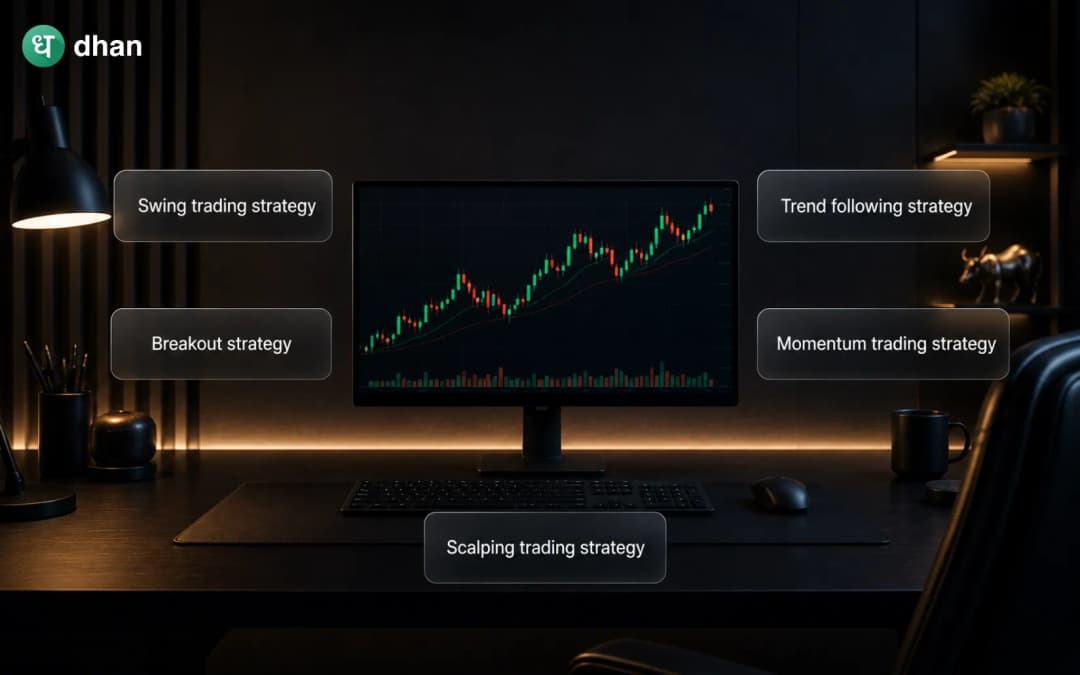
1. Swing trading strategy
In swing trading, traders seek to make profits from the short-term price changes that may last for a few days or weeks. Rather than trying to take advantage of all small price changes, swing traders hope to take a larger part of a market swing.
A trader may look for stocks that are showing strong trends, wait for pullbacks and enter once the price gives signs of moving in the previous direction again.
Swing trading can be easier to manage than short-term trading since positions do not have to be entered and exited within minutes or hours. However, holding positions overnight can leave the trader vulnerable to any unexpected news.
2. Trend following strategy
Trend following involves trading in line with the current market trend. If a security makes consecutive higher highs and higher lows, a trader might seek opportunities to buy. When prices are declining, the focus may shift to short selling where it makes sense.
Traders often use moving averages, trend lines and chart patterns to identify trends. The main idea is simple: rather than trying to predict when a trend begins or ends, the trader aims to participate in the trend while it continues.
The major risk is that markets do not always create trends. When the market moves sideways, trend-following trades may result in minor losses.
3. Breakout strategy
A breakout strategy aims to identify instances where prices break beyond key support or resistance levels. For example, if a stock has consistently failed to rise above a particular price, then breaking above that level might indicate a potential breakout.
Traders look at prices and trading volumes to determine whether a breakout has good strength. A strong breakout can lead to significant market moves due to increased buying or selling activity in the market.
However, breakouts can fail. The price may jump beyond key levels and quickly return to its earlier range. Therefore, it is important to have a clear strategy for exiting the trade.
4. Momentum trading strategy
Momentum trading involves identifying stocks or other financial instruments that show significant price movement. The core concept revolves around entering positions when momentum is strong and exiting when momentum begins to weaken.
Traders often analyse factors such as price movements, trading volumes, and recent performance of an asset to determine whether it has strong momentum. However, momentum can change quickly, so entering late increases the possibility of a sharp price reversal.
5. Scalping trading strategy
Scalping strategy is a high-frequency trading strategy that aims to profit from small, incremental price movements. It works best in highly liquid markets including forex pairs, large cap stocks and actively traded cryptocurrencies.
To execute this strategy, traders may use tools like moving averages, RSI, MACD, volume indicators, and candlestick patterns.
For instance, a trader buys some stocks with an intention to sell them shortly when the price rises, aiming to generate small but quick profits.
How to choose the right trading strategy
Choosing a trading strategy becomes easier by considering a few key factors:
- Trading time frame: Identify whether you want to make short-term trades, engage in day trading or hold positions for days or weeks.
- Risk tolerance: Select strategies that match your capacity to absorb losses on any given trade.
- Available capital: Ensure the strategy aligns well with your capital and does not require you to take any unnecessary risks.
- Market conditions: Consider whether the strategy is effective during strong trend, high volatility or range-bound market conditions.
- Time available: Select a strategy that suits the amount of time you can spend on monitoring and managing your positions.
- Consistency: Go for a strategy which has clear, well-defined guidelines and parameters to support the consistent execution of your trading plan with minimal deviations.
Common mistakes to avoid
Even a well-designed strategy can fail if it is not carried out properly. Some of the most common mistakes include:
- Trading without a plan: Entering a trade without clear entry points, exit strategies and an acceptable level of risk can lead to impulsive decisions and result in heavy financial losses.
- Risking too much capital: Putting too much capital in a single trade can lead to major losses if the market goes against you.
- Chasing the market: Entering a trade immediately after a sharp price rise may lead to entering at high prices with a bad risk-reward ratio.
- Making emotional decisions: The feeling of fear and greed, as well as an impatient attitude, can lead traders to make entries or exits at the wrong time.
- Ignoring market conditions: Trend-based strategies do not necessarily yield good results during range-bound markets.
Conclusion
The best trading strategy is not always the one that looks the most impressive or complex. A good strategy should be simple enough for you to follow consistently and within your risk boundaries.
Trend following, breakouts, swing trading and momentum trading all offer different ways to approach the market. Begin by understanding how a strategy works, then test it carefully and focus on controlling risks rather than trying to make quick gains.
FAQs
What is the best trading strategy for beginners?
There is no single best strategy for all beginners. Using a simple method with well-defined entry, exit, and risk guidelines may be easier to understand and apply.
Is swing trading better than day trading?
Neither is superior. In swing trading, traders hold positions for days or weeks, whereas in day trading, traders close their positions during the same trading day.
Can I use more than one trading strategy at the same time?
Yes, many experienced traders use more than one strategy. However, new traders should focus on developing solid skills of one strategy before attempting to combine them, as changing strategies during a trade can lead to heavy losses.
Which trading strategy is most profitable?
There is no one strategy that is profitable under all market situations. Profitability depends on factors like current market conditions, trading costs, trade timing, and how you handle risk.
Do trading strategies always result in profits?
No. Every trading strategy carries an element of risk; even the thoroughly tested can experience losses at times. Past performance of a strategy cannot be used to predict its future performance.