


Bid-Ask Spread in Trading Explained







Key takeaways
- The bid-ask spread is the difference between the highest price a buyer will pay and the lowest price a seller will accept.
- A narrow spread generally indicates better liquidity, while a wider spread can increase trading costs.
- Spread size is influenced by liquidity, trading volume, volatility, market activity, time of day, and major market events.
- Bid-ask spread and slippage are different: the spread is visible before an order, while slippage occurs when the actual execution price differs from the expected price.
- Traders can reduce the spread's impact by using limit orders, checking market depth, choosing liquid instruments, and trading during active market hours.
There is a gap between the price of something you want to buy and the price the seller is willing to sell it at. In stocks, this gap is known as the bid-ask spread. It subtly influences the price you pay or receive, regardless of the "last traded price" on your screen. Here, we shall discuss the basics of bid-ask spread - what it is, how to calculate it, why it exists, and how to minimise its influence on your trades.
What is a bid-ask Spread?
Each tradable security (be it a stock, an option, a futures contract) has two prices at any moment:
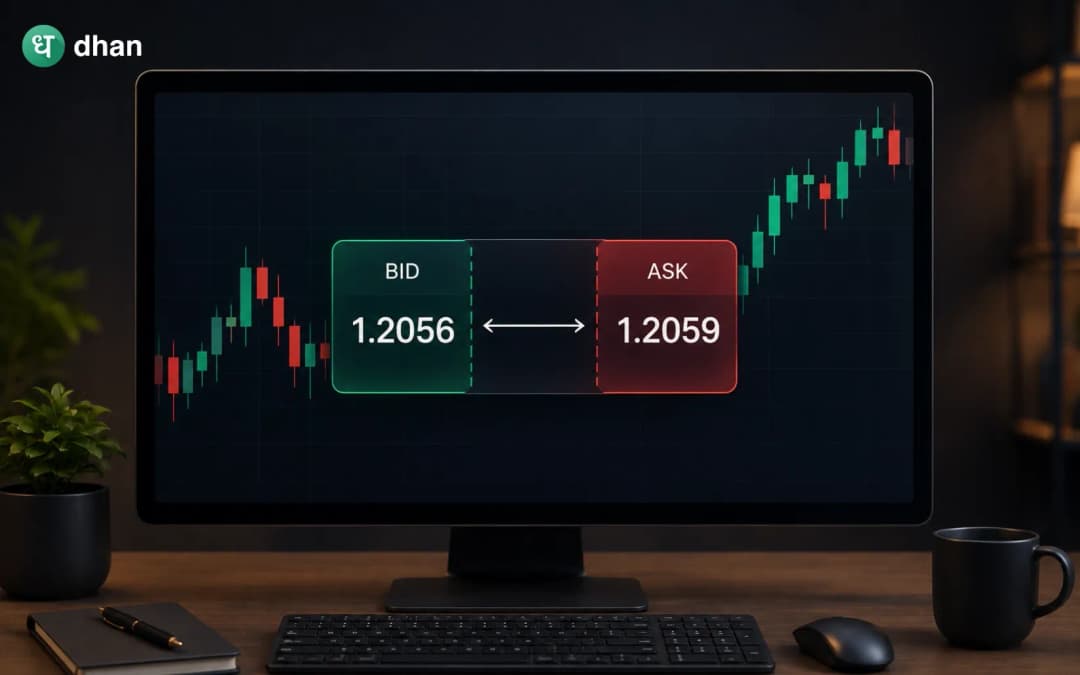
Bid price - the highest price a buyer is willing to pay at the moment
Ask price (also called the offer) - the lowest price a seller would be willing to accept
A bid-ask spread is nothing more than the difference between these two prices. It exists because buyers and sellers almost never agree on a price at the same time.
How is the bid-ask spread calculated?
The formula is easy:
Bid-Ask Spread = Ask Price − Bid Price
Alternatively, you can express it as a percentage of the ask price. This way, it is easier to compare spreads for securities with different values:
Spread (%) = (Ask − Bid) ÷ Ask × 100
Take a security on the National Stock Exchange (NSE) trading at a bid of ₹2,500 and an ask of ₹2,505, that's a spread of ₹5. Doesn't sound like much on a single trade. But run that same trade twenty or thirty times a day, and the ₹5 gaps stack up fast, quietly chipping away at profits before price movement even enters the picture.
Why does the bid-ask Spread exist?
The bid-ask spread performs some surprisingly useful function in the market.
India's markets mostly run on autopilot, with buyers and sellers matched directly by computer. But for certain low-activity products, the exchange still hires a "backup" party (a market maker) to make sure trading stays smooth, and prices stay reasonable, rather than leaving those products to trade only when two people happen to want the same thing at the same time.
Market makers and liquidity providers continuously quote both buy and sell prices, standing ready to trade even when a matching order isn't instantly available.
The spread compensates them for the risk they take on, since prices can move against them while they're holding inventory.
It also covers the cost of operating in the market and the risk of trading against someone with better information.
What are the factors that influence the bid-ask Spread?
The spread varies in accordance with the current market situation. The main factors influencing it are:
Liquidity: The most liquid stocks (usually large-cap stocks) have the tightest spreads, whereas small-cap stocks have larger spreads.
Volume: The higher the volume of trading, the smaller the gap between the bid and ask.
Volatility: Sharp movements in prices lead to widening of the spread due to the protection purposes of market makers.
Time of the day: The spreads usually widen during times of low participation and narrow during times of high participation.
Market-wide events: Spreads may vary in connection with major announcements (e.g., RBI announcements) in light of increased volumes and participation.
Sector: Research of Indian markets revealed that IT and telecom stocks generally have the narrowest spreads, while sectors like services, health care, and industrial manufacturing have wider spreads.
How does the bid-ask spread influence traders?
Imagine the bid-ask spread as a hidden cost of transaction - one which you pay even when there is no change in the stock price.
If you buy the stock at the ask price (let’s say ₹100.50) and immediately sell it at the bid price (₹100), you lose the value of the spread (₹0.50) right away. For long-term investors making trades occasionally, this cost will be negligible. But for intraday and options traders who place numerous trades during the day, it might influence their profitability significantly.
This is the reason why checking the bid-ask spread prior to placing an order is just as important as checking the price itself.
How do you check the bid-ask Spread while trading?
Most trading platforms provide you with live bid and ask prices; however, looking at the full market depth provides a clearer picture.
On the Dhan app, you can use the market depth functionality to see five levels of live bid/ask quotes as well as the quantity of pending orders on each level. Thereby, you can check liquidity before placing an order, rather than after.
For option traders, the option chain functionality provides you with bid-ask quotes in real time.
Bid-ask spread vs. slippage: What's the difference?
Often, people use these terms synonymously; however, it is not correct.
The bid-ask spread is the difference between the best buy and sell prices at any moment, which is visible on your screen before placing an order.
The slippage is the difference between the price you expect when placing an order and the actual price at which the order gets executed. Usually, slippage occurs only in the case of market orders in fast-moving or illiquid instruments, where the price has changed between the moment you pressed the "Buy" button and the execution of the order.
So, these phenomena are related: the wider the spread, the greater the slippage with the market order. The limit order does not suffer from slippage since it executes at the price which you specified, or better, although it has the possibility of not executing if the market changes against your order.
Thus, the distinction is important since traders often claim bad order execution by their brokers, when the reason is the wide spread and market order used in fast-moving or illiquid instruments.
Ways of minimising bid-ask spread impact on trading
Following some good practices goes a long way in minimising the spread impact:
- Using limit orders instead of market orders - especially when dealing with stocks/option contracts that have visible wide spreads to ensure you control your entry/exiting prices.
- Trading during active trading hours of the market, where spreads are likely to be the narrowest because of the increased participation in the market.
- Checking market depth rather than relying on the last traded price alone.
- Going for liquid instruments if you're trading with a very high frequency - illiquid instruments come with a high built-in cost.
- Being more cautious around news events when spreads can become wide in seconds.
Bid-ask spread in different markets
Spread varies greatly in behaviour across various markets, and it is useful to know how it behaves on average.
Equity delivery: Equity delivery is likely to be among the segments having the narrowest spreads, mainly in stocks with high volumes. For instance, a leading IT company or a private bank may have a spread of a few paise because of the continuous two-way participation by both institutions and individuals.
Intraday equity: Spreads in the intraday segment behave quite unpredictably. They are likely to be narrowest at mid-session times, with spreads widening temporarily in the first and the last fifteen minutes of trading.
Futures: Index futures on Nifty/Bank Nifty usually trade with narrow spreads due to high volumes, while futures on lower volume stocks may trade with wider spreads – especially when you're closer to the expiry date.
Options: Spreads are likely to be widest in the options segment. At-the-money options in highly liquid indices usually have relatively tight quotes, but far out-of-the-money strikes/options with low open interest closer to expiry date usually have spreads as a percentage of their premiums. That's the reason why options traders need to pay attention to open interest and volume in addition to the premium while entering a strike.
Commodities: On MCX, spreads react to various global cues, rupee movement, and the trading activity of a particular contract. Near-month gold or crude contracts will usually have narrower spreads than far-month contracts with thin participation.
Currency Derivatives: Spreads in currency pairs such as USD-INR futures usually remain narrow during Indian market hours, with spreads widening around major global economic data releases or RBI interventions.
Conclusion
The bid-ask spread is a small technicality but a real cost that forms part of every trade you place. Knowing why it exists, what causes it to widen/narrow, and ways of working around it makes it easy for you to trade efficiently, be it buying a blue-chip stock or trading an options contract.
Checking market depth, limit orders, and timing are simple practices that go a long way in minimising your trading costs.
FAQs
What indicates a narrow bid-ask spread?
It usually indicates liquidity and high participation in terms of the number of buyers and sellers, making it easy to enter and exit a position at prevailing price levels.
Is a wide bid-ask spread always bad?
Not necessarily bad – it means high trading costs and higher chances of price slippage – especially for active traders.
Does the bid-ask spread change during the trading session?
Yes. It usually narrows during high-volume periods and widens during quiet periods or around major news and policy announcements.
Why do options usually have wider spreads than stocks?
Mainly due to lower trading volume and higher pricing uncertainty in options – especially in strikes that receive less attention from traders.
Can I get rid of paying the bid-ask spread?
I cannot help you totally avoid it - it's part of the trading. But following good practices, such as limit orders, trading of liquid instruments during high participation periods can significantly help you reduce the bid-ask spread.