Top 10 Largest Companies on NASDAQ by Market Cap








Key takeaways:
- The 10 largest NASDAQ-listed companies have a huge market capitalisation, exceeding the nominal GDP of China, Germany, Japan and India.
- Artificial intelligence is the biggest growth driver, as NVIDIA, Microsoft, Alphabet, Amazon, Meta, Broadcom and Micron collectively commit billions of dollars to AI chips, cloud infrastructure, data centres and generative AI platforms.
- NVIDIA and Micron have generated the highest returns over the past 5 yrs while gaining 900% & 1260%, respectively.
Apple, Microsoft, Alphabet, Amazon & Meta together account for more than $15 trillion in market capitalisation while representing over 50% of the combined value of the companies on this list.
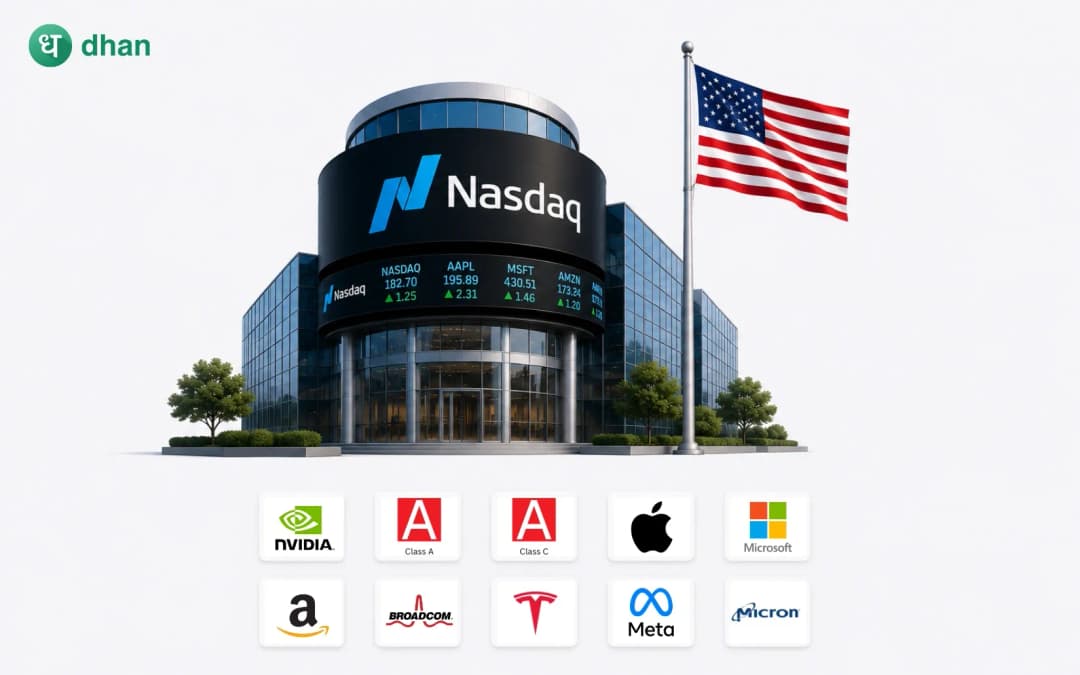
AI has transformed the US stock market, with just a few tech companies driving most of the market's wealth creation. Today, the 10 largest companies listed on NASDAQ drive a combined market capitalisation of more than $28.5 trillion.
Collectively, these companies generated over $2.7T in annual revenue and billions in free cash flow, giving them the financial strength to invest aggressively in next-generation technologies while returning capital to shareholders.
So let’s cover the 10 biggest NASDAQ-listed companies by market capitalisation as of June 2026.
10 largest companies listed on NASDAQ
The table below ranks the largest companies listed on NASDAQ based on market capitalisation as of June 2026.
Note: The data for the above table has been taken from TradingView as of June, 2026.
NVIDIA Corporation
A winner in artificial intelligence infrastructure worldwide. It is popular for its GPUs as well as for CUDA, which is a proprietary software platform of NVIDIA used by more than 6 million developers and over 40,000 companies.
The software moat gives NVIDIA exceptional pricing power and high customer switching costs. It makes NVIDIA a preferred AI infrastructure partner for hyperscalers, enterprises and governments.
While GPU demand continues to drive growth, NVIDIA is working on several AI projects. These include projects such as the Blackwell architecture, AI networking, enterprise software & sovereign AI initiatives.
Alphabet (Class A)
Alphabet Class A has grown far beyond a search engine company and is one of the most diversified AI and digital infrastructure companies in the world. known as Google and owns several subsidiaries such as Google Search, YouTube, Google Cloud, Google Ventures, Google DeepMind, Waymo, etc.
Google Search & YouTube continue to generate huge cash flows, but Google Cloud is becoming the company’s fastest-growing earnings division as businesses accelerate their adoption of AI.
Alphabet’s annual revenue crossed $400 billion in 2025, Google Cloud achieved an annual revenue run rate of $70 billion, and YouTube’s advertising and subscription revenue topped $60 billion.
Alphabet (Class C)
Alphabet Class C shares give buyers the same ownership as Class A shares but without voting rights. For investors only focused on the long-term financial gain, it makes them a desirable option.
As enterprise artificial intelligence use sped up, Google Cloud sales increased 36% annually, and Alphabet's 2025 revenue reached $400 billion.
Also produced an operating cash flow of $164.7 billion and bought back more than $45 billion of Class A and Class C shares, hence boosting shareholder value.
Apple
With an installed base of more than 2.5 billion active devices, Apple has created one of the most valuable consumer technology ecosystems in the world. Though the iPhone is still its main source of income, investors are starting to appreciate the company's growing services division, which brought in more than $416 billion in fiscal 2025.
The company's prospective revenue growth will rely on ongoing Services development and effective AI integration.
Microsoft
Ranked fifth, Microsoft has evolved from a software firm into the world's top provider of AI and cloud computing solutions. Though still important products, Windows and Office are no longer Microsoft's primary engine of growth; Azure, which generates over $75 billion yearly, has taken that place.
Microsoft Cloud's revenue was $168.9 billion, mostly from companies’ high demand for Azure, Microsoft 365, GitHub, and AI-powered Copilot solutions. With a strong 34% return on equity, Microsoft disclosed $281.7 billion in fiscal 2025 sales.
Amazon
Though many of us associate this business with a shopping website, the company has evolved into a varied technology leader with cloud computing, digital marketing, and artificial intelligence, providing more profit than e-commerce.
Amazon generated $716.9 billion in sales in 2025, with Amazon Web Services providing $128.7 billion and more than half of the operating income.
Amazon is investing heavily in AI chips and AWS data centres while generating steady growth from cloud services, advertising, Prime memberships and its online marketplace.
Broadcom
Broadcom an important role in AI infrastructure by supplying networking chips and connectivity solutions used in hyperscale data centres.
Unlike many other semiconductor businesses, Broadcom generates ongoing software income via VMware. It offers Broadcom a steady cash flow and a varied corporate plan.
With $20 billion coming from AI-related products, total revenue for fiscal year 2025 is $64 billion.
Tesla
Most investors know Tesla as an electric vehicle company. But today, it is much more than that. The company is investing heavily in artificial intelligence, autonomous driving and clean energy, even though vehicle sales continue to be its core business. Its energy generation and storage section installed a record 46.7 GWh in 2025.
Also making significant investments in Full Self-Driving, Optimus humanoid robots, artificial intelligence infrastructure, and the Cybercab platform. Its long-term worth will rely on autonomous mobility, Optimus manufacturing, energy storage development, and FSD acceptance.
Meta Platforms
Meta Platforms is now one of the world's largest investors in AI infrastructure. The company is backed by 3.58 billion daily active users across Facebook, Instagram, WhatsApp and Messenger.
AI-powered recommendations are helping improve user engagement and advertising performance. In 2025, Meta generated $200.97 billion in revenue.
Investors should keep an eye on AI-driven advertising, WhatsApp monetisation, and Meta AI adoption as the following long-term profit drivers for the company.
Micron Tech
Micron has become one of the main winners of the artificial intelligence boom as demand for high-bandwidth memory keeps rising. Micron provides HBM, which is necessary to run and train complex artificial intelligence models, therefore making Micron a major source for leading AI chip makers.
With management confirming that HBM manufacturing is basically sold out through 2026, supporting higher prices and profits, it stated $37.4 billion in sales in fiscal 2025.
Investors should keep an eye on important earnings drivers like long-term supply contracts, AI server demand, and HBM capacity growth.
To Conclude
Through leadership in artificial intelligence, cloud computing, semiconductors, digital advertising, and enterprise software, the biggest NASDAQ-listed companies help to shape world markets.
Although their scope is remarkable, long-term investment success relies on analysis of profitability quality, capital distribution, competitive advantages, and future development drivers.