Trailing Stop Loss





Key takeaways
- A trailing stop loss serves as a risk management strategy and automatically moves with the rising stop price to protect your gains.
- This feature allows traders to avoid emotional exits when markets fluctuate.
- Traders and investors should maintain a proper trailing distance to balance risk and reward.
Profit maximisation happens to be the ultimate goal of every trader. However, if you want to stay profitable, you must know when to exit. Many traders book profits too early out of fear. Again, holding on to a position too long, hoping for profits, can eventually erode the gains. Both these situations can hurt your overall trading performance.
This is where a trailing stop loss can help you lock in your profits. This is different from a regular stop loss that remains fixed. Instead, it adjusts automatically as prices move in your favour. In the process, you can protect your gains while still enjoying room for further upside.
In this blog, we have explained how a trailing stop loss has become one of the most practical tools to balance risk management and protect profits.
What is a trailing stop loss?
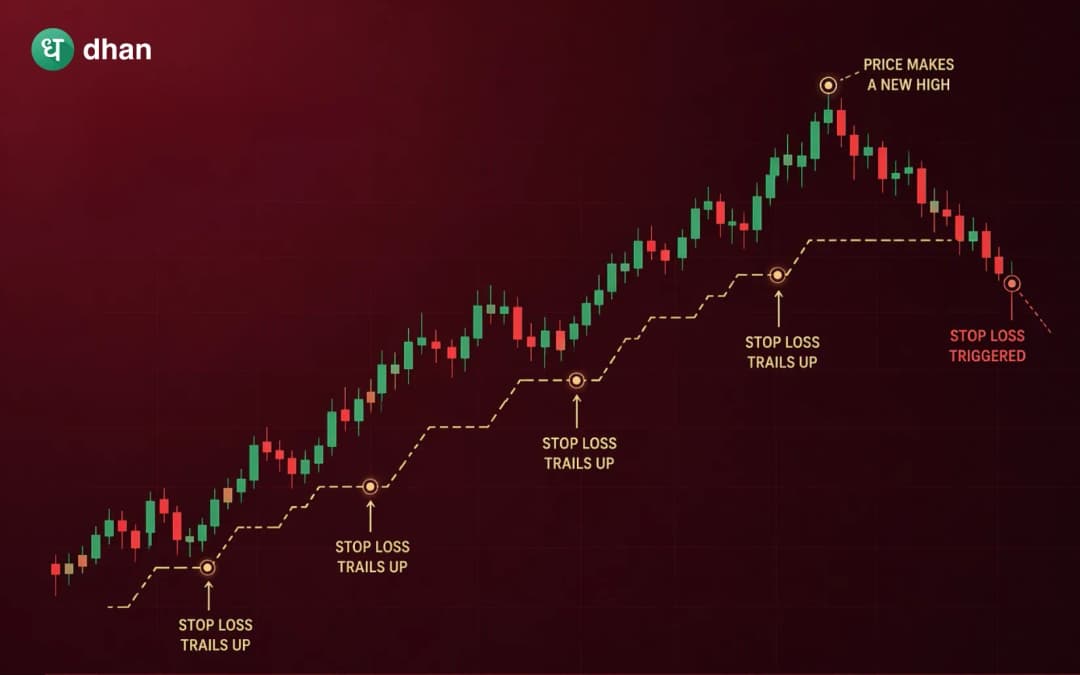
You may consider a trailing stop loss as a dynamic stop loss order. It automatically moves along when there’s a favourable price movement in your trade. The primary goal of a trailing stop loss is to protect your gains while you can still benefit from the continued price momentum.
The adjustable nature of a trailing stop loss makes it different from a fixed stop loss. However, if the market starts moving against you, it does not move backwards. The sell order is triggered at a favourable exit price, where you book your profits.
For instance, you buy a stock at INR 500 and set a trailing stop loss of INR 20. If the stock price rises to INR 550, the trailing stop loss automatically moves up to INR 530. Now, if the market experiences a sudden volatility and the price falls back to INR 530, the stop loss is triggered, and you exit the trade. This prevents further erosion of your profits when markets turn unfavourable. In the process, you can book a portion of your profits, but you do not have to adjust the stop loss constantly.
Particularly, trailing stop losses are popular in trend-following strategies. This feature helps you stay invested when the momentum seems strong. You do not have to guess the perfect exit price. You simply use this feature to allow the market trend to decide when your position should close.
Trailing stop loss, therefore, helps both beginners and experienced traders create a more disciplined approach to managing their trades.
How a trailing stop loss works in trading
Let’s understand how a trailing stop loss works in trading in three steps.
Initial stop loss placement
The initial step is about deciding your trailing distance. This distance determines the gap between the current market price and the selling price.
Some traders are comfortable with percentage-based trailing stops. Others prefer fixed point values. For instance, you may set a trailing stop loss of 5%, or a fixed trailing stop of INR 20. It depends on the volatility of the stock and your strategy.
However, you must follow a realistic strategy. If the trailing stop is too tight, the sell order may unnecessarily be triggered due to small fluctuations in the market. Again, if it is too wide, you may have to lose a significant portion of your profits before you exit. The goal should be to balance flexibility with protection.
How the stop loss adjusts upward
The key feature of a trailing stop loss is that it moves only when the price moves in your favour. Suppose a stock continues to rise steadily after purchase. The trailing stop continues moving upward along with the price, while it maintains the distance you have already defined.
After a while, there’s a decline in the stock price. The stop loss remains fixed at the highest level adjusted, and doesn’t move downwards. So, your profits that have been accumulated remain protected.
Active traders find this automation beneficial as it reduces the need for constant monitoring. A trailing stop loss also prevents emotional decision-making while trading.
What happens when the market reverses
If the market reverses and falls enough so that the trailing stop level is reached, the stop loss gets triggered automatically. Based on the order type you selected, the trade exits, and you book your profit. This system helps traders avoid giving back large portions of unrealised profits during sharp reversals.
Why traders use trailing stop losses
Trailing stop loss orders help traders protect their gains and reduce emotional decisions to manage risks better.
Protect profits during strong trends
Investors can participate in larger market trends with trailing stop losses. You do not have to book your profits too early, and you can stay invested as long as the price continues to move in your favour. The trailing stop keeps moving upward and protects your gains.
Reduces emotional trading decisions
Often, traders may exit profitable trades too early out of fear. Again, greed sometimes prevents them from booking profits at the right time. With a stop loss order, you can avoid both these emotional extremes.
Better risk management
When you visualise long-term success in trading, risk management is non-negotiable. Trailing stop losses help you balance downside protection with participation in the upside.
You do not have to manage every trade movement manually. This allows you to concentrate more on strategy and position sizing. The exit management is automated by a trailing stop loss. This disciplined trade management matters more than predicting every move correctly.
Different ways to set a trailing stop loss
Depending on your strategy, you may choose to place a trailing stop loss in three ways.
Percentage-based trailing stop loss
With a percentage-based trailing stop loss, you fix the selling price of a stock at a fixed distance based on a percentage. For instance, if you set a 5% trailing stop loss, the cap always remains 5% below the highest price reached after you entered the trade. Beginners find this method simple and easy to understand. It works well in trending markets when stocks move steadily over time.
However, you must adjust the percentage depending on the volatility of the stock. For stocks that are highly volatile, the trailing percentage must be slightly wider.
Volatility-based trailing stop loss
Some traders decide the placement of their stop loss value based on volatility in the market. They do not fix percentages. Instead, they keep adjusting the stop loss depending on how much the stock price usually fluctuates. With this approach, you can prevent premature exits caused by normal swings in the market.
Often, experienced traders prefer this strategy. It aligns with the stop loss more closely with the actual behaviour of the market.
Technical indicator-based trailing stop loss
Sometimes, traders performing technical analysis place their stop losses using the indicators of the chart and price structures. Common methods of placing this type of trailing stop loss involve using moving averages, support levels, or Average True Range indicators.
During a strong uptrend, a trader may trail the stop below a rising moving average. As a result, you create strategy-based exit decisions.
Common mistakes traders make with trailing stop losses
Avoid these three common mistakes traders often make while using trailing stop losses.
Keeping the trailing stop too tight
Often, traders place the trailing stop too close to the current price. However, small fluctuations in the market can trigger exits even when the broader trend continues to be strong. As a result, they miss out on larger trends.
Ignoring market conditions
While trading, you must understand that different trailing stop strategies are necessary as market conditions differ. A wider trailing distance works in volatile markets. In stable trending markets, you need tighter stops. So, the same trailing setup does not work for every stop in every condition.
Changing stop losses emotionally
Some traders start moving their trailing stop losses farther away once the market starts falling. They hope for the prices to recover and keep adjusting them. However, this often turns manageable losses into much larger ones.
Trailing stop loss for different trading styles
With the right approach, a trailing stop loss can be beneficial in intraday, swing, or positional trading strategies.
Intraday trading
During intraday trades, you deal with rapid price movements throughout the session. When markets are volatile, trailing stop losses help you secure profits quickly. Fast execution is extremely important in this type of trading. It reduces the need for constant manual adjustments.
Swing trading
If you’re into swing trading, you usually hold your position for several days or weeks. In this type of trading, a trailing stop loss helps you stay invested during medium-term trends. When the momentum weakens, the sell order is triggered and you book your gains.
Positional and long-term trading
Positional and long-term investors use the trailing stop loss feature during extended trends in the market. Over the longer horizon, you do not have to react to small price fluctuations. Instead, you can use this feature to protect larger capital accumulated during prolonged bull runs.
The bottom line
Risk management is as important as protecting your profits. A trailing stop loss order helps you strike this balance.
However, observe the stock price closely to understand the level of volatility it undergoes in the market. A thoughtful approach with trailing stop losses can help you remain consistent as you protect your gains and build disciplined trading habits across different market conditions.
FAQs
How is a trailing stop loss different from a normal stop loss order?
While a normal stop loss order remains fixed at the pre-decided price, a trailing stop loss order moves with favourable movement in price. During reversals, the latter helps them protect their profits.
Can a trailing stop loss order fail?
Usually, a trailing stop loss order does not fail as these are advanced features. However, if there’s a huge gap in prices, the order may not be triggered at the exact intended price.
Can trailing stop losses help protect profits automatically?
Yes. This is because trailing stop losses are adjusted dynamically. They help you book your profits, and there’s no need for constant manual monitoring.
What is the best trailing stop loss percentage?
There is no fixed percentage. The ideal trailing stop depends on the volatility of the stock, your strategy, and individual risk tolerance.
Are trailing stop losses suitable for beginners?
Yes. Beginners can use trailing stop losses to improve their discipline. It also reduces the chances of emotional decision-making during trades.