What is Finnifty







Key takeaways
- Finnifty is a sectoral index that tracks the financial services sector in India.
- Banks, NBFCs, and insurance companies mostly constitute the Finnifty index.
- Traders track the Finnifty index to gain sectoral insights and active derivatives trading.
The financial services sector is one of the powerful forces that drive Indian markets. The overall economic momentum of the country, including credit flow and liquidity, is influenced by various financial institutions. Insurance companies, NBFCs, and other organisations associated with finance collectively define this influence. It’s due to this strong impact that traders and investors closely observe sector-specific indices. This helps them feel the pulse of the market more clearly.
Finnifty is one of these indices that track this sector, and it has gained attention in recent years. Active traders looking for exposure to financial sectors often track this index. Finnifty helps you track how financial companies perform as a group.
In this blog, we have comprehensively explained what Finnifty is, how it works, and why it matters for traders.
About Finnifty
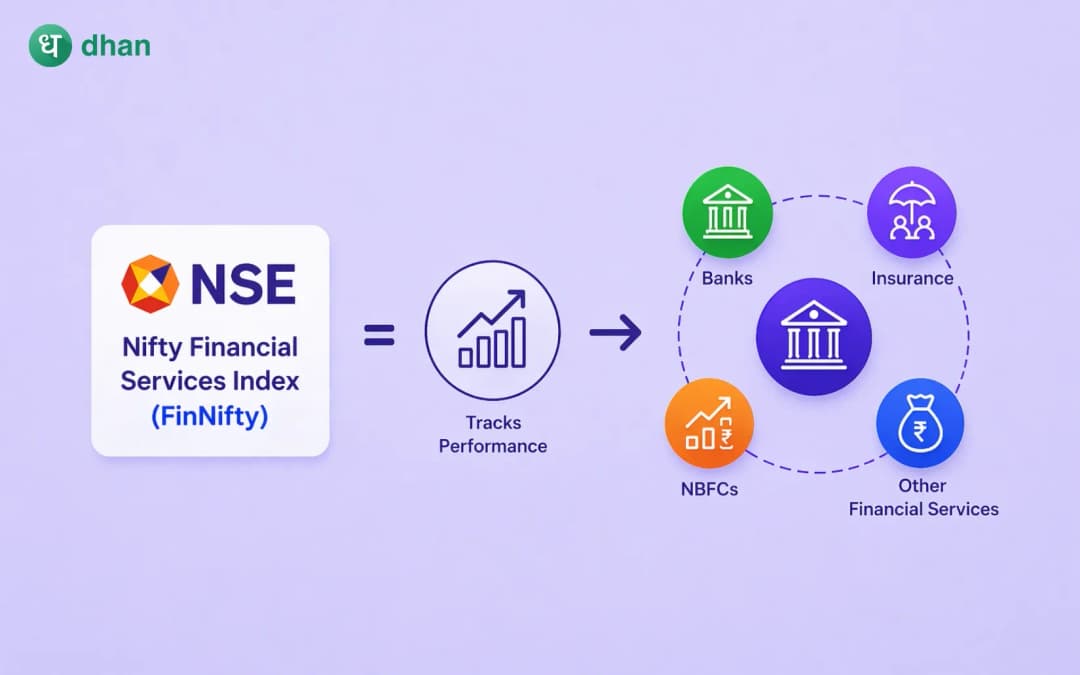
First, let’s understand what is Finnifty. It denotes the Nifty Financial Services Index, a sectoral index that represents the financial services industry in India. The index includes companies from sectors like banking, insurance, housing finance, NBFCs, and other financial institutions listed on the NSE.
The Finnifty tracks the performance of India’s financial market as a whole. It does not reflect the entire market like the Nifty 50. Instead, its focus lies only on financial companies.
While the Finnifty is more concentrated, it’s more responsive to changes in:
- Interest rates
- Credit growth
- Performance of the banking sector
The capital markets in India, along with the growth in its GDP, are influenced largely by financial services. That’s why Finnifty is considered a crucial indicator of economic health. Traders also engage in derivatives trading through futures and options on Finnifty. Currently, it has emerged as one of the most-watched sector indices in India.
How Finnifty works in the stock market
Finnifty includes companies from the financial services sector that meet certain eligibility criteria. These include their size in terms of market capitalisation, liquidity, and frequency of trading.
The goal is to make sure that only financially strong and actively traded companies make their way to the index.
Index calculation and weightage
A free-float market capitalisation-weighted method is followed in Finnifty. This means the influence of companies with higher market value and publicly available shares is higher on the index movement.
The contribution of large financial institutions to fluctuations in the index is higher compared to smaller companies. Therefore, even a few major stocks from the banking or financial segments can impact the direction of the Finnifty on any trading day.
Trading and derivatives activity
Finnifty is extensively used in trading derivatives like futures and options contracts. Active traders track Finnifty to take positions based on how they expect the financial sector to perform.
Financial stocks often react strongly to changes in interest rates, demand for credit, and updates in policy. Finnifty shows significant volatility during intraday and short-term trading. That’s why it’s popular among traders looking for sector-based strategies.
Which companies are included in Finnifty?
The current composition of the Finnifty as of 23.05.2026 is presented below:
- Axis Bank
- BSE
- Bajaj Finance
- Bajaj Finserv
- Cholamandalam Investment and Finance Company
- HDFC Bank
- HDFC Life Insurance Company
- ICICI Bank
- ICICI Lombard General Insurance Company
- Jio Financial Services
- Kotak Mahindra Bank
- LIC Housing Finance
- Max Financial Services
- Muthoot Finance
- Power Finance Corporation
- REC
- SBI Cards and Payment Services
- SBI Life Insurance Company
- Shriram Finance
- State Bank of India
Banking companies
A major part of the Finnifty family is composed of banking stocks. Leading banks from the private and public sectors, like HDFC Bank, ICICI Bank, and State Bank of India, are included in the index. These institutions influence credit growth and deposit trends, besides impacting the overall liquidity in the economy. Considering the larger weightage, banking stocks often form the core part of the Finnifty.
Insurance and financial services companies
The index also includes insurance and diversified financial firms. For instance, companies like Bajaj Finance and HDFC Life Insurance influence credit expansion, consumer finance, and insurance penetration in India. In financial services, these companies reflect the long-term structural growth of companies.
NBFCs and housing finance companies
NBFCs and housing firms also constitute a part of the Finnifty. These companies influence how retail consumers, small businesses, and housing sectors receive credit.
Why Finnifty matters to traders and investors
Both traders and investors track the Finnifty as it offers exposure to the financial sector and helps them track economic trends. Short-term traders also prefer derivatives in Finnifty.
Provides focused exposure to the financial sector
The Finnifty index helps you gain a clear view of the financial sector without any influence from other industries like IT or FMCG. Traders follow this index to isolate trends specific to the sector and build targeted strategies based on the outlook of the financial sector.
Helps track economic and credit growth trends
The financial sector is closely associated with economic activities. Financial companies tend to perform better when the demand for credit increases. Investors track Finnifty to understand broader economic trends like the growth of the loan, the impact of interest rates, and the liquidity of the economy.
Popular for derivatives and short-term trading
Futures and options traders often use Finnifty, considering its liquidity and volatility. Both intraday and short-term strategies are preferred as financial stocks react quickly to economic news or changes in policies.
Finnifty vs other market indices
Let’s understand how Finnifty differs from other popular market indices like the Nifty 50 and the Banknifty.
Factors that influence Finnifty movements
Movements in the Finnifty are largely influenced by three key factors.
Decisions on interest rates
Changes in RBI policies directly impact lending rates. This influences the profitability of banks and financial institutions.
Economic growth and market sentiment
The demand for credit increases when economic activities are strong. This strengthens the performance of the financial sector and improves the movement of the index.
Regulatory and policy changes
Banking regulations, NBFC policies, and financial reforms can significantly impact the sentiment of investors. The direction of the index also changes accordingly.
Advantages and limitations of Finnifty
Now, let’s take a look at the advantages and limitations of the index.
Advantages
- You get focused exposure to financial services through the Finnifty index.
- In the derivatives market, Finnifty is highly liquid.
- Traders looking for targeted exposure to the sector and a better understanding of financial trends often track this index.
Limitations
- Finnifty is a sector-specific index and carries the risk of concentration.
- It is more sensitive to interest rates and economic cycles compared to diversified indices.
To wrap up
The Finnifty is a crucial benchmark that helps you understand the health of the financial services sector in India. It reflects the performance of banks, insurance companies, NBFCs, and other financial institutions in the country, which defines the strength of its economy.
Whether you’re tracking the performance of the finance industry or trading derivatives, a clear view of Finnifty can help you understand how the financial environment behaves. Keep an eye on the index and analyse the performance of individual stocks under the Finnifty for deeper insights.
FAQs on Finnifty
What does the Finnifty track?
As a sectoral index, the Finnifty tracks the financial services companies in India listed on the NSE.
Which companies are included in Finnifty?
The Finnifty is composed of leading banks, NBFCs, insurance firms, and financial institutions like major private and public sector companies.
How is Finnifty different from Banknifty?
Banknifty includes only banking institutions in India. Finnifty, on the other hand, covers the entire financial services sector.
Can traders buy and sell Finnifty derivatives?
Yes, traders can trade Finnifty futures and options, and these are preferred for their volatility.
Why does Finnifty matter to investors?
Finnifty matters to investors as it helps them track the performance of the financial sector. The index offers valuable insights into broader economic and credit trends.