Difference between ETF and Mutual Funds




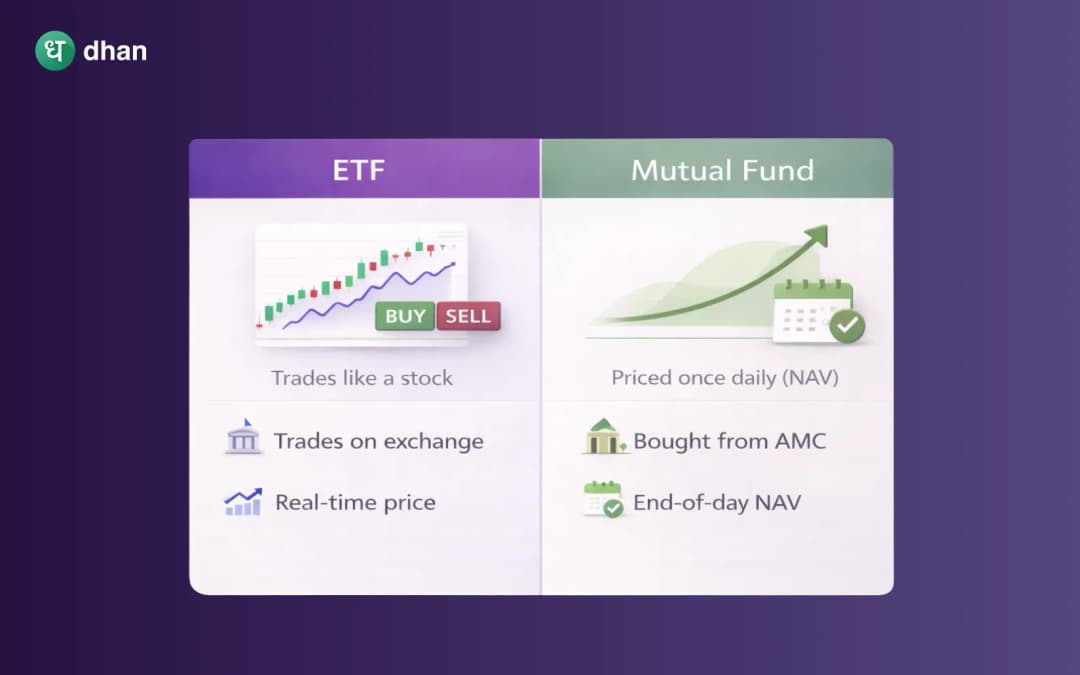


Investors tend to get confused many times between exchange-traded funds (ETFs) and mutual funds. This is because both are market-linked investments which pool capital and invest in securities. They might seem to be alike at first sight; however, their structure and trade style, costs, and flexibility are quite different.
It is important to have knowledge of these differences as they have a direct impact on your investment strategy, risk management, and long-term wealth.
This article outlines difference between ETF and mutual funds in terms of trading mechanisms, pricing, costs, liquidity, and risk. It seeks to assist investors in selecting the best option that suits their investment style.
What is an ETF?
An Exchange-Traded Fund (ETF) is an investment fund that follows an index, commodity, industry or asset class and is traded on stock exchanges like a share. ETFs integrate the characteristics of mutual funds and equities, which makes them transparent and flexible.
They usually are passive investments that are designed to imitate the performance of an index like the Nifty 50 or the Sensex. Rather than picking stocks individually, ETFs invest in a bunch of securities, which replicate the index composition.
In contrast to mutual funds, ETFs may be sold or bought in the market hours on exchanges like the NSE and the BSE. Depending on demand and supply, their prices vary throughout the trading day. Investors who favour low-cost passive investment, swift entry and exit, and exposure to particular sectors or indices usually tend to use ETFs.
Advantages of investing in ETFs
These are the benefits of ETF investing:
- Lower expense ratios in most cases
- Intraday trading flexibility
- Transparent holdings
- Tax efficiency in certain markets
- Suitable for tactical allocation
What is a mutual fund?
A mutual fund refers to an investment instrument which is professionally managed, and where the capital of several investors is pooled together and invested in equity, bonds or other assets. A professional fund manager manages the fund and makes investment decisions according to the objectives of the fund.
Mutual funds are not traded on exchange platforms by investors. They instead purchase or redeem units at Net Asset Value (NAV) announced by the Fund House directly, which is calculated once at the end of each trading day.
Mutual funds may be active or passive. Active funds use stock selection to outperform the market, whereas passive funds seek to track an index. These are controlled by agencies like the Securities and Exchange Board of India. They guarantee transparency and investor protection. Long-term investors prefer mutual funds because they involve systematic investment and professional management.
Advantages of investing in mutual funds
Mutual funds are often preferred by long-term investors focusing on disciplined wealth creation.
- Professional active management
- No need for a trading account (for direct mutual funds)
- Goal-based investing
- Suitable for beginners
Difference between ETF and Mutual Fund
Here we will understand how is ETF different from mutual funds.
Trading mechanism
ETFs are traded on a stock exchange just like shares and can be bought and sold by investors during ordinary market hours. Mutual funds, on the other hand, can be purchased or redeemed at the asset management company directly at the end-of-day NAV.
Pricing structure
ETFs' prices vary during the trading day depending on the demand and supply of the markets. Mutual funds are priced once per day after the markets close based on the aggregate value of the underlying assets.
Cost and expense ratio
ETFs tend to have lower expense ratios as they are passively managed and track indices. Mutual funds, particularly the actively managed mutual funds, are more costly because of research, fund management, and administrative fees.
Liquidity and flexibility
ETFs provide intraday liquidity and enable investors to respond rapidly to the market forces. Transactions in mutual funds are done once on a daily-basis, restricting real-time flexibility.
Management style
The majority of the ETFs utilise passive strategies, imitating the index performance. Mutual funds may either be managed actively to outperform markets or passively, such as index funds.
Transparency
Disclosure of ETF holdings is usually done on a regular or daily basis. ETFs are comparatively more transparent as the mutual fund portfolios are periodically disclosed, mostly monthly or quarterly.
To make your decision easier, we have built a quick ETF vs Mutual Fund comparison tool that allows you to evaluate both investment options side by side. Try it, you will love it.
ETF vs Mutual Funds: Returns & Risk
Both ETFs and mutual funds give market-linked returns, which means the performance is dependent on underlying securities and market conditions.
ETFs seek to reflect index performance, and hence, their returns are much in line with the benchmark. They hardly outperform the market but offer predictable performance at reduced cost.
Mutual funds and particularly those that are actively managed, can underperform or overperform based on the strategy of the fund manager and the timing of the market. This brings in opportunity and risk, both.
Both types of investments have diversification since they invest in a basket of securities. Nonetheless, sector-specific ETFs can be more volatile as opposed to diversified mutual funds. Risk levels are determined by asset allocation, market conditions and the investment horizon as opposed to the investment instrument solely.
When should investors choose ETFs?
ETF is appropriate for an investor who favours a low-cost and passive investment approach. They best suit individuals who prefer to monitor market indices instead of depending on the decisions of fund managers.
Investors who are active market followers and seek the freedom to purchase or sell at any time during trading hours might favour ETFs. They can also be used to gain exposure to sectors, commodities, or overseas markets in a short time.
Investors who are cost-conscious leverage lower expense ratios, particularly within long-term portfolios. ETFs are also suitable for investors who are familiar with demat accounts and stock trading platforms.
When should investors choose mutual funds?
Mutual funds are more suitable for those investors who want long-term wealth creation and professional management. Investors who like a hands-off approach can go with the convenience of having fund managers who conduct research and manage portfolios.
Mutual funds are ideal for disciplined investing and consistent capital allocation through the Systematic Investment Plan (SIP). They can be more convenient to investors who do not actively follow the markets. Moreover, mutual funds are also suitable for those who seek goal-oriented investments like retirement, child education and wealth accumulation since they provide diversified choices with respect to varying risk profiles.
You must also read this: ETFs vs Mutual Fund: Which offers more flexibility?
To conclude
Learning the difference between an ETF and a mutual fund enables investors to match their investment preferences with their objectives and risk tolerance. ETFs are more flexible, transparent and less costly, whereas mutual funds offer professional management and structured long-term investment.
Hence, one-size-fits-all doesn’t apply here. The correct choice between EFT and a mutual fund is determined by factors like the investment horizon, cost preference, trade involvement, and comfort in tracking the market. Before choosing to invest in ETFs or mutual funds or both in a diversified portfolio, it is advisable for investors to analyse their financial goals and risk tolerance, along with their degree of involvement.
FAQs
1. Are ETFs safer than mutual funds?
Both mutual funds and ETFs have market risks. It is the underlying assets and diversification that determine safety.
2. Can I start SIP in ETFs?
Yes, investors can manually invest fixed amounts periodically through trading accounts.
3. Do ETFs give better returns than mutual funds?
Not necessarily. ETFs reflect index performance, whereas mutual funds can perform better or worse based on fund management and market conditions.
4. Should beginners invest in an ETF or a mutual fund first?
Mutual funds can be opted for by beginners who seek simplicity and professional guidance. Investors who feel at ease with trading in the market can consider ETFs due to their cost efficiency and flexibility.
5. Which is more tax-efficient, an ETF or a mutual fund?
Taxes on ETFs and mutual funds are dependent on the asset class and holding period. Equity ETFs and equity mutual funds usually have similar taxation in India.