What is a Passive Fund?








Did you ever think of a strategy while wealth building where you do not constantly try to beat the market?
Instead of chasing high returns, the priority has now shifted to steady growth of wealth in a cost-efficient way. Passive investing perfectly fits into this mindset.
Today, you’ll come across a wide range of passive mutual funds where you can ride the market growth, but the process doesn’t require constant monitoring or any complex decision-making.
Understanding the meaning of passive fund
A passive fund is a type of mutual fund that replicates the performance of a specific market index. It does not try to outperform the market. Neither does it actively select stocks. Instead, it simply mirrors the composition of an index, like the Nifty 50 or the Sensex.
The idea behind a passive fund is that, if the market grows over time, the fund also grows with it. The fund manager does not try to choose better-performing stocks or time the market. For passive funds, the role of the fund manager is just to make sure that the portfolio closely tracks the index chosen for the fund.
The approach of passive funds removes subjectivity. It reduces the chances of human errors. This type of fund provides exposure to a specific segment of the market or the overall market. Investors looking for a simpler way to grow with the market often choose passive funds as a methodical and transparent solution.
How do passive funds work?
A passive fund simply replicates the structure of the index that is chosen. In an index, a specific set of companies is present with defined weightages. The index fund invests in the same set of companies in the same proportion.
It does periodic rebalancing, which is necessary in index funds, and is another crucial feature. When the composition of the index changes, the holdings are adjusted accordingly. This makes sure that the fund closely follows its benchmark.
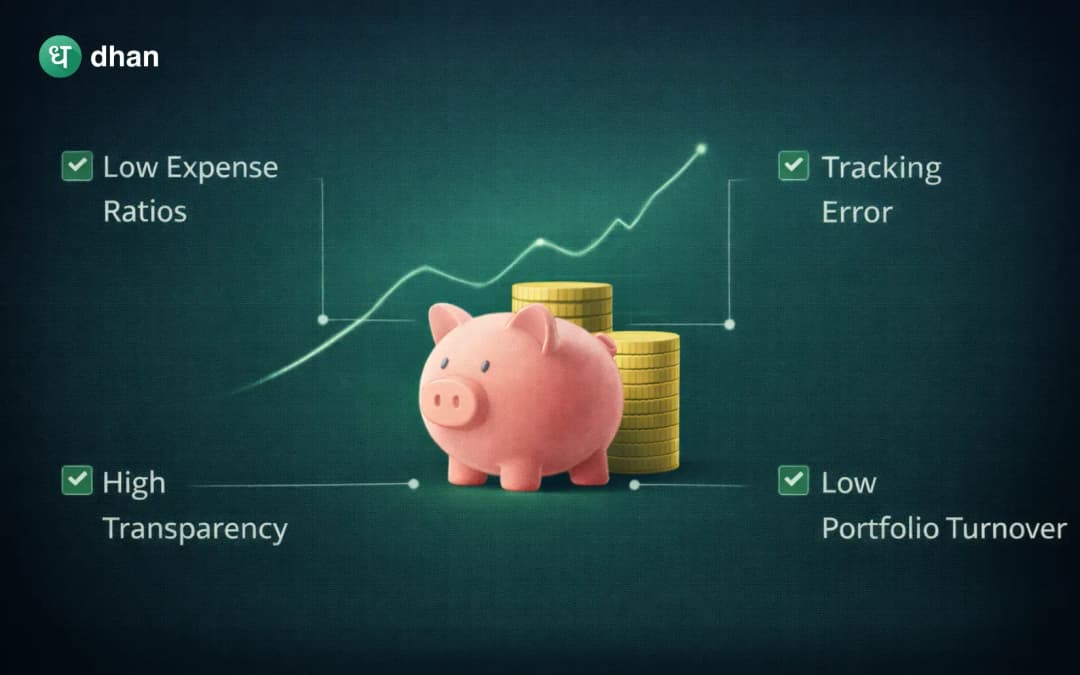
Another key concept of passive funds is tracking error. It is the difference between the performance of the fund and the index that it tracks. Although passive funds try to minimise this gap, operational factors can lead to small differences.
Types of passive funds
Broadly, passive funds can be categorised into two types.
Index funds
Index funds are one of the most common types of passive investments. These funds track a specific index in the market. You can buy and sell them just like regular mutual funds.
As an investor, you can start with relatively small amounts. You can even create SIPs in passive mutual funds. If you are looking to enter the equity market without worrying about selecting stocks, these index funds are a suitable choice. As they replicate popular indices, investors gain a broad exposure. These funds are suitable for beginners, too, particularly when they look for a simple way to get started.
Exchange-traded funds (ETFs)
Another common form of passive investment is ETFs. They are traded like individual stocks on exchanges. As a result, the prices of ETFs fluctuate throughout the trading session based on demand and supply in the market.
If you want to invest in ETFs, you will need a demat account and a trading account. Just like stocks, you can buy or sell the units anytime during the trading sessions. You’ll come across ETFs tracking different indices, sectors, or even commodities like gold and silver. The wide range of investment avenues through ETFs can help you diversify your portfolio.
Passive funds vs active funds
Passive funds differ from active funds in terms of the approach to investment and cost.
Investment approach
The investment strategy defines the key difference between passive and active funds. The goal of active funds is to perform better than the market. Therefore, fund managers choose the stocks based on research and analysis.
Passive funds, on the other hand, follow the performance of the market. Their goal isn’t to beat the index. The purpose of passive funds is to closely match the performance of the market. As a result, this investment strategy is more predictable. The decisions of fund managers do not impact the performance of passive funds.
Cost difference
Passive mutual funds involve lower costs, which is one of their most significant advantages. As the investment process does not involve active stock selection, passive funds come with significantly lower expense ratios.
This cost advantage plays a crucial role in improving net returns over time. When you stay invested for the long term, even small differences in expenses can significantly increase your returns.
Benefits of investing in passive funds
Passive mutual funds are cost-effective. Investors also find them transparent and predictable due to the consistency they maintain based on the index.
Low cost
The cost-efficiency of passive funds is one of their key benefits. As they involve lower expense ratios, investors can keep a larger portion of their returns. Over longer investment horizons, this cost-effectiveness becomes substantially rewarding.
Transparency
Passive mutual funds track a specific index. That’s why investors can transparently view their holdings. Therefore, you always know where your money is invested. It makes the process easy to understand.
Consistency
The returns you receive from passive funds are aligned with the market. Although they do not outperform an index, they also avoid the risk of underperformance, something which might happen due to poor stock selection. Long-term investors often include passive funds in their portfolios, considering this consistency.
Risks and limitations of passive funds
Although passive funds come with several advantages, investors should be wary of certain limitations of these funds.
- One of the main drawbacks of passive funds is their inability to outperform the market.
- Also, if the index performs poorly, the fund will reflect the same performance.
- The risk factor in the market remains constant. Passive funds are directly linked to the overall movements in the market.
- Tracking error can result in slight deviations from the returns delivered by the index.
- Passive funds also lack flexibility. As they have to follow the index, the fund manager cannot exit underperforming stocks unless the index itself changes. As a result, passive funds have limited ability to respond to market conditions.
Who should invest in passive funds?
A wide range of investors prefer to include passive funds in their portfolios.
Beginners find them appealing as they are simple and easy to understand. They do not have to analyse individual underlying stocks or track market trends constantly.
Long-term investors who prefer a disciplined approach also find passive funds suitable for their portfolios. The lower expense ratio makes them ideal for cost-conscious investors, which helps to maximise returns over time.
Those who prefer a simple investment strategy and cannot afford the time to frequently monitor underlying stocks also find passive funds appealing. They do not need to actively make decisions as they stay invested in the market.
Passive funds in long-term wealth creation
The cost efficiency of passive funds makes them a crucial component for long-term wealth creation. These funds help you capitalise on the overall growth trajectory of the economy over time.
As the costs are lower, you can retain a greater part of your returns. Eventually, this helps to enhance the effect of compounding. This leads to significant accumulation of wealth over long periods.
Passive mutual funds complement other forms of aggressive investing. You may not get aggressive gains in the short term from passive funds. However, they do provide stability and consistency to your portfolio, both of which are crucial to building resilient long-term portfolios.
Conclusion
With passive funds, you get an effective way to ride the economic growth, and it doesn’t involve the challenges of active investing. These mutual funds track an index, which ensures consistency and cost efficiency.
If you’re already investing in large or mid-cap funds, you may consider including some passive strategies that create steady wealth over time. Investors who value cost-efficiency and stability must explore the best-performing passive mutual funds tracking different indices.
FAQs
Where does a passive mutual fund invest?
A passive mutual fund invests in the underlying stocks of an index in exactly the same weightage. It tracks the index and doesn’t try to outperform it. Therefore, the passive fund replicates the composition of the index. As a result, investors can earn returns similar to the overall market.
Are passive funds better than active funds?
Passive funds are not necessarily better than active funds. They are more cost-efficient and consistent. However, active funds may outperform the market in certain cases, but they come with higher costs. The decision of fund managers significantly influences their performance.
Can I invest in passive funds through SIP?
Yes, you can create an SIP to invest in passive mutual funds. However, you would need a trading account to buy ETFs.
Do passive funds have risk?
Yes, passive funds are market-linked instruments and involve risks. As they track an index, their performance depends on how the market performs.
What is tracking error in passive funds?
Tracking error is the difference between the performance of the passive fund and the underlying index. This type of error shows up due to factors like expenses and operational inefficiencies.