What is NFO (New Fund Offer) ?






For retail investors in India, mutual funds have emerged as one of the most preferred avenues to grow wealth. With digital access to mutual funds and increasing awareness, a higher number of investors are exploring these schemes. Among these, New Fund Offers often attract disciplined investors. Particularly, when fund houses launch new strategies or thematic opportunities, investors keenly anticipate these NFOs.
If this term sounds new to you, read on to understand what an NFO is. In this blog, we have comprehensively discussed how it works, different types of NFOs, along with their features, benefits, and risks.
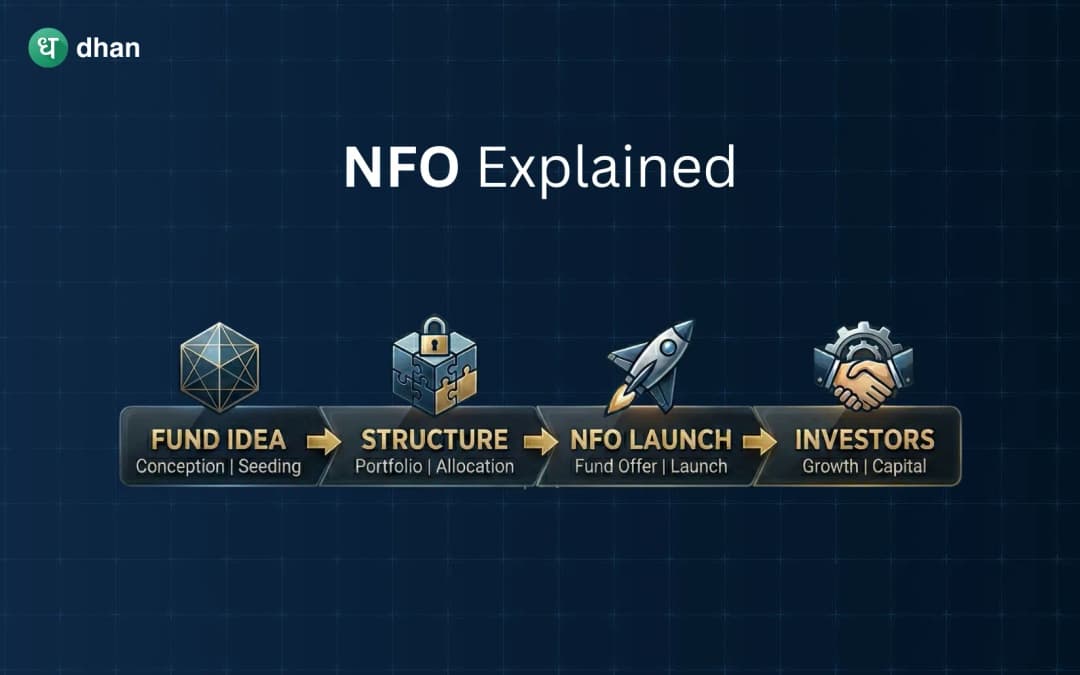
NFO Explained
Investors willing to explore what NFO is must understand the basics first. NFO stands for New Fund Offer. When an asset management company launches a new mutual fund scheme, the initial subscription period of the fund is referred to as an NFO.
Investors can apply for the units of a new scheme at an initial offer price. Typically, it is INR 10 per unit. Investors can subscribe to the fund before it officially begins operations during the period of this offer.
To understand NFO meaning, investors should also know how it differs from an IPO. In an IPO, you can purchase the shares of a company. On the contrary, an NFO allows you to buy units of a mutual fund scheme. The fund house pools these contributions from investors and allocates them across different types of securities like equities, bonds, money market instruments, or other assets.
Every NFO comes with a Scheme Information Document. This SID carries the details about the:
- Investment strategy
- Asset allocation
- Risk factors
- Benchmark index
The launch of NFOs is regulated by the SEBI, which protects investors and ensures transparency. When the NFO period closes, open-ended schemes are reopened for transactions. Its NAV starts fluctuating, depending on how the market performs.
How does an NFO work?
Investors interested in knowing what is NFO must also understand how an NFO works. We have explained the process in this section.
Announcement of the launch
When an AMC plans to introduce a new scheme, the launch details are announced beforehand. It includes:
- The objective of the fund
- Names of the fund manager
- Benchmark index
- The subscription period
Usually, the NFO window remains open for a limited time.
Subscription period
Investors can put in a lump sum amount during the subscription period. Some NFOs are open-ended. They allow investors to register for SIPs when the scheme reopens after allotment.
Allotment of units
Once the subscription window closes, the units are allotted to investors at the initial offer price.
Deployment of funds
Next, the fund manager deploys the collected capital into securities as per the mandate of the scheme. For equity NFOs, the process involves buying stocks that align with the investment goal. If it is a debt NFO, the process may involve buying bonds and money market instruments.
NAV calculation
Once investments start pouring in, the NAV of the fund keeps changing daily. This is based on the market value of its underlying securities.
Open-ended vs closed-ended NFO
Through open-ended NFOs, investors can buy and redeem units after the NFO period ends. However, closed-ended NFOs come with a fixed maturity period. They may get listed on stock exchanges for trading.
Types of NFOs
Fund houses launch NFOs across different categories of mutual funds. As an investor, you must understand the different types of NFOs that would help you choose one based on your goals and risk appetite.
Equity fund NFO
Equity NFOs primarily invest in stocks. These may include:
- Large-cap funds that invest in established companies
- Mid-cap and small-cap funds that offer higher growth potential
- Sectoral or thematic funds that help you gain targeted exposure in specific industries like technology, infrastructure, or healthcare
- Flexi-cap funds that dynamically allocate assets across different market capitalisations
Investors with a long-term horizon and moderate to high risk tolerance usually invest in equity NFOs.
Debt fund NFO
Debt NFOs invest in fixed-income instruments. These may include government securities, corporate bonds, treasury bills, and money market instruments.
Common categories of debt fund NFOs are:
Usually, conservative investors looking for relatively stable returns with lower volatility opt for debt fund NFOs.
Hybrid Fund NFO
These NFOs invest a mix of equity and debt instruments. Their goal is to balance growth and stability.
Some examples of hybrid fund NFOs are:
- Aggressive hybrid funds
- Balanced advantage funds
- Conservative hybrid funds
These funds adjust their asset allocation, depending on market conditions.
Index fund & ETF NFO
Passive NFOs like index funds or ETFs track a specific benchmark index. They do not actively select stocks, but mirror the composition of an index. Generally, they are cost-effective and suit long-term investors who prefer passive investing.
Solution-oriented NFO
Investors with specific financial goals usually go for solution-oriented funds. These include:
- Retirement funds
- Funds for children’s education
Some of these NFOs may come with a lock-in period, which suits long-term financial planning.
Key features of NFO
As an investor, you must be familiar with the defining features of NFOs.
Fixed initial offer price
During the launch period, the units are usually priced at INR 10. However, this does not imply the fund is cheaper or more attractive compared to existing schemes.
Defined investment goal
Each NFO comes with a clearly stated goal. It may be capital appreciation over the longer horizon or generating income.
Professional fund management
The investment strategy is overseen by experienced fund managers. This keeps them aligned with the mandate of the scheme.
Diversification benefits
Mutual funds pool money across multiple securities. As a result, investors gain diversified exposure even with small investments.
Regulatory transparency
SEBI mandates disclosure of risks, portfolio strategy, fees, and other important information. Investors can, therefore, make informed decisions.
Benefits of investing in an NFO
Investors can gain several potential advantages from NFOs.
Early access to new strategies
Often, NFOs introduce innovative themes or strategies that were not available previously. This allows investors to participate in those themes from the beginning.
Portfolio diversification
When you add an NFO that provides exposure to a new asset class, sector, or strategy, it helps you diversify your overall portfolio.
Systematic allocation
An NFO needs fresh capital to start. This ensures that the portfolio of the fund is built systematically as per the stated mandate.
Professional management
Investors benefit from the expertise of fund managers and research teams. Professionals actively monitor the portfolio and manage it.
Long-term growth potential
Long-term investors may benefit from equity-oriented NFOs, particularly when they participate in early growth opportunities.
Risks associated with NFO
While MF NFOs present you with opportunities, they also carry certain risks.
No past performance or track record
NFOs do not have historical data validating their performance. Therefore, investors have no other option than to rely on the reputation of the AMC and their experience in fund management.
Market risk
Sometimes, market conditions turn unfavourable soon after launch. This may affect short-term returns.
Risk of strategy execution
The ability of the fund manager to execute the desired strategy determines the performance of the fund. Investors must factor in the risk of strategy failure or poor execution.
Liquidity concerns
Closed-ended NFOs may restrict redemption until the units mature. This can limit the flexibility of redemption.
Risk of thematic concentration
Sectoral or thematic NFOs may carry higher risk due to their concentrated exposure in some industries.
Who should consider investing in NFO?
NFO in mutual funds may be suitable for you under any of the following circumstances.
- If you have a long-term investment horizon
- Your risk tolerance is moderate to high
- You want exposure to new themes or strategies
- If you need to diversify your portfolio
To wrap up
If you have been wondering what is NFO and how it works, we have explained the concept for your convenience. While the early access to innovative strategies offers certain benefits, investors must also weigh the risks associated with NFOs.
The key is not to invest simply because a scheme has been launched. Investors must evaluate the objective of the scheme and determine whether or not it aligns with their financial goals. Remember, goal-based investing delivers better results compared to decisions driven by hype.
FAQs
What is NFO in mutual funds?
An NFO is the initial subscription period of a newly launched mutual fund scheme. During this period, investors can purchase the units at the offer price. After this period, the fund begins its active operations.
Is investing in an NFO better than existing funds?
Not necessarily. It largely depends on the objective and strategy of the fund, and how it aligns with your goals.
Can I start SIP in an NFO?
Most open-ended NFOs allow investors to register for SIP after the allotment process. So, you can start an SIP once the scheme is reopened for ongoing transactions.
Are returns from an NFO guaranteed?
No. Like all mutual fund investments, returns from an NFO depend on its performance in the market and the execution of the fund manager.
How long should I stay invested in an NFO?
Consider the category of the fund before determining your investment horizon. For equity NFOs, the ideal investment horizon should be more than 5 years.