What is an NSDL demat account?




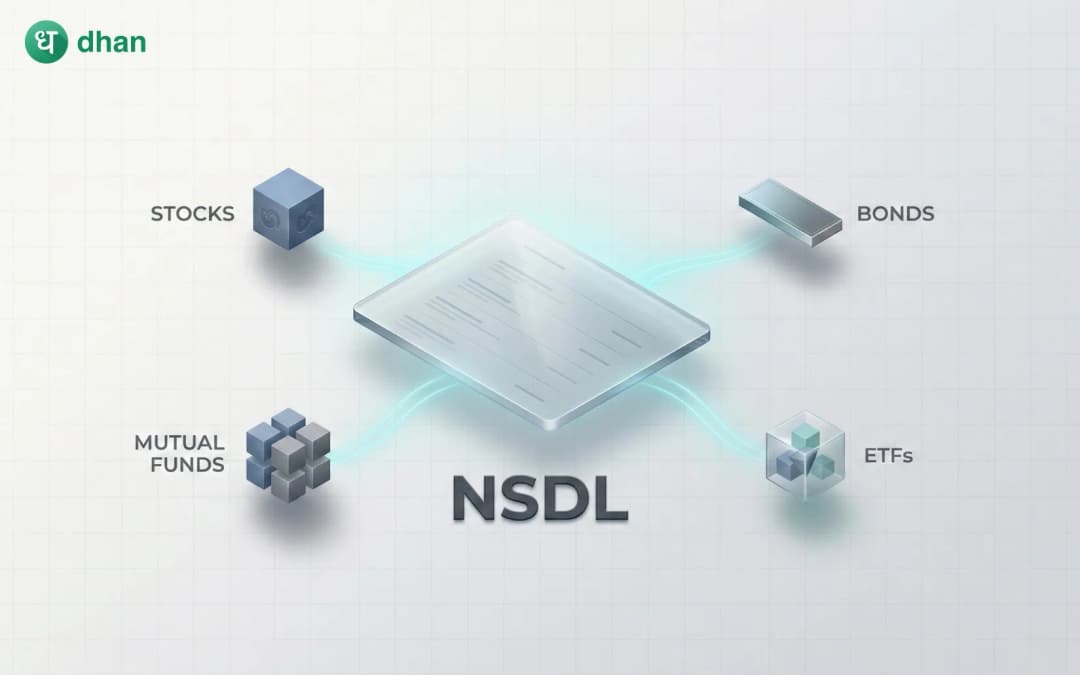



As an investor, you have been using a demat account to buy and sell shares. But have you ever wondered where those shares are actually stored? Think of any securities, like stocks, bonds, or ETFs. These assets are electronically stored in a demat account.
However, your demat account actually belongs to either National Securities Depository Limited (NSDL) or Central Depository Services Limited (CDSL), the two central depositories of India.
In this guide, we have comprehensively explained what an NSDL demat account is and how it facilitates investors.
What Is a Depository? A brief history of NSDL
From the perspective of investors, a depository is just like a bank that stores securities. However, it doesn’t store physical certificates. Your shares, bonds, and mutual fund units are digitally stored in the depository. The process eliminates paperwork and reduces fraud. The settlement process through stock exchanges and brokers has become much smoother.
The two main depositories of India are NSDL and CDSL.
The National Securities Depository Limited was established in 1996. NSDL was driven by banks and the NSE. The structure of the NSDL demat account depends on a network of Depository Participants (DPs). These include banks, brokers, and financial institutions. These DPs serve as the interface between the investor and the depository.
Services offered by a NSDL demat account
Have a look at the key services NSDL offers. With an NSDL demat account, you can hold, track, and transfer securities easily.
1. Safe Storage of Securities
The primary role of an NSDL demat account is to provide a secure storage space for your holdings. It electronically saves your shares, bonds, ETFs, debentures, government securities, and mutual fund units. So, you need not face the risks of handling physical certificates which may be lost, stolen, or forged.
2. Seamless Settlement of Trades
With NSDL, you can smoothly buy and sell shares through your broker. Your securities get credited or debited automatically within regulatory timelines. As a result, you experience seamless trading, even at high frequency.
3. Pledging and Unpledging of Shares
Do you trade in derivatives or need margin for short-term needs? With an NSDL demat account, you can pledge your securities digitally. This is a fast and secure process, which is completely regulated. Likewise, you can also unpledge in a few clicks.
4. Corporate Actions Processing
NSDL handles corporate actions like dividends, bonus shares, stock splits, and rights issues. These actions are handled directly in your demat account. So, you need not fill out forms or follow up the process manually. Once the company announces these benefits, you find the changes in your demat account automatically.
5. Access to NSDL e-Services
The online platform of NSDL, IDeAS, is beneficial to investors. You can use this platform to view your statements, transaction history, and holding reports. Investors can benefit from the transparency through these e-services and can track their portfolio at any time.
Which brokers offer NSDL demat accounts?
Many full-service brokers and those backed by banks offer NSDL demat accounts. With some brokers, you may also get the option to choose between NSDL or CDSL. Regardless of the depository, your securities remain properly regulated and easily transferable.
Is an NSDL demat account better or safer?
No, NSDL is not inherently safer than CDSL. As both these depositories operate under strict regulations of the SEBI, your security is guaranteed. The safety of investors depends on the authentication processes and the discipline of transactions of their DPs.
Investors often believe in some common myths, like that NSDL is premium or that CSDL is cheaper. However, none of these is true. Ultimately, your DP decides the charges, and the depository has nothing to do with it.
Likewise, returns, corporate action processing, and settlement speed are regulated and comparable. When you choose an NSDL demat account, the decision depends on the comfort of the platform, the reliability of the DP, and your personal convenience. Both these depositories provide a strong and secure framework to store and transfer securities.
Does NSDL cost more?
Fees are not levied by the depositories themselves, but by your DP. NSDL-linked bank DPs may appear costlier considering traditional fee structures. On the contrary, CDSL often partners with discount brokers. This gives the impression that their charges are low.
As an investor, you need to compare DP charges, annual maintenance fees, and transaction costs. You must select a DP that seamlessly balances affordability, service quality, and ease of access.
Should you switch depositories?
It’s possible to switch your depositories or DPs without affecting your investments. Some investors switch depositories to benefit from better services or lower charges.
You need to close the existing demat account and transfer the holdings. However, if your current DP provides stability and meets your requirements, there’s no need to change it.
The process of changing depositories is regulated, so that you can seamlessly transfer your securities.
Final wrap
An NSDL demat account lets you store your securities and manage them electronically through a secure and regulated framework. This depository is known for its strong DP networks and established infrastructure. Along with the oversight from SEBI, NSDL helps investors with smooth trading and settlements. It also handles corporate actions seamlessly. As an investor, your experience ultimately depends on the DP you choose and the quality of services they offer. Considering all the parameters, NSDL continues to be one of the most popular options.FAQs
What is an NSDL demat account?
An NSDL demat account is an electronic account that stores your securities like shares, bonds, and ETFs under the National Securities Depository Limited. This is one of the two SEBI-regulated depositories in India.
Is an NSDL demat account safe?
Yes. NSDL follows SEBI regulations and uses secure authentication systems. Your overall safety also depends on the DP linked to your account.
How can I check if my demat account is with NSDL?
NSDL demat account numbers start with “IN” and come with a 16-character alphanumeric structure.
Are NSDL charges higher?
NSDL does not charge investors directly. Fees vary based on the DP. So, the overall cost depends on the bank or broker through which you open your demat account.
Can I move my holdings from one depository to another?
Yes. You can transfer your holdings through a regulated process if you choose a new DP or platform that suits your needs.