Order Flow vs Technical Analysis: Which Works Better for Intraday Trading?





Most traders begin their journey with technical analysis.
They learn:
These tools have been widely used for decades.
But over the last few years, many active traders have started exploring another approach called Order Flow trading.
This has created a common question:
Which works better for intraday trading?
Order Flow or technical analysis?
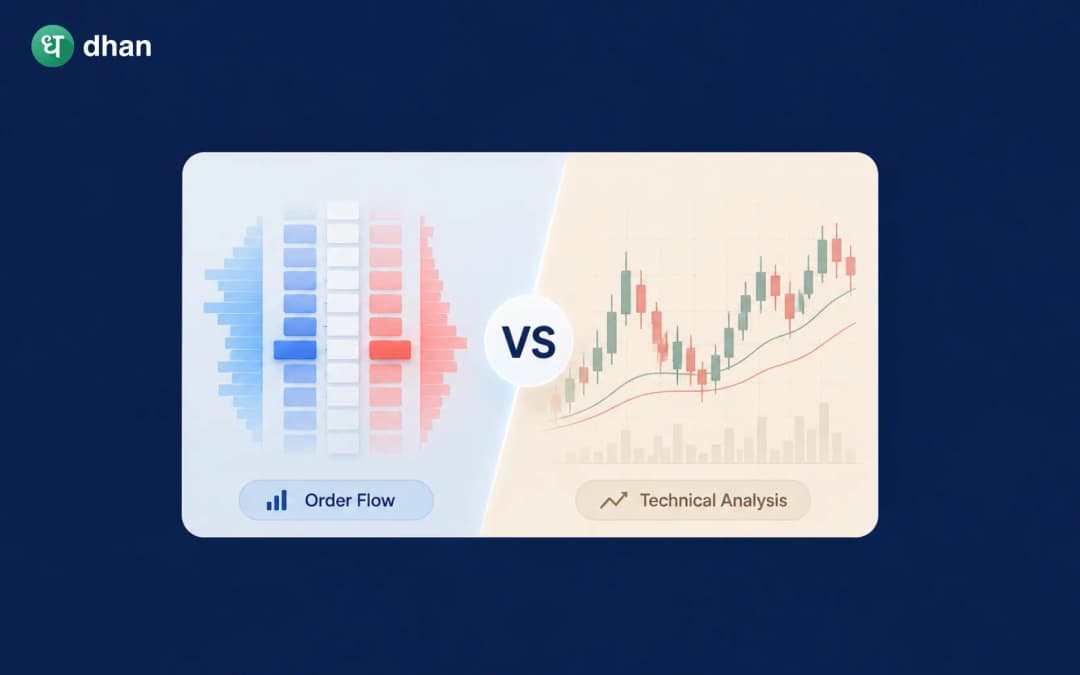
The truth is that both approaches study the same market from different perspectives.
Understanding the difference between them can help traders build better decision making frameworks.
What Is Technical Analysis?
Technical analysis studies historical price movement.
Traders use charts and indicators to identify:
- Trends
- Momentum
- Reversal zones
- Breakouts
- Market structure
The assumption behind technical analysis is that price action reflects market psychology.
Popular technical analysis tools include:
- Candlestick charts
- Moving averages
- RSI
- Bollinger Bands
- Fibonacci retracements
- Trendlines
- Chart patterns
Technical analysis remains the most widely used trading approach globally.
What Is Order Flow Trading?
Order Flow trading focuses on real time buying and selling activity.
Instead of only studying completed candles, traders analyze:
- Aggressive buyers and sellers
- Bid and ask activity
- Volume at price
- Delta
- Imbalances
- Absorption
- Liquidity interaction
Order Flow tools attempt to reveal what is happening inside each candle.
This gives traders a more detailed view of market participation.
The Core Difference
The biggest difference is this:
Technical analysis studies the result.
Order Flow studies the participation behind the result.
For example:
A candlestick breakout may look bullish on a traditional chart.
But Order Flow may reveal:
- Weak aggressive buying
- Seller absorption
- Negative delta divergence
This can help traders judge whether the breakout is strong or weak.
How Technical Analysis Helps Traders
Technical analysis is useful because it simplifies the market.
It helps traders identify:
- Trend direction
- Key levels
- Structure
- Momentum
- Historical reaction zones
It is also easier for beginners to learn compared to advanced Order Flow analysis.
For many traders, technical analysis forms the foundation of their trading system.
How Order Flow Helps Traders
Order Flow tools are often used for:
- Intraday timing
- Confirmation
- Liquidity analysis
- Breakout validation
- Scalping
- Reversal detection
Instead of only asking:
“Did price break resistance?”
Order Flow traders also ask:
“Were buyers actually aggressive during the breakout?”
Example: Technical Analysis vs Order Flow
Imagine BANKNIFTY breaks above resistance.
A technical trader may see:
- Breakout candle
- Strong volume
- Trend continuation
An Order Flow trader may also check:
- Delta strength
- Bid versus ask aggression
- Imbalances
- Absorption near highs
- Volume concentration
If sellers absorb aggressive buying near resistance, the breakout may fail.
This additional layer of information is why many intraday traders combine both approaches.
Advantages of Technical Analysis
1. Simplicity
Charts and indicators are easier to understand for beginners.
2. Wide Adoption
Most traders globally use technical analysis.
3. Strong for Structure
Technical analysis works well for:
- Trend analysis
- Swing trading
- Market structure
- Long term charts
4. Flexible Across Markets
It can be applied to:
- Stocks
- Indices
- Forex
- Commodities
- Crypto
Advantages of Order Flow
1. Real Time Participation
Order Flow attempts to show what buyers and sellers are doing in real time.
2. Better Intraday Timing
Some traders use Order Flow for more precise entries and exits.
3. Liquidity Analysis
Traders can study aggressive execution and absorption.
4. Useful in High Liquidity Markets
Order Flow is commonly used in active instruments with strong participation.
Limitations of Technical Analysis
Technical analysis may sometimes:
- Lag fast market movement
- Produce false breakouts
- Ignore participation quality
- Miss liquidity behavior
Indicators are also derived from historical price data.
Limitations of Order Flow
Order Flow analysis has its own challenges.
These include:
- Steep learning curve
- Fast moving information
- Complexity for beginners
- Data interpretation errors
- Information overload
It is not a shortcut to profitable trading.
Which Is Better for Indian Intraday Traders?
There is no universal answer.
However, technical analysis is usually better for:
- Beginners
- Swing traders
- Simpler workflows
- Higher time frame analysis
Order Flow may be useful for:
- Active intraday traders
- Scalpers
- Options Expiry traders
- Traders focused on execution timing
Many experienced traders use both together.
For example:
- Technical analysis for structure
- Order Flow for confirmation and execution
Why Order Flow Is Growing in India
Indian derivatives markets have seen significant growth in participation.
Highly active instruments like:
- NIFTY
- BANKNIFTY
- Weekly options
generate strong intraday liquidity.
As a result, more traders are exploring:
- Footprint charts
- Delta analysis
- Volume Profile
- Imbalance tracking
Modern trading platforms are also making these tools more accessible to Indian retail traders.
Final Thoughts
Technical analysis and Order Flow are not enemies.
They are different ways of understanding the market.
Technical analysis helps traders identify structure and direction.
Order Flow helps traders analyze participation and execution.
For many traders, the strongest approach is combining:
- Market structure
- Price action
- Volume analysis
- Order Flow concepts
- Risk management
No tool guarantees success.
But understanding how the market actually moves can help traders make more informed decisions.