What are Equity Indices?


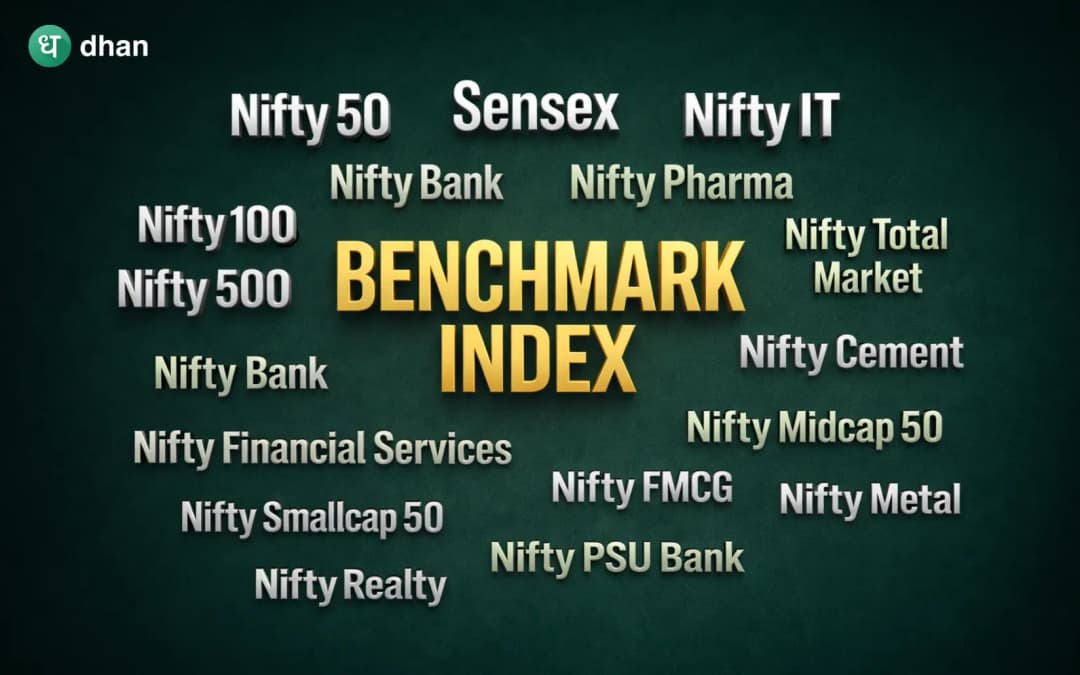



You might have heard terms like Nifty 50, S&P 500, or Sensex, which are repeatedly used in media and news reports. These are equity indices key benchmarks that represent how a group of stocks is performing.
These indices provide a clear picture of a group of stocks and their performance. Instead of tracking hundreds or thousands of individual stocks, investors use indices to understand the overall direction of the market or a specific sector. When any index rises, it represents that the underlying group of stocks are performing well, while if the index falls, it reflects broader market weakness.
If you are a beginner, the equity index is the best starting point. In this article, you will learn what are equity indices, how they work and how professional traders use them during live sessions.
Understanding an equity index
An equity index is a collection of selected stocks which represents a specific market, sector, or theme. These stocks are chosen based on predefined criteria such as market capitalisation, liquidity, and industry representation.
For example, the Nifty 50 includes the top 50 and most actively traded companies listed on the National Stock Exchange of India. Together, they represent a significant portion of the Indian equity market.
Equity indices are used as the benchmarks. Performance of portfolios, mutual funds and the overall economy is usually compared with respective indices for performance gauging. You cannot directly invest in the index, but you can invest in the products like index funds and ETFs that replicate the performance of any specific index.
How equity indices work
Now that you know what are equity indices, let’s get in some details. The collection of stocks in any equity index is not random. They are selected based on specific criteria such as size, trading volume, or sector representation. This ensures that the index accurately reflects the market segment it is designed to track.
Not all stocks in the index influence the index equally. Their weighting is done by certain methods, which are listed below:
- Market-cap weighting: In this method, companies with larger market capitalisation have more impact on the index.
- Price weighting: as the name suggests, in this method, any company's impact is decided by its stock price. Stocks with higher prices carry more weight. This method is not less commonly used in today's market.
- Equal weighting: In this method, there is no comparison parameter. All stocks contribute equally, regardless of size.
Most major indices, including the Sensex, use market-cap weighting. The index value moves based on the combined price movements of its constituent stocks. If most of the stocks rise, the index goes up. If they fall, the index declines.
Companies' capital and their size increase or decrease over time. Their performance changes. Hence, the indices need a periodic review to monitor the company's performance. Stocks that no longer meet the criteria may be removed and replaced with better-performing or more relevant companies. This process is called rebalancing.
Types of equity indices
Equity indices are classified based on their market representation. The following are the most common types of equity indices:
Broad market indices
These indices include big, well-known businesses and reflect the market as a whole. Take the Sensex and Nifty 50, for instance. They are frequently used as market-wide benchmarks.
Sectoral indices
Sectoral indices track specific industries such as banking, IT, or pharmaceuticals. For example, the Nifty Bank focuses only on banking stocks. These indices help investors analyse how a particular sector is performing.
Thematic indices
These indices are built around specific investment themes such as ESG (Environmental, Social, Governance), consumption, or digital economy. They are useful for investors who want exposure to a particular long-term trend rather than the entire market.
Global indices
Global indices track international markets and economies, such as the Dow Jones Industrial Average or NASDAQ Composite. These indices help investors understand global market trends and diversify geographically.
Why equity indices are important
There are several reasons why the equity indices play a crucial role in financial markets. The first reason is that they act as a performance indicator. Traders and investors gauge the market by looking at the index performance. For instance, if the Nifty 50 is rising, it generally indicates positive market sentiment.
The equity index serves as the benchmark for mutual funds and portfolio managers to compare their returns. You can gauge the effectiveness of any mutual fund, whether it is outperforming or underperforming the market.
Indices also provide insights into economic health. A rising stock market usually represents business growth and investor confidence, while a declining market may signal economic concerns.
An equity index allows investors to do passive investing. Investors can invest in index funds or ETFs that track an index, allowing them to earn market returns without actively picking stocks.
How investors use equity indices
Traders and investors use equity indices in the following ways:
Trading
Equity indices are actively traded through derivatives such as futures and options. These instruments allow traders to speculate on market direction without buying individual stocks. Index trading is popular because it reduces company-specific risk.
Benchmarking portfolio performance
This is one of the most common uses of indices. Investors compare their portfolio returns with an index like the Nifty 50. If your portfolio returns 10% while the index returns 15%, it means your investments underperformed the market.
Passive investing via index funds & ETFs
You cannot directly invest in the index. But you can invest in index funds or ETFs, which are designed to track indices. Index funds and ETFs replicate the composition of an index. For example, a Nifty 50 index fund invests in the same 50 companies in similar proportions.
Such investing does not need active fund management, hence they usually charge low fees. Many investors use index funds and ETFs for diversification.
Market sentiment analysis
Indices are excellent indicators of market sentiment. Bullish sentiment is represented by a rising index, and bearish sentiment is represented by a falling index. Investors and traders can develop their strategies with this information.
Sector analysis
Sectoral indices help identify which industries are performing well. For example, if the Nifty Bank is outperforming, it indicates strength in the banking sector. Investors may then allocate more capital to that sector.
Advantages of equity indices
The equity indices provide the following advantages:
- They provide instant diversification by including multiple stocks in a single basket. This reduces the impact of any one company’s poor performance.
- Indices make it easier to track the market. Rather than analysing dozens of stocks, investors can simply follow an index to understand overall trends.
- Indices also support passive investing, which is cost-effective and requires less active management. Because they follow predefined rules, they eliminate emotional bias and promote disciplined investing.
Limitations of equity indices
The equity indices have the following disadvantages:
- The index represents the overall average growth of a group of stocks. Hence, they may not deliver the high returns that individual stocks can offer.
- Indices are heavily influenced by large companies. A few big stocks can drive most of the index movement, which may not accurately reflect smaller companies.
- Indices are based on existing data and may not quickly adapt to sudden market changes or emerging opportunities.
To wrap up
Equity indices represent a group of companies which are selected based on certain criteria, such as market capitalisation, sector, or theme. The Nifty 50 and Sensex are the most popular indices in India. These indices are helpful for different purposes, such as serving as a benchmark for mutual funds and your portfolio, and investors use them for passive investing through ETFs and index funds. Also, traders use it for options trading and sector analysis.
If you are a beginner, learning about the indices is most important for you. It will help you understand the market quickly. Indices give a clearer picture of overall market sentiment. Instead of checking every stock for its movement, the index offers a simplified view of the market.
FAQs on Equity Indices
Can you invest directly in an equity index?
No. You cannot invest directly in the indices, but there are other instruments like ETFs and index funds through which you can match the performance of the indices, like the Nifty 50.
Which is the best equity index for beginners?
Broad market indices like the Nifty 50 or S&P 500 are ideal for beginners. They provide diversification and represent overall market performance.
How are stocks selected for an equity index?
There are certain criteria by which stocks are selected, such as market capitalisation, liquidity, and sector representation. The criteria are set to ensure the index accurately reflects a specific market or segment.
What is index rebalancing?
The indices need periodic audits. In these audits, the companies that no longer meet the criteria are replaced with other companies that meet the criteria to maintain accuracy and relevance. This process of updating the list of stocks in an index is known as index rebalancing.
Are sectoral indices riskier than broad market indices?
Yes, sectoral indices are generally riskier than the broad market indices, as they focus on a single industry. Their performance depends heavily on sector-specific factors, which make them more volatile.