What is Nifty Next 50?







Key takeaways
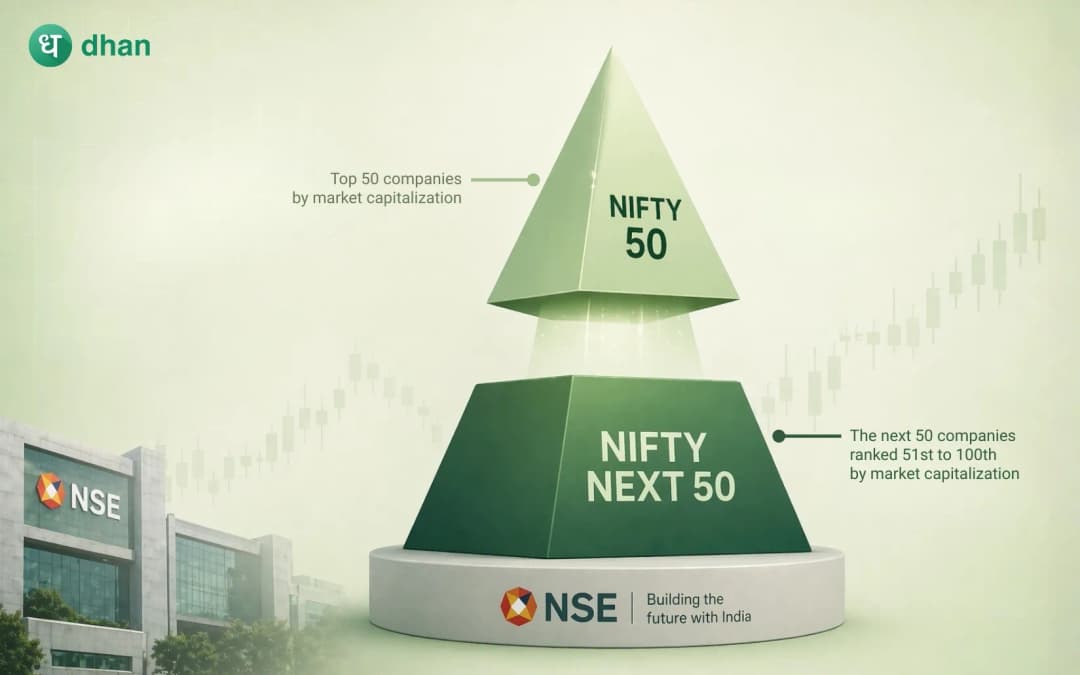
- The Nifty Next 50 include 50 companies, which are ranked just below the companies which form the Nifty 50 index.
- The index contains companies from various sectors such as finance, banking, IT, energy, and more, offering diversification to investors.
- Many Nifty Next 50 companies grow and shift to the Nifty 50 index.
Investors in the Indian stock market have a few popular indices that allow them to monitor the performance of different groups of companies. While most people know about the Nifty 50, many investors are now looking at the Nifty Next 50 because of its strong growth potential and exposure to future market leaders.
If you are interested in investing in the stock market and want to know where large emerging companies fit in, learning about “what is Nifty Next 50” can help you make smarter investment decisions.
Understanding the Nifty Next 50
So, what is Nifty Next 50? NIFTY Next 50 is a stock market index developed by the National Stock Exchange (NSE). It consists of 50 companies, which are ranked just below the companies which form the Nifty 50 index (from 51 to 100 in terms of market cap).
In simple words:
- The Nifty 50 comprises 50 of the largest and most liquid stocks on the NSE.
- After the Nifty 50, the Nifty Next 50 index comprises the next 50 big companies.
These companies are seen as future prospects for the Nifty 50 as they are already big, established and growing rapidly.
How the Nifty Next 50 works
Companies included in Nifty Next 50 are selected based on:
- Free float market cap
- Free float market value
- Liquidity
- Trading activity
- F&O segment eligibility
The NSE periodically reviews the index to ensure that it reflects current market conditions.
When a Nifty Next 50 company grows big and strong enough, it graduates to the Nifty 50. Similarly, companies that don't perform and whose market cap falls are replaced.
The dynamic nature of the index makes it exciting for investors looking for long-term growth opportunities.
Key features of the Nifty Next 50
Explore the main characteristics that set the Nifty Next 50 apart from other market indices.
1. Includes emerging market leaders
Many of the companies in this index are leaders in their industries and have good growth potential. A few of the companies that are now part of the Nifty 50 were earlier in the Nifty Next 50.
This makes the index attractive for investors wanting exposure to future blue-chip companies.
2. Diversified across sectors
The index contains companies from various sectors, such as:
3. Higher growth potential
The Nifty Next 50 has more growth-stage companies than the Nifty 50. These businesses may have higher earnings growth, expansion of business and increasing market share.
It is this that has allowed the index to generate long-term returns over growth cycles in the past.
4. Slightly higher volatility
The index has high growth potential but can also have higher market fluctuations than the Nifty 50.
Many companies are still growing aggressively, and their stock prices may be more sensitive to economic shifts, quarterly earnings or industry trends.
Difference between Nifty 50 and Nifty Next 50
A quick comparison of India’s two major large-cap stock market indices.
Investors looking for stability often turn to the Nifty 50, while the Nifty Next 50 is for investors who have a comparatively higher risk appetite for long-term growth.
Why investors prefer the Nifty Next 50
Nifty Next 50 is popular among many investors as it provides the advantages of large-cap investing with higher growth potential. Some of the reasons behind its popularity are:
Strong long-term performance
The index has produced competitive returns over long periods of time as an investment compared to many traditional investment vehicles.
Exposure to future blue-chip stocks
Companies can be part of the Nifty 50 if they perform well and can sustain performance. Early investors may profit from long-term appreciation.
Better diversification
Rather than investing in one or two companies, the index diversifies investments among 50 companies across various sectors.
Passive investing opportunity
The Nifty Next 50 index is tracked by many mutual funds & ETFs. This allows investors to benefit from the growth of the index without needing to pick individual stocks.
Popular companies in the Nifty Next 50
The Nifty Next 50 is a basket of many fast-growing large-cap stocks that are expected to join the Nifty 50 in the future. These companies are from different industries and play significant roles in the growing Indian economy.
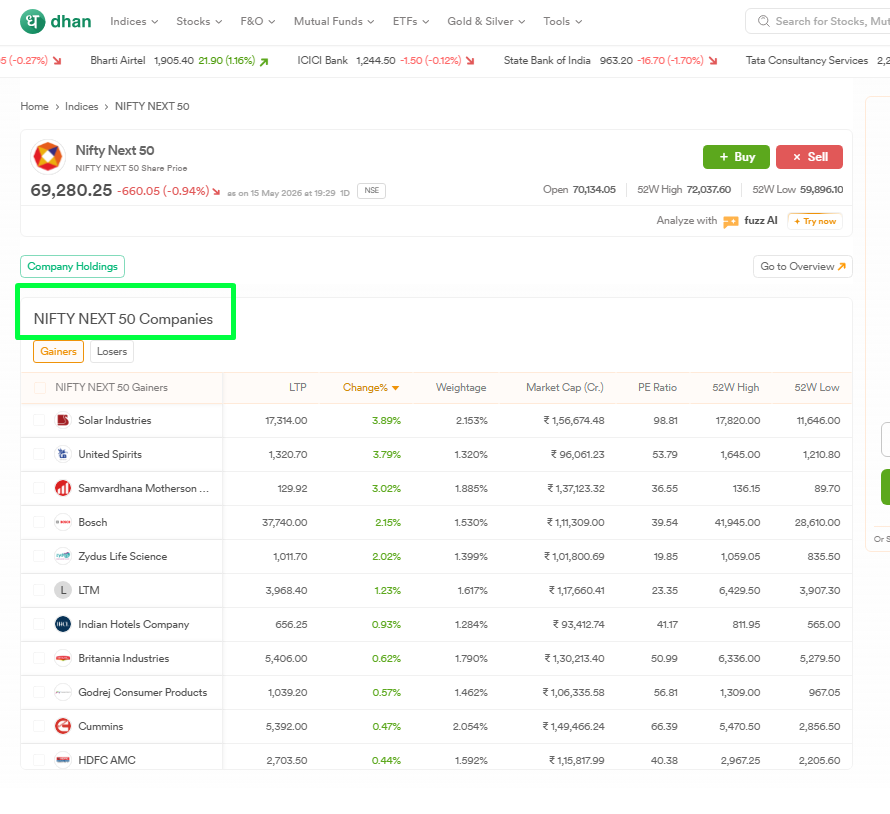
The “NIFTY NEXT 50 Companies” section on Dhan (as seen in the image above) shows some of the companies that are currently part of the index, along with information such as weightage, market capitalisation, PE ratio and stock performance.
The screenshot also shows the index’s top gainers, providing investors with a quick snapshot of stocks that are performing well.
The index comprises companies across industries such as:
- Financial services
- Insurance
- Retail
- Pharma
- Technology
- Infrastructure
- Manufacturing
Many of these businesses already have growing customer bases and strong market positions and are growing their business operations. Some companies in the index may eventually be moved into the Nifty 50 as they continue to grow in market cap and overall performance.
Ways to invest in the Nifty Next 50
You can’t invest directly in the index, but you can invest via:
- Index Funds: These are mutual funds which replicate the composition of the Nifty Next 50.
- Exchange-Traded Funds (ETFs): Traded Funds (ETFs) ETFs that follow the index can be bought and sold on the stock exchange just like common shares.
- Stocks Individually: You can also invest in individual companies in the index. This requires more research and monitoring.
Final thoughts
The NIFTY Next 50 provides investors with an opportunity to participate in the growth of India’s next set of large-cap companies. It provides diversification, growth potential and exposure to future blue chip businesses. It may be more volatile than the Nifty 50, but many long-term investors find it a suitable addition to their diversified investment portfolio.
FAQs on Nifty Next 50
1. How often does the Nifty Next 50 index change?
The NSE periodically reviews the Nifty Next 50 every 6 months in March and September. The composition of companies may change due to factors such as market capitalisation, liquidity and overall market performance.
2. Can companies move from the Nifty Next 50 to the Nifty 50?
Yes, the companies which are doing really well and moving up in the ranking in the market can finally end up in the Nifty 50 index.
3. Is the Nifty Next 50 suitable for long-term investing?
Many investors feel that the Nifty Next 50 is a suitable option for long-term investment as it includes growing large-cap companies that have the potential to grow in the future.
4. What is the difference between investing in a Nifty Next 50 ETF and an index fund?
An ETF is bought and sold on the stock exchange like a stock, whereas an index fund is purchased directly through a mutual fund platform at the end-of-day NAV.
5. Does the Nifty Next 50 include companies from multiple sectors?
Yes, the index has companies from different sectors like finance, healthcare, retail, technology, infrastructure, and manufacturing that help in providing diversification to investors.