What is Sensex? Meaning, Calculation & How It Works





For market participants who are starting their journey in the Indian stock market, there is one term that they hear almost everywhere, whether it's news headlines, market updates, or investment discussions, i.e., Sensex. The Sensex is often used as a benchmark to describe the performance of the Indian stock market.
But what is Sensex? Why does it matter so much? And how is it calculated?
Understanding the Sensex is important for every investor as it represents the performance of some of the largest and most influential companies that are listed on the BSE in India. The Sensex is a barometer of the overall health of the Indian economy and its equity markets.
In this blog, we will explore the meaning of Sensex, the calculation of Sensex, how Sensex works, and the importance of Sensex for investors in India.
Understanding the meaning of Sensex
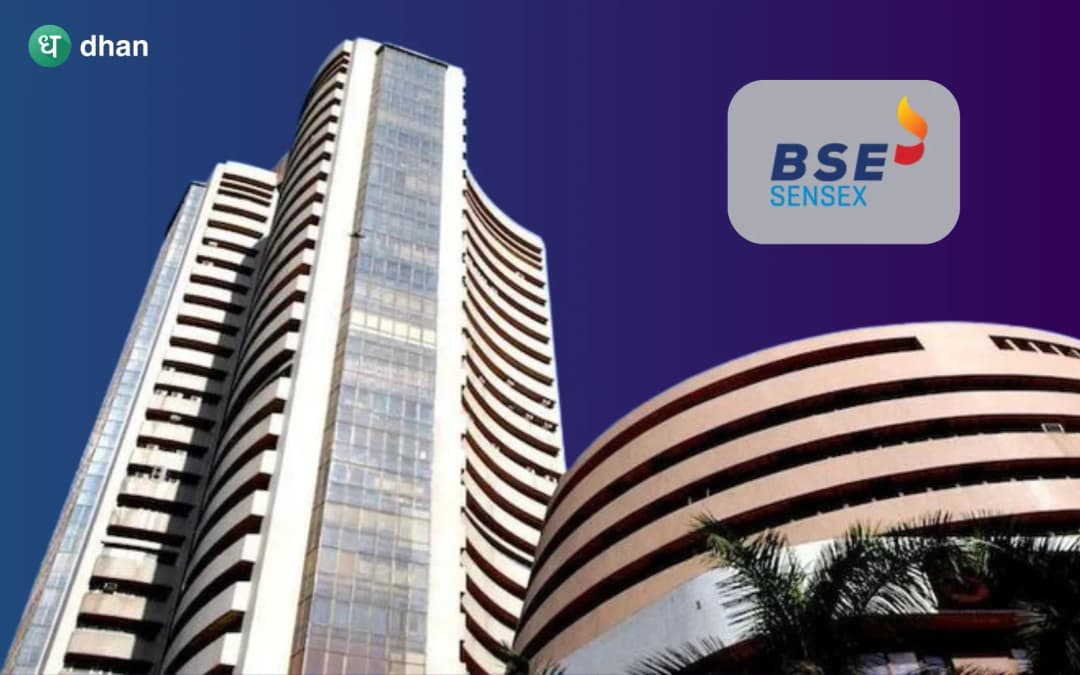
Sensex is an abbreviation of the Stock Exchange Sensitive Index. It is used as a barometer for the Indian stock market. It is the benchmark index of the Bombay Stock Exchange (BSE) in India that represents the performance of the 30 most prominent companies listed on the BSE. The index is a portmanteau of two words, Sensitive and Index, coined by stock market expert Deepak Mohani.
These 30 companies are among the largest and most actively traded companies in the country. Investors, analysts, and financial institutions closely monitor the Sensex to identify the trends in the market, make informed investment decisions, and gauge the overall economic sentiment of the Indian economy.
How Sensex works?
Now, you know what is Sensex. Let’s understand how it works. It serves as a barometer of the Indian stock market, and it is a reflection of the sentiment and economic health of the country as a whole. When the index increases, it indicates optimism within the market, whereas a decline indicates pessimism in the market about the future.
The value of the Sensex changes on the basis of the market capitalisation of the companies that are listed in the index. If the majority of the stocks in the Sensex increase, the index value rises, and vice versa.
How is Sensex calculated?
The calculation of the Sensex is based on the free float market capitalisation methodology, which was implemented since 2003, replacing the earlier weighted market capitalisation methodology. This approach takes into account only the shares available for public trading, excluding those held by the promoters or by other locked-in entities.
The formula for Sensex is:
Sensex = (Free float market capitalisation of 30 Companies / Base market capitalisation) x Base value of the index
The base year for the Sensex calculation is 1978-79, and the base value is 100. The base market capitalisation is Rs. 25041.24 crore. Thus, this formula can be written as:
Sensex = (Free float Market Capitalisation of 30 companies / 25,041.24 crores) * 100
Major components of the calculation are:
- Free-float market capitalisation: This is calculated by multiplying the company’s share price by the total number of shares available for public trading. It specifically excludes shares held by promoters and government bodies, which are not available for sale.
- Market capitalisation: This is calculated by multiplying the company’s share price by the total number of shares issued by the company.
- Free-float factor: This factor is the ratio of floated shares to the outstanding shares. It shows the percentage of the shares that are available for the public to trade.
The Sensex value is calculated in real-time each trading day, and the index is updated intraday, although the change in the intraday index is not taken into account for the final end-of-day calculation. A higher value of the Sensex is an indication of better performance of the Indian stock market.
How Sensex constituents are determined
Companies are chosen to be included in the Sensex after a rigorous process under the supervision of the S&P BSE Index Committee. To qualify, companies are required to meet some specific criteria, such as:
- Listing on BSE: Only those companies that are listed on the Bombay Stock Exchange are considered to be constituents of Sensex.
- Market capitalisation: The companies must have a large cap market capitalisation.
- Liquidity: Stocks must be highly liquid, which means that they can be bought and sold easily.
- Strong core business: Companies should have strong revenue streams from their core business.
- Industry representation: The selection focuses on a balance in industry representation to represent the larger Indian economy.
- Financial performance: Companies should have a robust financial record and also be the best performing in their sector.
- Clean track record: Transparency in operations and absence of major legal or financial issues are important.
The composition of the Sensex is changed periodically in June and December by the BSE Index Committee to ensure it accurately reflects current stock market conditions.
How to invest in the Sensex
Investing in the Sensex involves investing in the companies that constitute the index. There are several ways through which investors can invest in the Sensex:
- Stock investment: The investors can purchase the stocks of individual companies that are included in the Sensex through their trading account with a registered stockbroker like Dhan.
- Exchange-Traded Funds (ETFs): ETFs on Dhan that track the Sensex provide another indirect option of investing in the Sensex.
- Index funds: Index funds passively track the Sensex and hold the same stocks in the same ratio as the index.
Before investing, investors must have a Demat account for holding shares electronically, a trading account for being able to buy and sell shares, and a bank account and PAN card. Thorough research and analysis of the constituent companies and market trends is necessary for making informed investment decisions.
Why is Sensex important?
Sensex is central to the Indian financial scenario for several reasons. Some of those reasons are addressed below:
- Market performance indicator: It is widely used by investors and analysts to get to know the health of the Indian stock market. A rising Sensex indicates that the top companies are doing well, which means that the market sentiment is positive.
- Economic barometer: As the Sensex tracks companies in different sectors that are important for the economic development of the country, its movements are often a reflection of the state of the overall economy.
- Investor sentiment: The Sensex provides insights about investor confidence; a rising index signals optimism, whereas a falling index signals uncertainty or market correction.
- Investment benchmark: Many mutual funds and investment portfolios use the Sensex as a benchmark to gauge their performance in comparison to the broader market.
- Attracting foreign investment: A healthy and stable Sensex indicates a healthy economy, which in turn attracts foreign direct investment (FDI) and foreign institutional investors (FIIs) to invest in Indian stocks.
- Tracking corporate performance: The 30 companies that make up the Sensex are leaders in their respective industries and thus serve as an indicator of corporate sector performance in India as a whole.
To wrap up
The Sensex is not just a numerical representation of stock prices, but an indicator of the overall economic health of India and investor sentiments. By keeping track of how the top 30 companies on the BSE in various sectors are doing, the Sensex provides a real-time snapshot of the financial health of the country.
Whether you are an experienced investor analysing the stock market trends or a beginner investing in a mutual fund SIP, understanding the Sensex is an important aspect of understanding the nuances of the stock market. Although you can't directly invest in the Sensex, it is a great source of information, which can help you make informed decisions on investing in the stock market.
FAQs on Sensex
1. What is the base year and base value used for calculating the Sensex?
The base period for the calculation of the BSE Sensex is the financial year of 1978-79. The base index value has been 100 points, and the base market capitalisation has been fixed at Rs. 25014.24 crores.
2. How frequently does the BSE revise the Sensex 30 list?
The constituents of Sensex are reviewed on a semi-annual (twice a year) basis in June and December by the S&P BSE Index Committee. Companies that cease to meet the strict liquidity, market cap, or sector representation criteria are removed and replaced by eligible and highly-performing emerging companies.
3. What is the difference between Sensex and Nifty?
While both are benchmark indices of the Indian stock market, Sensex is the proprietary index of the Bombay Stock Exchange (BSE) and comprises 30 large-cap companies. On the other hand, Nifty (or Nifty 50) is the benchmark index of the National Stock Exchange (NSE) and tracks the performance of the top 50 large-cap companies.
4. Can I invest directly in the Sensex?
No, you can not directly invest in the Sensex as it is just an index and not a tradable asset in itself. However, you can invest in the Sensex indirectly, via investing in a Sensex Index Mutual Fund or a Sensex Exchange Trading Fund (ETF), which pools funds from several investors to buy the same 30 stocks, in the same proportion as the Sensex.
5. Why does the Sensex value change every single second?
The Sensex value is calculated in real-time on the basis of the live trading prices of its 30 constituent stocks. As millions of buyers and sellers buy and sell these shares continuously from one another during market hours, their stock prices rapidly fluctuate. This, in turn, alters their free float market capitalisation, which results in altering the overall Sensex points every second.