
 Nifty 50
 Sensex
 US Tech 100
 Dow Jones
 FTSE
FTSE Dax
Dax CAC
CAC Nikkei 225
 Hang Seng
 SSE Composite
 TAIEX
TAIEX KOSPI
KOSPI Gift Nifty

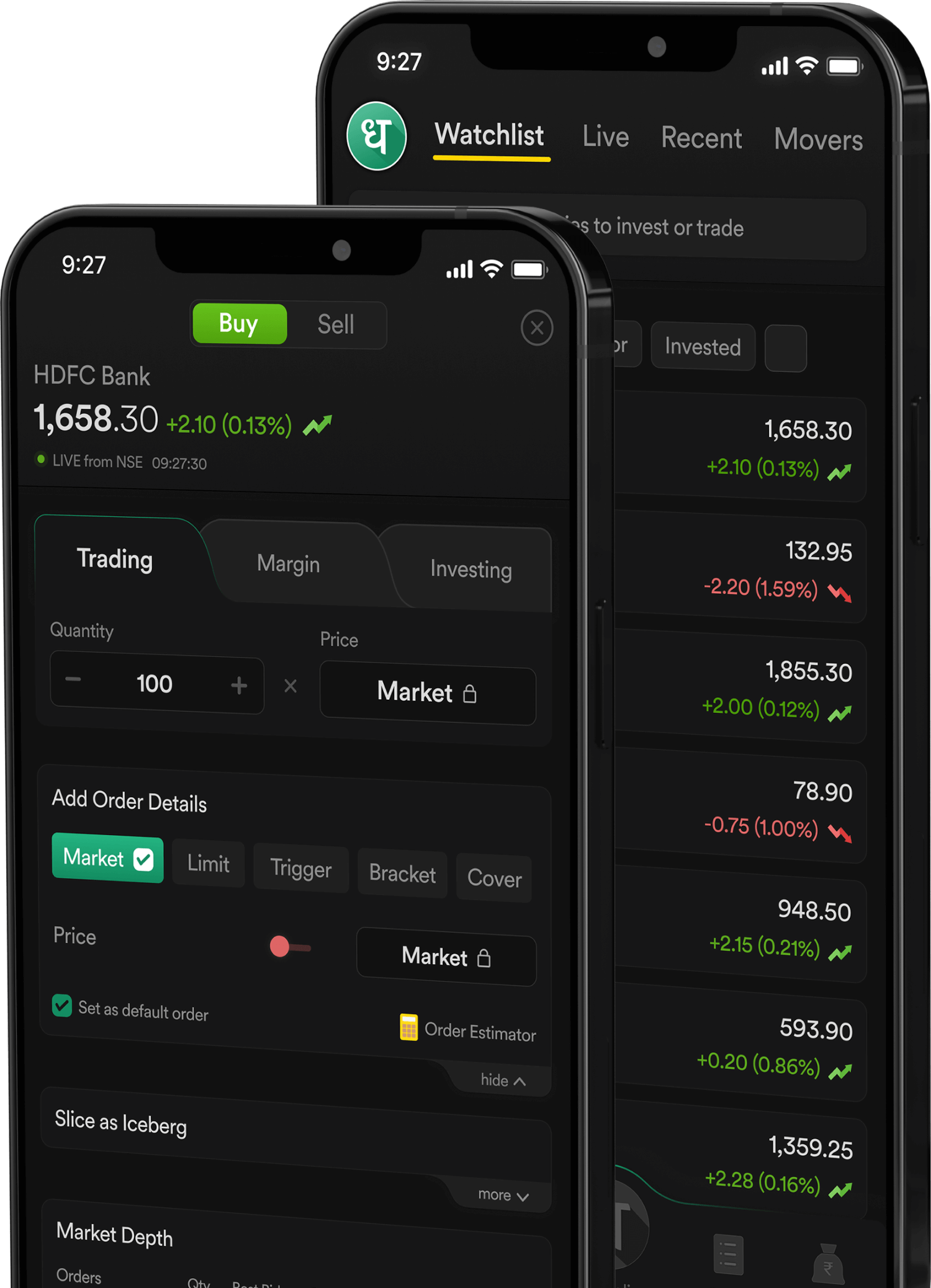
 Dhan App
 Chrome

Pay ₹0 Brokerage on Investing. Open Free Demat Account with Zero AMC for Life!
+91


Dhan App
Stock Market App built for Super Traders & Long Term Investors.

Dhan Web
Web Trading Platform for those who love to trade from the big screen.

Options Trader App
Option Trading App built especially for India's F&O Traders.

Options Trader Web
Option Trading Platform to build, analyze, & execute F&O trades.

Trade from tv.dhan.co
Trade with TradingView Chart features for FREE on tv.dhan.co.

Connect to TradingView
Connect Dhan to TradingView - Place orders from tradingview.com

DhanHQ Trading APIs
Trade with Algo, Connect Apps, Build Services using APIs for FREE.

smallcases on Dhan
Build wealth with smallcase investment for FREE on Dhan.

Margin Trading Facility
Get 4X Leverage on 1700+ stocks. Trade Now, Pay Later.

ScanX Stock Screener
50+ Readymade Screeners, Live Market Insights & Instant Trade Execution.

Rent Stocks via SLBM
Earn up to 35% p.a. over & above your portfolio holdings!

DEXT T3 Trading Terminal
Powerful Terminal Built for Power Traders - Get Speed, Flexibility, and Complete control.

Stocks
MTF, Instant Pledge, & more for online stock trading.

Commodity
Dashboard, Pledge Margin, & Charts for commodity trading.

Options
Strategy Builder, Flash Trade, & Margin for options trading.

Futures
Charts, Futures Chain, & Margin for futures trading.

ETFs
SIP, Forever Order, & Draft Order for investing in ETFs.

Mutual Funds
Invest in top rated direct mutual funds at 0% commission.

IPO
Apply for Upcoming IPO, Open IPO and SME IPO using mobile UPI in seconds!

NFO
Apply for NFOs directly at no extra cost.

Pricing
Open Free Demat with ₹0 AMC for Life-time! Get detailed pricing here.
Become a Partner
Join our growing network of authorised partners - lets grow together!

fuzz

Ask anything on finance, money or markets - Your AI-powered research partner.

Dhan Support
Browse through most commonly asked questions and get answer instantly.

Dhan Blog
Read about markets, trading strategies, investing & more.

Indicator by Dhan
Your bi-monthly trading deep dive into markets, insights, and strategies.

MadeForTrade Community
Be a part of India’s most active community of Super Traders & Long-Term Investors.

Products
Dhan App
Stock Market App built for Super Traders & Long Term Investors.
Dhan Web
Web Trading Platform for those who love to trade from the big screen.
Options Trader App
Option Trading App built especially for India's F&O Traders.
Options Trader Web
Option Trading Platform to build, analyze, & execute F&O trades.
Trade from tv.dhan.co
Trade with TradingView Chart features for FREE on tv.dhan.co.
Connect to TradingView
Connect Dhan to TradingView - Place orders from tradingview.com
DhanHQ Trading APIs
Trade with Algo, Connect Apps, Build Services using APIs for FREE.
smallcases on Dhan
Build wealth with smallcase investment for FREE on Dhan.
Margin Trading Facility
Get 4X Leverage on 1700+ stocks. Trade Now, Pay Later.
ScanX Stock Screener
50+ Readymade Screeners, Live Market Insights & Instant Trade Execution.
Rent Stocks via SLBM
Earn up to 35% p.a. over & above your portfolio holdings!
DEXT T3 Trading Terminal
Powerful Terminal Built for Power Traders - Get Speed, Flexibility, and Complete control.
Investments
Stocks
MTF, Instant Pledge, & more for online stock trading.
Commodity
Dashboard, Pledge Margin, & Charts for commodity trading.
Options
Strategy Builder, Flash Trade, & Margin for options trading.
Futures
Charts, Futures Chain, & Margin for futures trading.
ETFs
SIP, Forever Order, & Draft Order for investing in ETFs.
Mutual Funds
Invest in top rated direct mutual funds at 0% commission.
IPO
Apply for Upcoming IPO, Open IPO and SME IPO using mobile UPI in seconds!
NFO
Apply for NFOs directly at no extra cost.
Download the App Now!


IPO Allotment Status

Check and track the allotment status of recently closed IPOs in just a few steps.

Central Mine Planning & Design Institute
Issue Price
Allotment Status
Check on:
BSE

Speciality Medicines
Issue Price
Allotment Status
Check on:
BSE
Tipco Engineering
Issue Price
Allotment Status
Check on:
BSE
Amir Chand Jagdish Kumar (Exports)
Issue Price
Allotment Status
Check on:
BSE
Powerica
Issue Price
Allotment Status
Check on:
NSEInitial Public Offerings or IPOs offer an exciting opportunity for investors to participate in the growth stories of promising companies in India. The journey from application to potential allotment of shares involves several key steps. Here's all you need to know about each stage of your IPO journey. IPO allotment means shares of a company are distributed among the applicants through an Initial Public Offering to the public.
This is the biggest factor that influences IPO allotment. A highly oversubscribed IPO drastically reduces the chances of an allotment for every applicant. There are quotas for different categories of investors, such as Retail Individual Investors (RIIs), Non-Institutional Investors (NIIs), and Qualified Institutional Buyers (QIBs), among others, and an oversubscription in one category affects IPO allotment within that category.
Applications for Retail Individual Investors are often made in "lots." Although it might make sense to apply for more lots, RII categories often operate on a lottery system where one lot is granted to as many individual applicants as possible, instead of multiple lots to fewer applicants.
An IPO would reserve a specific percentage of its shares for different categories of investors. For example, the reservation for RIIs is 35%. The category that an investor makes an application in for IPO allotment determines the pool of shares they have to compete for.
The larger the IPO issue size, the more shares it has available for distribution, thereby increasing individual investors' chances of allotment, assuming similar demand levels.
The registrar, along with the stock exchanges, determines the basis of allotment, which may be in proportion, by way of a lottery system, or a combination, especially in oversubscribed categories.
RIIs have a reserved quota of 35% of the total IPO issue size. To qualify as a retail investor, the maximum investment limit is ₹2 lakhs per IPO per PAN.
Each unique PAN is considered a different application. In case more than one member of a family, spouse, parents, or adult children has a Demat account and all apply for one lot each, the statistical probability of the family getting an allotment increases.
Keep a track of IPO subscription status. It will not change the application's course, but it can give investors an idea of the allotment probability.
The first day when investors can apply for an IPO.
Last day to apply for the IPO.
The allotment has to be finalised by 6 PM on T+1, one working day following issue closure. Third-party verification of applications by registrars ensures that the PAN in the Demat account and the linked bank account match for accuracy.
If your application is unsuccessful, you will get a refund, and your ASBA funds will be unblocked within two working days after the closing date.
By T+2, the allotment of shares to successful applicants directly goes into their Demat account, ensuring quick access to their investments compared to the earlier regime.
On T+3, three working days after the issue closing, the shares of the company start trading publicly on stock exchanges. Faster listing means faster access to capital for the issuer and earlier liquidity to investors.
Investors can check the allotment status on the website of the IPO registrar, a SEBI-registered entity tasked with the responsibility of managing the entire IPO process. The allotment status can also be checked on NSE and BSE platforms.
Popular IPO Registrar Websites
Always ensure you are visiting the official registrar's website. You can find the name of the registrar responsible for an impending IPO in its Red Herring Prospectus (RHP) or on the exchange websites.
Do your due diligence on the company, its business model, financials, management team, and industry to which it belongs before applying for the IPO. Never apply based on hype.
This prospectus contains information about the IPO, risk factors, financials, and basis of allotment, among other details.
Apply seamlessly for an IPO through a broking platform that is trusted and reliable.
Ensure that there is enough balance in your bank account linked to your Demat for the ASBA process.
After applying, track the IPO timeline, particularly the dates related to allotment and listing.
Central Mine Planning & Design Institute, Speciality Medicines, Tipco Engineering are out for allotment today as of 28 March 2026.
There are no IPOs that are planned to be allotted today as of 28 March 2026.
You can check the IPO allotment with your PAN, your IPO application number, or your Demat account number (DP ID/Client ID).
The IPO allotment status is often announced on T+2 days after the IPO issue close date. The exact date will be mentioned in the IPO timeline.
You may not get the shares if the IPO was oversubscribed. In these cases, a lottery system is followed, and not all applicants can get an allotment of shares.
The IPO allotment date is the date when shares are allotted to the subscribers. The listing date is the date from which the company's shares commence trading on the stock exchanges.
In case of non-allotment of your IPO application, the blocked amount will be unblocked and refunded to your bank account within T+2 working days after the finalisation of the basis of allotment.
Join our Community

Follow us on



Partner with us
built with love
for Indians who love to invest & trade

We are part of Raise Financial Services
Explore | Sitemap
*All securities mentioned on this website are exemplary and not recommendatory.
*Current prices on the website are delayed by 15 mins, login to check live prices.
We are bullish on India, we are bullish on India's prospects to be one of the largest economies in the world. We believe that the stock market provides a unique opportunity for all of India's traders and investors to participate in the growth story of the country.
Yet, most investing & trading platforms in India have remained more or less the same over the past decade. Times have changed and retail traders and investors have become smarter about managing their trades and money. Modern traders & investors require an online trading platform that helps them keep up with the technological advancements of our time.
That's why we're building Dhan - to help you trade, to help you invest, and to help you participate in India's growth stock via the stock market with awesome features and an incredible experience.
©2021-2026 Raise Securities Private Limited (formerly Moneylicious Securities Private Limited). All rights reserved. CIN: U74999MH2012PTC433549 Raise Securities is part of Raise Financial Services.
In case of grievances for any of the services rendered by Raise Securities Private Limited, please write to grievance@dhan.co (for NSE, BSE and MCX) or grievancedp@dhan.co (for Depository Participant). Please ensure that you carefully read the Risk Disclosure Document as prescribed by SEBI, our Terms of Use and Privacy Policy. Compliance Officer: Mr. Manish Garg and Mobile: 8655740961 Email: complianceofficer@dhan.co To lodge your complaints using SEBI SCORES, click here.
Disclaimer: All communications with the client via chat, phone, or email are for support purposes only. Any commitments or statements made by the agent (human or virtual) shall not be binding on the company.
DHAN is a brand owned by Raise Securities Private Limited. All DHAN clients are registered under Raise Securities Private Limited. Clients are advised to refer to our company as Raise Securities Private Limited when communicating with regulatory authorities.
Procedure to file a complaint on SEBI SCORES: Register on SCORES portal. Mandatory details for filing complaints on SCORES: Name, PAN, Address, Mobile Number, E-mail ID. Benefits: Effective Communication, Speedy redressal of the grievances. You may refer the website https://scores.sebi.gov.in/ for more information. You may also download the SEBI Scores app to log a complaint Android: https://play.google.com store apps sebiscores iOS: https://apps.apple.com app sebiscores.
Disclaimer: Investment in the securities market are subject to market risks, read all the related documents carefully before investing. Brokerage will not exceed the SEBI prescribed limit
Attention investors:
Note: As a policy we do not give stock tips or recommendations and have not authorized anyone to give this on behalf of us. If you know anyone claiming to be a part of Dhan / / Raise or our associate companies or partners and offering such services, please report us on help@dhan.co. Important Information for Investors: To prevent unauthorized transactions in your trading / demat account, do not share your account details, credentials or any personal details with anyone. Keep your mobile number updated with your Stock Broker, Depository Participant and ensure that the same is registered with Stock Exchanges, Depository and KRAs. You will receive alerts and information on your registered mobile number / email for debit and other important transactions in your demat account directly from CDSL / Exchange on the same day. KYC is one time exercise while dealing in securities markets - once KYC is done through a SEBI registered intermediary (Stock Broker, DP, Mutual Fund, etc.), you need not undergo the same process again when you approach another intermediary. No need to issue cheques by investors while subscribing to IPO. Just write the bank account number and sign in the application form to authorise your bank to make payment in case of allotment. No worries for refund as the money remains in investor's account. This is issued in the interest of investors.
Investors should be cautious on unsolicited emails and SMS advising to buy, sell or hold securities and trade only on the basis of informed decision. Investors are advised to invest after conducting appropriate analysis of respective companies and not to blindly follow unfounded rumours, tips etc. Further, you are also requested to share your knowledge or evidence of systemic wrongdoing, potential frauds or unethical behaviour through the anonymous portal facility provided on BSE & NSE website. Issued in the interest of the investors.
Raise Securities Private Limited also known as Dhan is only an order collection platform that collects orders on behalf of clients and places them on BSE StarMF for execution. Client expressly agrees that Dhan is not liable or responsible and does not represent or warrant any damages regarding non- execution of orders or any incorrect execution of orders with regard to the funds chosen by the client or due to, but not being limited to, any link/system failure, delay in transfer of the funds on account of any unforeseen circumstances/issues in the banking system/payment aggregators or any other problems that may result in a delay in crediting the funds into the BSE Star MF's bank account. Raise Securities Private Limited (Dhan) does not engage in proprietary trading on its own account.
Mutual fund investments are subject to market risks, read all scheme related documents carefully before investing. Dhan is not a distributor or agent of any mutual fund. Mutual Funds are not exchange-traded products. Any related disputes will not have access to the Exchange-investor redressal forum or arbitration mechanism. For other disclaimers please refer https://dhan.co/advertisement-disclaimer/
Download client registration documents (Rights & Obligations, Risk Disclosure Document, Do's & Don'ts) in vernacular language: BSE | NSE | MCX
Kindly, read the Advisory Guidelines of BSE | NSE | MCX for investors as prescribed by the exchange with reference to their circular dated 27th August, 2021 regarding investor awareness and safeguarding client's assets