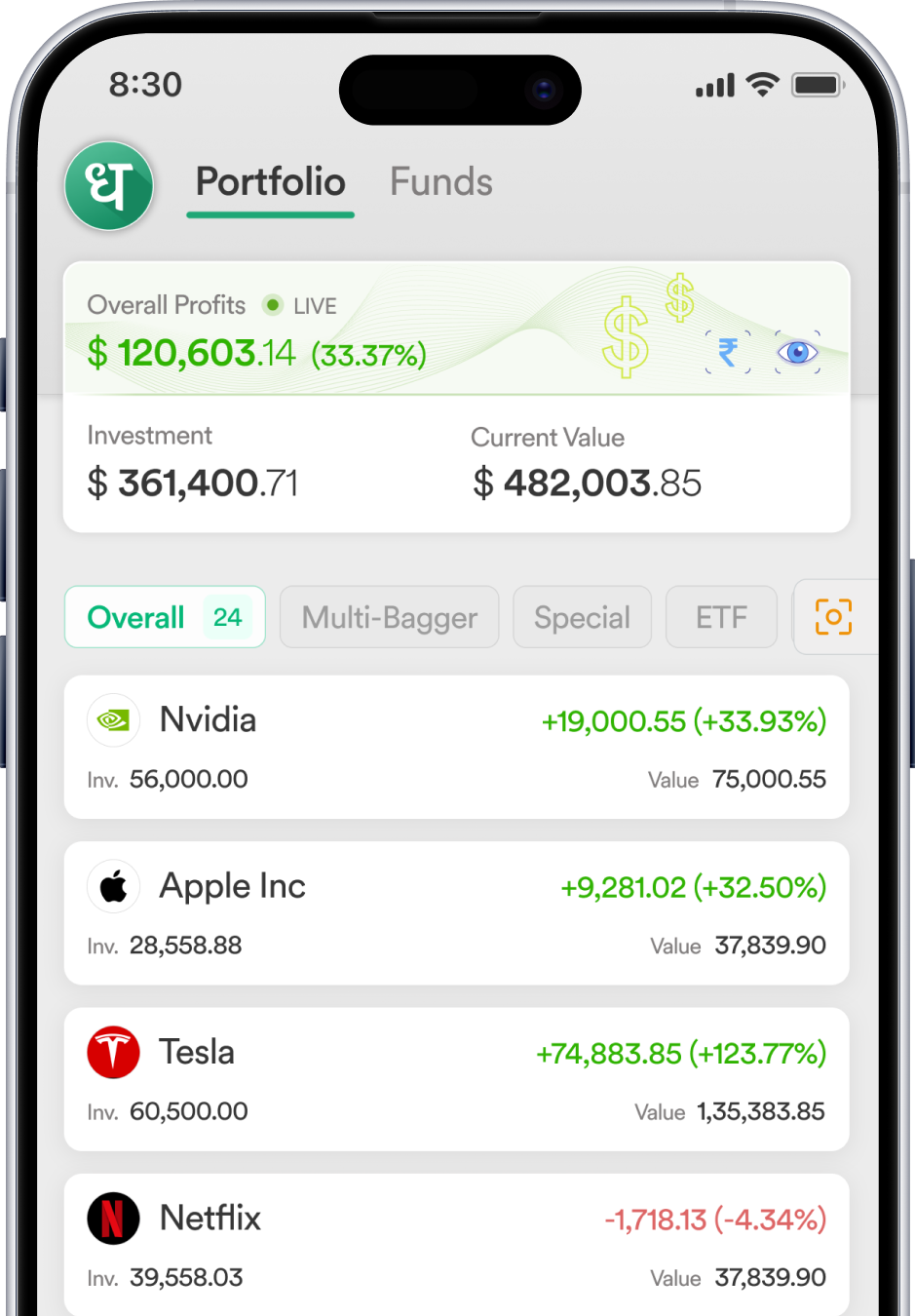
What can you see in the NYSE Stocks List?
The NYSE stocks list on Dhan covers every listed company on the New York Stock Exchange. This is a free list updated with live prices that you can browse without logging in. Here's what the page shows.
- Complete stock data: Each row displays the LTP in USD, percentage of price change in a day, volume, market capitalization, PE ratio along with the industry PE, 52-week high, and returns across five windows - 1 month, 3 months, 1 year, 3 years, and 5 years, besides ROE and ROCE.
- Alphabetical navigation: Investors can directly jump to companies starting with a specific initial from A to Z. The less common stocks have been grouped under “Others”.
- Sortable Market Cap, download CSV and analytics: You can click on the market cap header to re-rank the entire list from the largest NYSE-listed companies downward, or reverse the order. The visible data can be downloaded for offline comparison, while the Fuzz AI integration provides a quick analysis before you go deeper into each stock.
The New York Stock Exchange
The NYSE is the largest stock exchange in the world in terms of the combined market value of companies listed under it. It lists some of the century-old companies as well as newer large caps. This list of NYSE stocks on Dhan includes companies across almost every sector. You'll see semiconductor manufacturers, pharmaceutical giants, global banks, energy producers, and consumer staples businesses on this comprehensive list.
The way prices are set on the NYSE makes it technically different. Instead of running purely on an electronic order-matching machine, the NYSE continues to operate through Designated Market Makers (DMMs). Human and algorithmic intermediaries are assigned to specific stocks. They help to open and close each trading day through an auction process, matching the buy and sell orders to determine a single price for opening and closing.
This hybrid structure of the NYSE has been configured to reduce extreme price gaps that sometimes occur when a stock opens solely on electronic order systems.
How fractional investing from India works
A large number of companies on this list trade at prices that require substantial capital to buy, even one entire share. This is where Indian investors look for fractional investment opportunities in US stocks, where they can buy a part of a single share. Here's how fractional investing works for Indian investors.
- The GIFT City (IFSC) route: You do not need to route every rupee through the traditional LRS-to-foreign-brokerage path. Platforms like Dhan offer access to US stocks through India's International Financial Services Centre in GIFT City, Gujarat. This is a regulatory framework monitored by the IFSCA, allowing Indian investors to buy US securities without needing to open an account with an overseas broker directly.
- Buying in dollar amounts, not whole shares: As an investor, you do not have to specify a particular number of shares to buy. Instead, you can invest an amount in dollars, say $10, and receive the proportional fraction of a share that that amount can buy. This would be accompanied by a proportional price movement and proportional dividends, where applicable.
- Remittance is required: Even the GIFT City route is available, funds ultimately move out of an Indian bank account under the Liberalised Remittance Scheme of the RBI. This means the overall annual limit and reporting obligations still apply for foreign investments.
Reading the columns
Each row on the NYSE stocks list on Dhan carries the following details.
- Name: The name of the listed company, which is tagged with a coloured initial and logo.
- LTP: This is the last traded price of the stock, expressed in US dollars.
- Change %: The percentage of movement in the stock price so far in the current session.
- Volume: This is the number of shares traded in the session, which helps to measure liquidity.
- Market Cap (Mn): It's the overall market capitalisation of the company, expressed in millions of dollars, which can be sorted from large to small or in reverse order.
- PE Ratio: PE ratio is the price-to-earnings ratio of the company. It's calculated by dividing the current share price by its earnings per share and helps to determine how expensively or cheaply the market is valuing its profits.
- Industry PE: That's the average PE ratio across the industry peers of the company. Investors can compare the individual PE ratio with the industry PE for a broader context on whether a stock is trading expensive or cheap compared to its sector.
- 52W High: The highest price the stock has touched over the last 52 weeks.
- 1-month/ 3-month / 1-year / 3-year / 5-year Returns: This number shows the trailing returns across each window, allowing investors to compare recent performance against a longer record.
- ROE: It's the Return on Equity, or net income expressed as a percentage of the equity of shareholders. ROE is a parameter of how efficiently a company generates profit from the capital shareholders have put in.
- ROCE: Return on Capital Employed is the operating profit, expressed as a percentage of the total capital in use, including equity and debt. It's a broader measure of efficiency that also shows how the company uses borrowed capital.
How to use the table controls?
This page contains over 2,650 stocks, so the controls have been built to make it easy for investors to scan the companies efficiently.
- Alphabet filter: Investors can directly find companies starting with a specific letter when they know the name.
- Sorting by market cap: You can click on the header of the column to re-sort the full list based on size. It's a useful feature to start a screening session with the largest, or the most liquid names first.
- Download CSV: Compile the visible data on the page into a spreadsheet and download it for offline comparison across different companies or sectors.
- Fuzz AI: There's an “Analyze with Fuzz AI” feature that provides a quick summary of the stock generated by AI, before you go deeper into the individual page.
- Page numbers: The companies have been listed across hundreds of pages. Investors can use the page numbers at the bottom to move through the rest of the list.
Key terms to know
- LTP: The Last Traded Price is the most recent price at which a stock was transacted.
- Market cap: This is the total market value of the outstanding shares of a company. It is calculated by multiplying the share price by the total shares outstanding.
- PE Ratio: PE ratio is a measure of valuation of a stock, determined by comparing the share price of a company to its earnings per share. A higher PE usually denotes that the market is pricing in stronger future growth, or the stock is expensive compared to its current earnings.
- Designated Market Maker (DMM): This is an intermediary assigned by the NYSE. The DMM is responsible for maintaining a fair and orderly market in a specific stock, which includes managing the opening and closing auctions.
- ROE/ROCE: These are two separate profitability ratios that measure how efficiently a company converts equity of shareholders (ROE) or total capital employed (ROCE) into profit.
- Fractional share: It refers to a portion of a single share that investors can buy and gain proportional exposure to a stock even when they do not buy a full unit.
- GIFT City/IFSC: The International Financial Services Centre (IFSC) is a regulatory zone of India that allows Indian residents to access foreign securities, including fractional US stocks through platforms regulated by the IFSCA.
Why browse NYSE stocks on Dhan?
Investors gain some practical advantages as they screen NYSE stocks on Dhan.
- All companies listed in one place: There's no need to piece data together from multiple sites listing US stocks. This sortable table includes data on valuation, profitability, and returns for all NYSE stocks.
- Valuation data: The PE ratio and industry PE data are placed side-by-side, which makes it easy to compare valuation benchmarks of a company.
- Profitability at a glance: The ROE and ROCE columns allow investors to screen companies for efficiency without opening the financial statements of each company individually.
- A regulated path to investing: The NYSE stocks list has been integrated on Dhan. This platform offers access to fractional investment based on GIFT City. Investors, therefore, can directly purchase shares through the platform.
Things to know before investing in NYSE stocks
Before investing in US stocks based on this data, investors must consider a few points.
- Currency movement affects your actual return: The figures on this page are expressed in USD. Your actual return in rupees depends on the exchange rate between the US dollar and Indian rupee, which can move between purchase and sale.
- A low PE isn't automatically a bargain: A company may trade below its industry PE for a good reason. However, it may also show slower growth expectations, sector-specific headwinds, or a company-specific risk. So, consider PE comparisons along with the rest of the fundamentals.
- ROE can be inflated by leverage: If a high ROE is partially driven by heavy debt, it looks different from a high ROE driven by actually efficient operations. Compare ROE along with ROCE, which accounts for debt, to get a fuller picture.
- The LRS annual cap still applies: Although you invest through the GIFT City route, remittances abroad come under the overall Liberalised Remittance Scheme ceiling of USD 250,000 per financial year across all the purposes combined.
- Fractional shares carry limited voting rights: Fractional investors receive dividends proportionately to their share. But they may not enjoy full voting rights like whole shareholders.
- Tax treatment: Gains from stocks listed on the NYSE are treated as unlisted foreign securities for tax purposes. Tax on long-term capital gains and short-term capital gains applies, depending on whether the holding period crosses 24 months.
Frequently Asked Questions
What is the NYSE?
The New York Stock Exchange is the largest stock exchange in the world in terms of combined market value of companies listed under it. It is based in New York and contains a mix of established businesses and newer large-cap companies across every sector.
Can Indian residents invest in NYSE-listed stocks?
Residents in India can invest in stocks listed on the NYSE through platforms like Dhan. These platforms offer you access to these stocks through GIFT City IFSC framework of India or RBI's Liberalised Remittance Scheme. These are routed to an international brokerage and subject to the annual remittance limit of USD 250,000.
What does “fractional investing from $1” actually mean?
“Fractional investing from $1” means you can start investing in US stocks from just $1. However, $1 may not be enough to buy a whole share. If a stock trades at $500 and you invest $1, you're actually owning 1/500th of the share. Accordingly, you get proportional exposure to its price movement and dividends.
Why does the page show both PE Ratio and industry PE?
You can compare the PE ratio and the industry PE to determine the valuation of a company in the context of the industry. It helps investors judge whether a stock is trading at a premium or a discount to what the rest of its industry is currently priced at.
What's the difference between ROE and ROCE?
ROE is a parameter used to measure the profit generated from the equity of its shareholders. ROCE measures profit compared to the total capital invested by the company, which includes equity and debt. It provides a more comprehensive view of how efficiently a company uses its disposable capital.
Why do some stocks show no data under 5-year returns or ROCE?
It means that the company was listed too recently for that data window to exist.
Do I need a Dhan account to view the NYSE stocks list?
No, this NYSE stocks list is completely free to browse and download. You can view the LTP, change %, volume, market cap, PE ratio, returns, ROE and ROCE without logging in. A Dhan account is necessary only if you want to invest in NYSE stocks.

 Nifty 50
 Sensex
 Apple
Apple Microsoft
 NVIDIA
 Alphabet
 Amazon
 Meta Platforms
 Tesla
Tesla Netflix
 Walt Disney
 Eli Lilly
 UnitedHealth Group
 Visa
Visa Mastercard
 JPMorgan Chase
 Walmart
 Costco Wholesale
 Coca-Cola
 PepsiCo
 Palantir Technologies
 Broadcom
 Large Cap Funds
 Bluechip Funds
 Mid Cap Funds
 Focused Funds
 Small Cap Funds
 Sectoral Funds
 Large & Mid Cap Funds
 International Funds
 Flexi Cap Funds
 Value Funds
 Multi Cap Funds
 Contra Funds
 Dividend Yield Funds
 ELSS Funds
 Nifty 50 ETF
 Nifty Next 50 ETF
 Bank Nifty ETF
 Nifty IT ETF
 Sensex ETF
 Gold Rate in Mumbai
 Gold Rate in Delhi
 Gold Rate in Chennai
 Gold Rate in Kolkata
 Gold Rate in Bangalore
 Gold Rate in Hyderabad
 Gold Rate in Ahmedabad
 Gold Rate in Pune
 Brokerage Calculator
 Margin Calculator
 MTF Calculator
 Stock Lending Calculator
 Stock Return Calculator
 Stock Average Calculator
 Position Size Calculator
 Compare Indian Stocks
 IPO Return Calculator
 IPO Calendar
 IPO Allotment Status